Fields & Visions

Ori Gersht / Fields&Visions

Opening: 01/09/2022   Closing: 18/11/2022

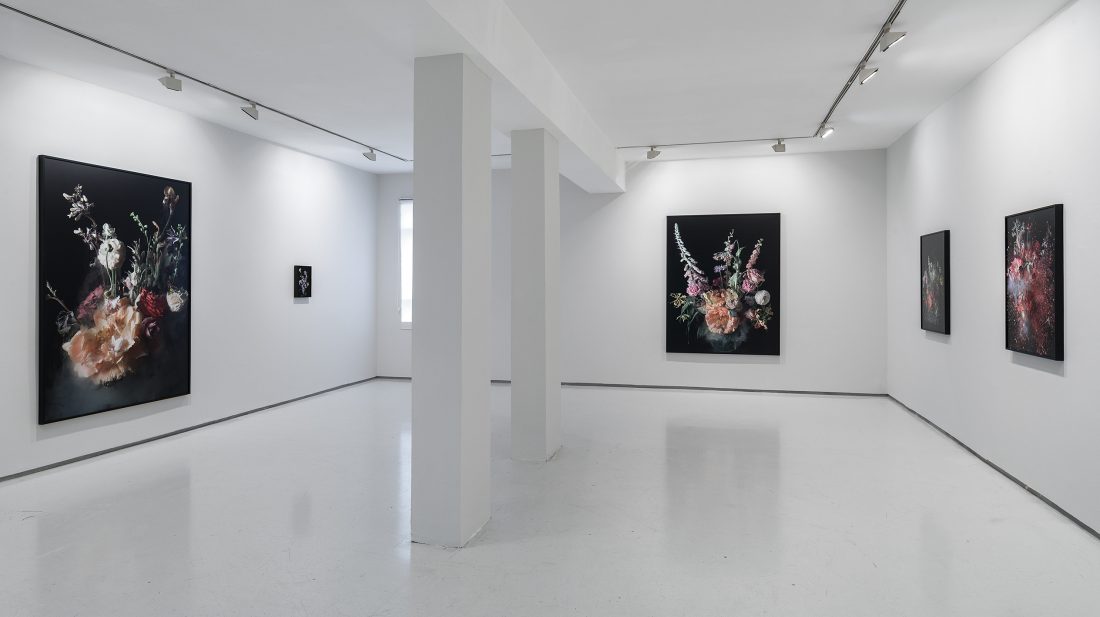
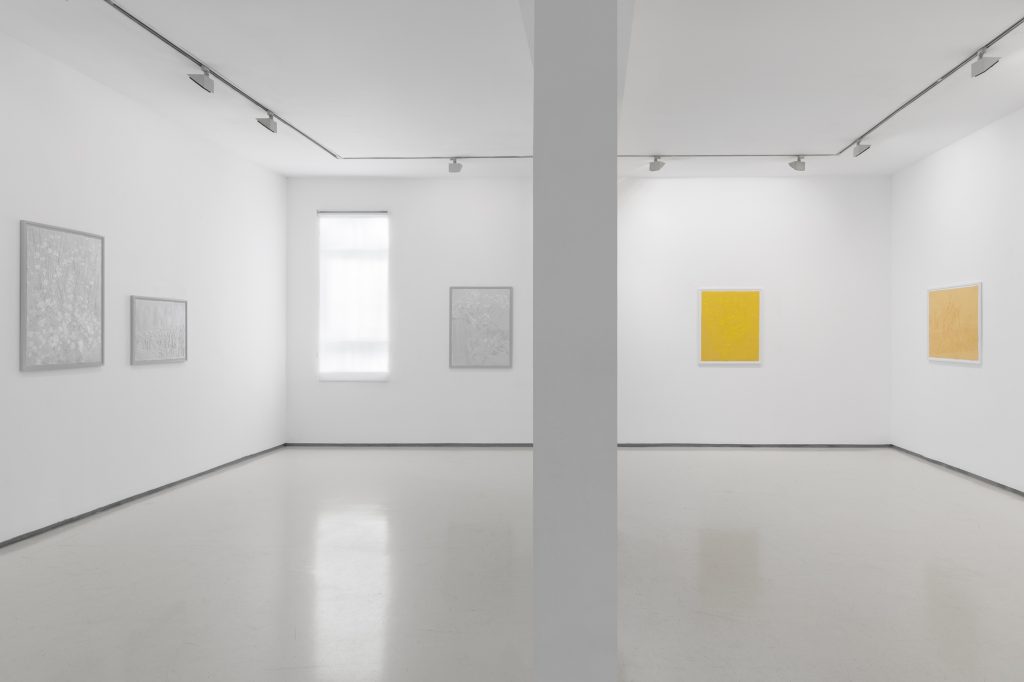
Ori Gersht, Untitled 05, Archival Inkjet Print, 194x150 cm, 2022
Detail From Ori Gersht, Untitled 04, Archival Inkjet Print, 100x77 cm, 2022
Detail from Ori Gersht, Untitled 02, Archival Inkjet Print, 100x77 cm, 2022
Ori Gersht, Untitled 06, Archival Inkjet Print, 217x150 cm, 2022
Ori Gersht, Untitled 02, Archival Inkjet Print, 100x77 cm, 2022

In this new body of work, Gersht returns to the botanical themes that have occupied him for so much of the last decade. The inspiration for this new work comes from the Swiss naturalist Maria Sibylla Merian, who travelled to Suriname (Dutch Guiana) in the 17th century and was the first artist to study and record native tropical plants and insects from that region.

Maria Sibylla Merian returned from her journeys with trophies and souvenirs from these newly discovered worlds. Her subsequent paintings and drawings would depict new species of flora and fauna previously unknown to American and European audiences. In doing so, she expanded our scientificand cultural knowledge of the world we live in and her artworks presented a new theatre of nature that exists far away in exotic and unimaginable locations. Despite its convincing realism, her paintings and drawings reveal a fusion of fact and fiction, to create a unique  and mysterious world that ignites our imagination.

To a certain extent, the way that Maria Sibylla Merian depicted and  illustrates her subjects, bares a certain relationship to the way in which Galileo used the lens of his telescope or Leeuwenhoek the lens of his microscope. All three discovered and revealed parts of the world that were previously invisible to the naked eye and in doing so, redefined our notion of the ‘real’.

Inspired by the pioneering efforts of these early explorers, Gersht’s new photographic works re-examine the relationship between artistic representation and the deceptive photographic claim of a single objective truth.

However, instead of travelling to remote places, Gersht has reproduced these exotic locations in his studio, bringing them to life with sudden violent disturbances to reinforce the authentic moment recorded by the camera. Then, with the aid of artificial intelligence software, he enlarges the low resolution photographs, inviting the computer to fill in the missing information and reshape the images. In a sense, the software is required to use its acquired knowledge to re-imagine the events and to present a new form of realism, fused naturally together.


The combination of the faithful trace of the optical lens in harmony with the computerized interpretation of the artificial intelligence, registers a shift in our concept of reality, as these photographs are no longer a faithful  depiction of the physical subject matter.

The use of the artificial intelligence transforms the nature of photographic representation and this new part optical, part digital reality, presents a shift in the discourse of authentic photographic vision, as the artificial intelligence redefines our perception of realism and in so doing, detaches the photographs from a particular time or place.


Ori Gersht,
London, August 2022

Chanan De Lange So It Goes

Chanan de Lange / So it Goes

Opening: 23/06/2022   Closing: 30/07/2022

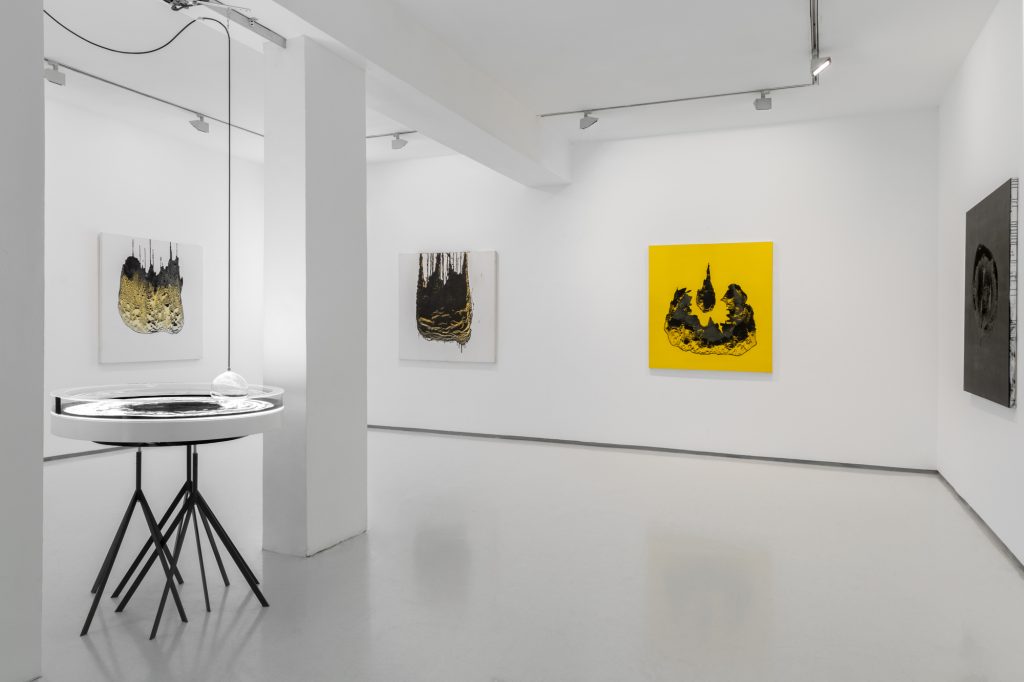
so it goes installation view
Untitled 10, Acrylic, Sand and Glue on Canvas,  128x120 cm, 2021-2
Untitled 5, Acrylic, Sand and Glue on Canvas, 128x120 cm, 2021-2
Untitled 1, Acrylic, Sand and Glue on Canvas, 120x128 cm, 2021-2
Untitled 3, Acrylic, Sand and Glue on Canvas, 128x128 cm, 2021-2
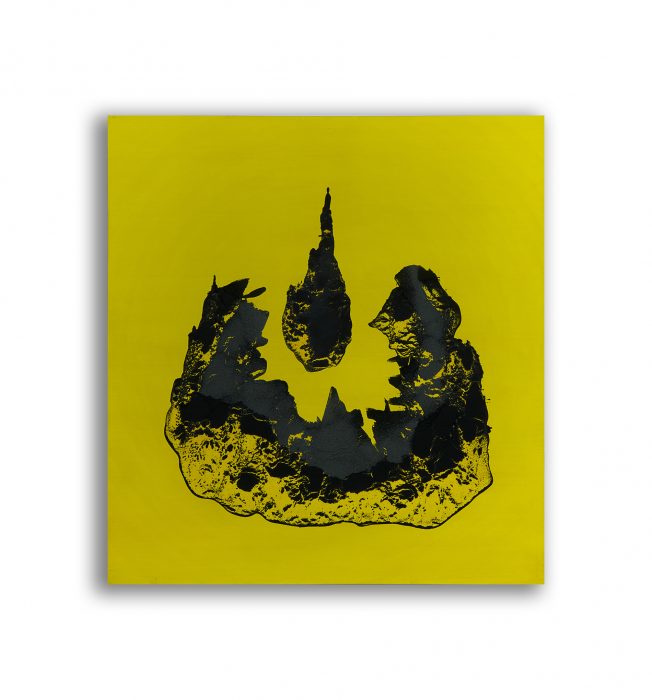
Chanan De Lange, Untitled 2, Acrylic, Burned Sand and Glue, 130x120 cm. 2021-2
Untitled 8, Acrylic, Sand and Glue on Canvas, 128x120 cm, 2021-2


Chanan de Lange | So It goes | 23.6.22-30.7.22


“And Lot’s wife, of course, was told not to look back where all those people and their homes had been. But she did look back, and I love her for that, because it was so human. So she was turned into a pillar of salt. So it goes.” –  Kurt Vonnegut, Slaughterhouse-Five


In his recent series of works, Chanan de Lange focuses on sand as a material and a signifier – of mankind, of a place, of the land. First, de Lange lays down cotton canvases painted with acrylics on his studio floor, “pouring” yellow carpenter’s glue on the canvas to create the work’s formal foundation. He then sprinkles sand on the glue, using a sieve: burnt black industrial sand, red sand gathered near Mitzpe Ramon and quarry sand. While the glue is still in its liquid state, he picks up the canvas and tilts it, allowing gravity to guide the movement of the sand in a controlled manner.

The grains of sand move and shift along the glue according to de Lange’s hand movements. The action stops once the desired shape “takes hold” on the canvas. After the glue has completely dried, loose sand is removed with a hard brush, and the sand grains fixed in the glue remain and determine the final work. Like in action paintings, the body takes part in the artmaking process. In de Lange’s practice in general, and in this exhibition in particular, there is always significance to the random, to uncertainty, both in the creative act and as part of the statement.

The works featured in this exhibition engage with forced migration as a result of wars, persecutions and pandemics, most of which are the outcome of human actions. The grains of sand that de Lange scatters are at the mercy of external forces that impact their migration. They are pushed out of their place, and settle on the glue, with no control over their fate until the work is completely dry. So it goes.

The exhibition takes its name from Kurt Vonnegut’s Slaughterhouse-Five. Throughout the book, the depictions of cruelty and death almost always end with the phrase “so it goes,” as a critical commentary on the ease with which human injustices are tolerated, and the indifference in the face of tragedies.

*

Prof. Chanan de Lange is a B.des Graduated with honors of the Department of Industrial Design at Bezalel. Active as a designer since 1985. Lecturer at Bezalel since 1988. Previously served as head of the bachelor’s department in industrial design at Bezalel and head of the master’s program in industrial design at Bezalel.


Chanan de Lange has presented a variety of solo exhibitions in Israel and abroad, including at the Tel Aviv Museum of Art (1994, 2011); Haifa Museum of Art (2000, 2005); Novalis Fine Arts Gallery, Torino, Italy (2008); Living Design Center Ozone, Tokyo, Japan (2002) and more. Participated In many group exhibitions, including at the Israel Museum, Jerusalem; Haifa Museum; Design Museum, Holon; Cooper Hewitt, Smithsonian Design Museum, New York; The University Art Gallery, Tel Aviv; Wilfried Museum and more. His works are included in the collections of the Tel Aviv Museum, the Israel Museum, the Design Museum in Holon, the Haifa Museum and other public and private collections.

*

With thanks to: Yoram Aschheim, Eyal Shushan, Boaz and Alon, Noga Litman. With a special Thanks to Tal de Lange.

Translated by Maya Shimony

Eyeful

Yonatan Zofy / Eyeful

Opening: 13/05/2022   Closing: 17/06/2022

yonatan zofy eyeful
yonatan zofy eyeful
yonatan zofy eyeful
yonatan zofy eyeful
yonatan zofy eyeful
yonatan zofy eyeful
Crown Daisy 4, Acrylic on plastic, 70x100cm, 2021
Crown Daisy 1, Acrylic on plastic, 50x70cm, 2021
Crown Daisy 2, Acrylic on Plastic, 100x70cm, 2021
Senecio 3, Acrylic on plastic. 46x70cm, 2022
Senecio 1, Acrylic on Plastic, 50x70cm, 2022
Senecio 6, Acrylic on plastic, 96x70cm, 2022

The works in the exhibition are made of acrylic on plastic. The acrylic was not applied directly to the surface. Each section was painted separately on a large nylon sheet, and after drying, it was peeled from the nylon and attached to the plastic. Thus, each painting consists of a combination of hundreds of dried acrylic strokes. It is a method of painting with “dry” acrylic.

Each stem and each leaf previously existed as a separate object. Each part had a separate existence, a thing in itself, and only then was it added to the whole, assimilated into the painting. Even after joining the painting, each part maintains a thin contour around it, a frozen memory of its former independence. Each painting in the exhibition presents a world made up of countless “individual details.”

The stem progresses in a straight line toward the light, to the moment of realization. In stems, life is pushed through a narrow aperture, thrusting forward in a straight line, aspiring to the sun, determined to open up to the world.


Yonatan Zofy


Eyeful

Yonatan Zofy’s flowers open and close day in day out. When the sun shines, they glimmer, turn golden, aspiring upward, towards the light. When the moon rises they bow their heads and hide in the dark, occasionally emerging with a faint twinkle.

The crown daisies and groundsels bloomed at the right times of the year around Zofy’s studio in Ramat Gan, resembling yellow suns: the former in mid-spring, and the latter in early winter. They all withered eventually. Zofy waited patiently for them to bloom or dry out, so as to paint and peel them. Inside the narrow studio, the summer sun gradually turned yellow on the plastic, becoming multiple rugs of living or dead crown daisies; while the fog was absorbed in the plastic as grayish azure in which groundsels appear and disappear. Only after an annual cycle in the flowers’ life passed, and a moment after they sprouted again, was his work completed.

In his previous works, Zofy’s point of departure was the technique, which gradually crystallized into an image obeying a predetermined regularity: an intense graphite drawing created waves on paper, transforming it into a compressed pillow; an act of filling squares in shades of gray ultimately materialized into the shape of a fish. In the current works, Zofy performs a reverse move: now, the point of departure is an image. The flowers blooming around his studio are the basis for his technique. The three-dimensional crown daisies and groundsels turn two-dimensional via applications of acrylic paints; they are subsequently peeled off the nylon and return to their three-dimensional state, floating and hovering on the surface, as if they were about to develop roots in the air and climb up.

From a distance, Zofy’s crown daisies and groundsels are almost invisible. They form two uniform fields, each single-colored and one-dimensional: gold and silver, summer and winter, sun and moon. Approaching the work, the stems and petals that Zofy gently peeled from the nylon sheets are revealed in their three dimensions, and the eyes suddenly open.


Text by Noga Litman

Translated by Daria Kassovsky

Tal Yerushalmi Real Life

Tal Yerushalmi / Real Life

Opening: 25/02/2022   Closing: 29/04/2022

Real Life 1
Real Life 2
Real Life 3
Real Life 4
Untitled 1, 2020, Acrylic, Oil and soot on canvas, 130x170cm
Real Life, 2020, Acrylic and Oil on canvas, 154x150cm
Untitled 6, 2021, Acrylic and Oil on canvas, 100x120cm
Untitled 8, 2021, Acrylic, Oil and soot on canvas, 140x200cm
Untitled 7, 2021, Acrylic, oil and soot on canvas, 147x150cm
Farewell party, 2021, Acrylic and Oil on canvas, 130x130cm

Real Life 

Tal Yerushalmi 


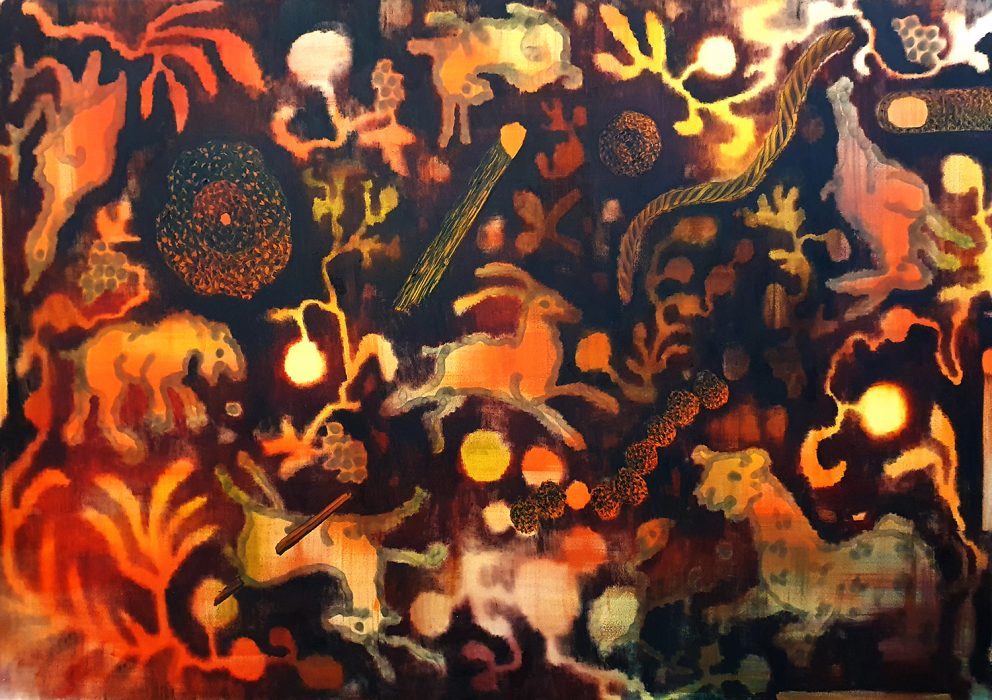
A few years ago, I left a hole in a painting; exposed canvas, non-painting at the very heart of the pictorial domain. The painting started filling with other holes, which over time turned into images: a rock, necklace, bone, sun moon and stars, a flame and a scorched hole with thick smoke rising from it. The painted flame wished to burn the painting and so I lit a fire, this time a real one, and with a lit candle burnt holes through the canvas. I had no idea that the holes I was burning will blur the line between life and painting, opening a space between reality and illusion. Was I playing with fire? Was I provoking the void? 

The burnt holes became flowers and eggs, complete with snakes, spiders, and insects that crawled out of them. As I lay underneath the canvas and burned holes in it, sooty figures started to take shape: donkeys, rabbits, tigers, fish and birds, animals painted with flames. The new guests populated and animated the painting, floating as smoke without a place, space or time. The painting was their world. But I was not satisfied with the abstract space, I was looking for something else. I sought a place to be in, a ground on which I can put my feet, real life. 

I mix Prussian blue with some black, creating a deep, dark and infinite space. Here I will find what I am looking for. I struggle to see in this darkness, my eyes cannot tell dark purple from black, I light a candle. Herons, cranes, and ducks flock to the canvas, asking me to draw a small lake for them to stay and wade through the water, after all, they are waterfowl. But all that flows from my brush is muddy turpentine, greenish brown puddles. This is not exactly the ground I am looking for, but I guess it will have to do.

Cockroaches, cobwebs, and insects fill the empty space, running along the ropes, eating the paint and leaving the canvas, eating the canvas and leaving holes to remember them by. The cockroaches get everywhere, inside the painting and on the frame, greeting me in the stairwell each morning, smiling at me upside down and wiggling a tentacle. At night, I catch one of them on my toothbrush and another swimming in the sink. Pigeons find refuge in the space under the tiled roof, building nests on my windowsill, laying eggs from which chirping chicks hatch and wake me up at dawn. They enter through the windows, leaving droppings everywhere and then cannot find their way out.

Did the pigeons and cockroaches come through the hole I have left in the painting and reached my home? Did I create them in matter and paint and turned them into flesh and blood, feathers and tentacles? Should I have exercised more caution with the power of the brush and paint? Exhausted and at my wits’ end with the chaos in my home, realization dawned on me: That is exactly what I have been looking for. The life that teems under the tiled roof set my imagination ablaze, and I do not stop painting: Cockroaches in the bathroom and in the kitchen, climbing on me at night, pigeons laying eggs on my head. There is a party on the roof, the pigeons are drunk on vodka and wine, the cockroaches breakdance, blasting tracks by Fatboy Slim at full volume. “Enough! Keep it down!” I yell, but they cannot hear me. Either way, I do not dare go up on the roof. Maybe if I stop drawing birds they will disappear from my life? I erase them from the paintings, covering them with layers of paint. If painting has the power to conjure, then surely it also has the ability to banish. And maybe also the other way around?

I called Igor over to seal the openings in the roof. He promised he will chase away the pigeons but I heard them dying over two weeks. I called Oshri the exterminator, who climbed down the roof horrified, swearing to never come back. In the morning I arrived at my studio to discover that insects have eaten my paintings. They settled for the layer of paint, leaving white holes in the surface of the painting, exposing the canvas. What a beautiful image! After all, I invented it. 


Noga Gallery of Contemporary Art

February 2022


Text editing: Mei-Tal Nadler | English translation: Maya Shimony 

The invention of Painting: How did you do it?

Group Exhibition / The invention of Painting: How did you do it?

Opening: 10/12/2021  Closing: 21/01/2022

Joshua Borkovsky | Miriam Cabessa | Maayan Elyakim | Gabriel Klasmer | Jossef Krispel | Itzhak Livneh | Gil Marco Shani | Yonatan Zofy

Curator: Itzhak Livneh

The invention of painting
Itzhak Livneh, Untitled, Mixed Media on Panel, 70x80cm
Itzhak Livne, oil on Formica, 35X50 cm 2020
Itzhak livne, mixed media on panel , 50X80 cm ,2019
Jossef Krispel, Untitled, spray paint on canvas, 70x80cm
Jossef Krispel, Window, 2018, spray paint on canvas, 80x60cm
Joshua Borkovsky, Mirror (floor reflection), 2020, Distemper on Wood Panel, 120x58cm
yonatan zofy, hide with the index finger 1, pencil on paper, 60x85cm
yonatan zofy, hide with the index finger 2, pencil on paper, 60x85cm
yonatan zofy, pillow, plastic glow, 95x66cm
miryam cabesa, oil on metal, 50X47 cm
miryam cabesa, an order in the mess, 2021, oil on metal, 50X75 cm
Gil Marco Shani, Kitchen, Oil on canvas, 24.5x34.5cm
Gil Marco Shani , oil on canvas, 30X30 cm
Gabriel Klasmer, untitled, oil on wood, 60cm diameter
Gabriel Klasmer, Untitled, 2021, acrylic on canvas, 100x70cm

The Invention of Painting | Group exhibition at Noga Gallery of Contemporary Art | December 2021

The exhibition title is taken from a common theme in 18 th century painting – that of the Corinthian
maiden Butades tracing her lover’s shadow on the wall, as he prepares to go to war. These paintings
follow a 2 nd century story by Pliny the Elder’s about the invention of painting by a young woman, the
daughter of a potter, whose predicament and ingenuity have made her the inventor of painting.

The exhibition The Invention of Painting wishes to show how painters invent, each in his or her own
way, the art of painting and do not accept painting as a “natural” and conventional universal method,
one that they simply have to learn and master, in a more or less distinct way than others.

Like any myth, Pliny the Elder’s myth of the origin of painting does not claim to be, nor can it be,
historically accurate. We know that cave paintings significantly predate ancient Greece. Butades’s
invention offers something else: It provides an urgent answer to a unique situation, one that centers on
love, parting, and looming death. We can assume that under different circumstances, a different
manner of painting would have been invented.

Unlike the manner of painting invented by Butades, which was ingenious but technically simple, the
painters featured in this exhibition are characterized by an invention of painting that does not reveal the
technique or traces of its making. The absence of any trace of the painting instrument is not new.
Already in 17 th Flemish art, some painters worked in a way that made it impossible to understand how
their paintings were made just by looking at them. This painting style evolved from the desire to achieve
radical naturalism. The world is not comprised of brushstrokes, and neither should its depiction. With
the invention of photography, efforts of this kind shifted from naturalism to photorealism: Painting that
emulates the photographic image. Conversely, most schools and styles of Modern painting championed
a focus on the traces left by the painting instruments and wished to expose the painting’s underlying
mechanisms. Since then, it seems that anyone can paint. Even my kid.

The exhibition The Invention of Painting features paintings that foil attempts to decipher how they
were made. Their making remains a mystery to the viewer, who while looking at them, struggles or fails
completely to “recreate” how they were made in his or her mind. The paintings are imbued with the
magic of enigma and mystery that seem to have been lost. Painting is essentially a traditional craft, but
nevertheless, one that can be invented again and again. The need for the invention of painting at this
time is more urgent than ever.

Anat Betzer | “That is the Bunch of Live Flowers!”

Anat Betzer | “That is the Bunch of Live Flowers!”

Opening: 07/10/2021   Closing: 04/12/2021

Noga Gallery_001
Noga Gallery_002
Noga Gallery_003
Noga Gallery_004
Noga Gallery_005
Untitled #1,2021, Oil on canvas, 70X50 cm
Untitled #2,2021, Oil on canvas, 100X70 cm
Untitled #3,2021, Oil on canvas, 100X70 cm
Untitled #5,2021, Oil on canvas, 100X70 cm
Untitled #16,2021, Oil on canvas, 50X30 cm

“That is the Bunch of Live Flowers!”[1]

Anat Betzer at Noga Gallery of Contemporary Art


In her new exhibition, Anat Betzer continues her in-depth exploration of painting and its realistic manifestations. The show is centered on women’s heads painted from the back—a delicate erotic image that transforms into a black hole of sorts, floating in a bright sky, detached from the body. Fauna and flora, both framing and framed, hover in a world which is empty yet ornate, fragmented, terrifying, but full of humor.


The images are acutely depicted in great detail, cut-cropped and placed in the middle of the canvas like a feverish vortex in the heart of the desert of nothingness; a wound (hole) or a scar (hill) left as a sign of something that once existed or as a seductive hint of a hidden face. The images leap out towards us or look at us. They are as sensual as the onset of the thicket, where something tried to take an orderly shape but became disheveled and underwent a near-surrealistic metamorphosis. Hair pulled-back becomes a rococo ornament; a braid is assimilated in a feather, like a montage concatenation of dreams. And the painting—its quintessential or latent axis signifies the center, the target composition kept in our consciousness, facing us like a mirror.


In other paintings the image falls to the bottom of the canvas and even beyond it. It is cut exactly along the line of the painted eye, leaving the focal point as an absent-present—an unexplained cut that confronts us with a cognitive dissonance: an occurrence of which we get only the “tail”; an event whose essence is external, taking place outside (as the cruel beheading performed by the artist on the chicken images in the exhibition), and its “plot” is derived from the assimilated habits of our perceptions, of the self-evident imprinted in us by observation of life.


In his book And It Came to Pass, Hayyim Nahman Bialik recounts the legend of King Solomon and the bee, featuring three main characters: King Solomon, the wisest of all men, the bee, and the Queen of Sheba. Having been stung in the nose by a small bee, and once his anger subsided, the Queen of Sheba comes to visit King Solomon. As part of the teasing verbal exchange between the two, the queen proposes to the king the challenge of the living flowers: a bunch of artificial flowers (“the work of men’s hands”) versus a bunch of live flowers (“the work of nature”). His embarrassment at the inability to distinguish between the two by their appearance is solved for him by the (cheeky) little bee, who identifies the bunch of live flowers. Nature is wiser than man, even the wisest of men.


In the exhibition “That is the Bunch of Live Flowers!” Betzer looks directly at the politically, socially, and ecologically chaotic reality, addressing the question of representation in a unique complex manner. She delves into center and margins, back and forth, a gaze at and a reciprocated gaze, inviting the viewers to look at themselves, at their reflection, to peek at the world and at the woman.


The Covid-19 year, which has led many of us to realms of anxiety, helplessness, and loss of meaning, is conspicuously present in this new series of paintings. Their small scale, relative minimalism, modesty, silence, and sense of solitude (not to say isolation)—in addition to Betzer’s constant desire to find and create beauty, to cling to the flimsy, familiar and hackneyed image, reexamine it and reaffirm its power—yield a powerful statement about a moment of radical existence. It is a statement underlain by despair and profound concern alongside passion and great vitality.


[1] A quote from the legend of “King Solomon and the Bee,” in: Hayyim Nahman Bialik, And it Came to Pass: Legends and Stories about King David and King Solomon, trans. Herbert Danby (New York: Hebrew Publishing Company, 1938), p. 92.

Eti Jacobi | A Monkey with Yellow Fever

Eti Jacobi / A Monkey with Yellow Fever

Opening: 28/05/2021  Closing 29/07/2021

Eti Jacobi, Exhibition View, Noga Gallery, 2021
Eti Jacobi, Untitled #1, 2019, Acrylic on canvas, 60x70cm
Eti Jacobi, Untitled #2, 2019, Acrylic on plywood, 60x60cm
Eti Jacobi, Untitled #3, 2019, Acrylic on plywood, 60x60cm
Eti Jacobi, Untitled #4, 2019, Acrylic on canvas, 40x40cm
Eti Jacobi, Untitled #5, 2020, Acrylic on canvas, 40x40cm

There are numerous episodes, myths, legends, anecdotes and stories that involve the medium of painting: in his Natural History, Pliny describes a painting by the famous Zeuxis in which some grapes were so successfully represented that birds flew up to it; in his The Lives of the Artists, Giorgio Vasari, wrote that Paolo Uccello – who had this name because he loved animals and would often paint them – was once so offended by Donatello that he refused to come out of his room but sat working at his drawings, and whenever his wife called him to come to bed he would answer “What a wonderful thing perspective is!”

However no story is more appropriate to this occasion than the one told in The Unknown Masterpiece by Honoré de Balzac. This is not the time to tell the full story, and notwithstanding the differences between the cases, the comparison to Eti Jacobi – her practice, her works, her devotion, her obsessions – is fitting. Her modus operandi, her untiring desire to unlock the mystery of painting, a quest that has been keeping her busy for more than forty years, is a model for what art could be, and should aspire to be.

Through the juxtaposition of works that appear to be different – a neophyte would say “abstract” versus “figurative” works, but such distinctions have little place in Jacobi’s complex universe – but which are in fact created with the same mind (and body) set, the artist is challenging our own mind and our own body; yes the full body, because speaking only about the eyes would be in fact misleading since Jacobi’s large paintings need our full attention. 

In other words, through this strategy of juxtaposition, which she has employed before, Jacobi is demanding full attention, full devotion and commitment. What appears to be shapeless is in fact the opposite. What seems to depict figures, eventually turns into pure color – or lack thereof, if we consider the strong presence of black in this exhibition. 

A malady, just as the title suggests, is what Jacobi ‘suffers’ from and constantly endures. It does not matter if a work takes six months or six minutes to be completed. The position from which the artist creates actually happens to be same, due to the fact that there is in each case an equal craving to possess all the unknown rules for the making of the perfect painting and there is an equivalent force which is directed to the understanding of how to push the limits of color applied on a surface. Thus, through such ‘simple’ actions, Jacobi reveals to us, paradoxically, how painting is still the most difficult language created by humankind.

 In the company of Poussin (just like the protagonist of Balzac’s story), Caravaggio (whose whispers can be heard in Jacobi’s dark still lives) and the unique light that every day touches this land and enters her studio, the artist creates a world in which she sets the rules in order to challenge them, “warms up” (this is how she often defines her drawing practice) in order to create art that has nothing to do with today, yesterday or tomorrow’s currencies. Like painting itself, despite how the times try to convince us otherwise, Jacobi’s practice is a constant siege, which goal is to conquer immortality. 

—Nicola Trezzi

Matan Ben-Tolila Cat Steps

Matan Ben-Tolila / Cat Steps

Opening: 05/03/2021   Closing: 05/05/2021    Curator: Yonatan Ullman

Cat steps, 2020, Oil on canvas, 170x106cm
Omer, 2020, Oil on canvas, 150x150cm
צולל (דיפטיך) 65+95 סמ כל אחד 2021
150x150 cm. oil on canvas, 2021
80x60 cm, oil on canvas, 2021
140x112 cm, oil on canvas, 2019
The visit, 165x120 cm, oil on canvas, 2019
Circles (no2), 165x120 cm, oil on canvas, 2019
in sea, 160x100 cm, oil on canvas, 2019
Circles 4, 110x80 cm, oil on canvas, 2019
מראה-הצבה--2--

Cat Steps / Matan Ban-Tolila – press releae

In another place / Yonatan Ullman
Far away from here lies an endless, wonderful, enchanted, mysterious, dark space.
I am drawn there every time anew.
It’s addictive.
When I am there, here does not exist.
When I am here, I think about returning there.

There is freedom there.
Freedom to wander.

Tigers roam free.

A cave.
A vortex.
A portal.
A passage.

I peek through the gap in my camouflage net.
On the other side an unmanned plane is revealed.
Sometimes I imagine I was it.
Drifting.
Somewhere.
Above and beyond.
Cruising.
Absolute silence.
I’m upside-down.
The canopy is like coordinates.
Directing.
Centering.
Orienting.
Anything is possible.
I send a signal to my home base – can anyone hear me?
Where to now?
Deeper.
Further.
Surprising, thrilling, stunning.
Beyond knowledge or understanding.
Careful!
Not too far.
You may never return.
But, the temptation is so great.
How much beauty lies here.

Then… I am back here.

At night, I gaze beyond the window.
I can hear our world – full of life, vitality, motion.
Banal althea flowers, which I passed by thousands of times while driving,
become a phenomena.
Dancing with the moon that drifts through the dark skies.
Growing slowly.
Ever closer to each other.
Striving for contact.
How much beauty is in them.


Alexandra Zuckerman Flower Fields

Alexandra Zuckerman / Flower Fields

On View


Alex_002
Alex_001
Alex_003a
Flower Field Ⅰ, 2019, Penclis on paper, 102x72cm
Flower Field Ⅲ, 2019, Penclis on paper, 102x72cm
Flower Field Ⅹ, 2019, Penclis on paper, 102x72cm
Flower Field Ⅶ, 2019, Pencils on paper, 102x72cm
Flower Field Ⅸ, 2019, Pencils on paper, 102x72cm
Flower Field XIII, 2019, Pencils on paper, 102x72cm
Flower Field XVI,, 2019, Pencils on paper, 102x72cm
Flower Field XVIII, 2019, Pencils on paper, 102x72cm

Noga Gallery of Contemporary Art is pleased to announce the opening of “Flower Fields” a solo exhibition by Alexandra Zuckerman. This is Zuckerman’s second solo exhibition at the gallery.

Rooted in the language of drawing, and yet informed by its numerous declinations – from painting to tapestry, from animation to textile –, the work of Alexandra Zuckerman sheds light on the thin line separating the field of Fine Art from that of applied arts; furthermore her appropriative use of techniques that belong to folklore, tradition and even amateurism, aims at contextualizing the histories of female artistic practices against a backdrop of unilaterality, which dominates the History of Art (with capital H and A).

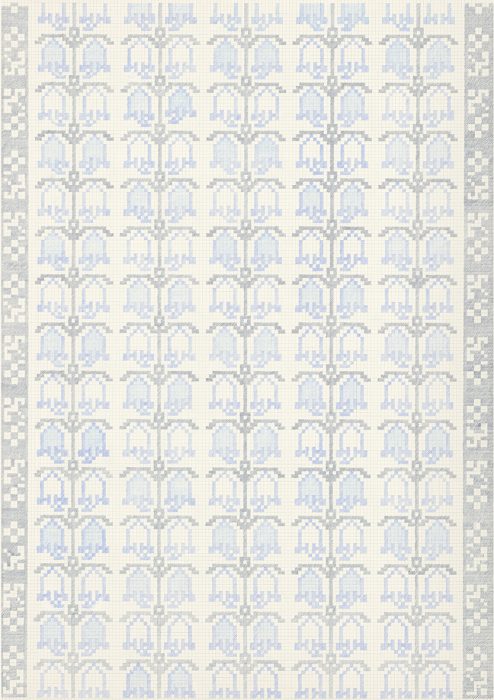
Her latest body of work, which gives the title to this exhibition, is inspired by technical illustrations included in manuals and magazines for embroidery, cross – stitch and knitting. These images are specific and universal at the same time, they trigger the memory of places like Russia – where the artist was born and grew up before immigrating to Israel with her family – or Jaffa – where she currently lives.

Each drawing starts with a grid, which is drawn by hand, and consequently enriched by different fields of color, which are obtained by filling, again by hand, each square with crayons. Due to this technique, this series of drawings behaves differently according to their position in front of the viewer. Similarly to mosaics, they allow a double encounter –“bird’s–eye view” versus closeup.

In addition to that, the artist is interested here in the notion of repetition and how such repetition both entails pleasure and echoes the original craft – embroidery, cross–stitch and knitting –connected to the source of these images. Following such premises, some drawings are based on textile patterns and ornaments; there is always a tension between the motifs that appear in each drawing and its palette, which is based on tonal variations.

Continuing Zuckerman’s aforementioned interest in gently dismantling the notion of unilateral perception, this new series is emphasizing the possibility of working through abstraction and figuration simultaneously; while this tension can be encapsulated by the coexistence between an abstract layer – the pencil grid – and a figurative layer – the crayons blocks , between black and white – the pencil and the paper – and color – the crayons –, one cannot help but think how such tension can symbolize, once again, the artist’s desire to create a space that incorporates categories in order to erase them. Last but not least, the strict technical procedure behind these works could be seen, paradoxically, as a meditative act, confirming once again Zuckerman’s drawings as visual oxymorons.

—Nicola Trezzi

Gallery Collection Sale

Special Sale from the Gallery Collection

Opening: 17/07/2020  Closing: 31/07/2020

Opening Days:

Wed-Thu 12:00-18:00

Fri-Sat 11:00-13:00

*Other days by appointment only

Mosh Kashi, 2003, Svach, oil on canvas, 19x19cm
Gilad Efrat, Hatzor, 1998, oil on canvas, 163x110cm
Miriam Cabessa, Untitled, oil on wood, 145x190cm
Elinor Carucci
Elinor Carucci
Mosh Kashi, Crimson fields, 2011, oil on canvas. 80x80cm
Mosh Kashi, Silver Leaves, oil on canvas, 21x19cm, 2005-2010
Mosh Kashi, Icon yellow fields, 2009, oil on canvas, 24x19cm
Mosh Kashi, Crimson fields, oil on canvas. 20x20cm, 2011
Eti Jacobi, Landscape with a Girl and Boats, 2007 80x120cm Acrylic on Plywood
Eti Jacobi, Landscape with a Girl (Andromeda), 2007, Acrylic on Plywood, 80x120cm
Talia Keinan, 3 Angels, mixed media on paper, 52x40, 2007
Talia Keinan, Untited,pencil on paper,40x30cm,2006
Talia Keinan, Falling leaf, ink on paper, 30x20cm, 2011
Michael Halak, Greenolive, Oil on Canvas, 120x80cm,2014
Michael Halak, Untitled, pencil on paper, 60x45cm,2015
Shahar Yahalom, pencil on paper, 16.5x23cm, 2012
Shahar Yahalom, The Swimmers, 30x20cm, Ink on paper, 2012