Conceptual Arcadia

David Ginton / Conceptual Arcadia

Opening: 17/02/2006   Closing: 24/03/2006

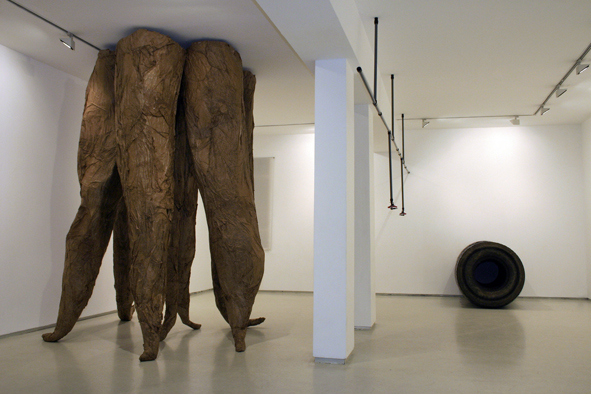
Conceptual Arcadia, Exhibition view, Noga Gallery of Contemporary Art, 2006
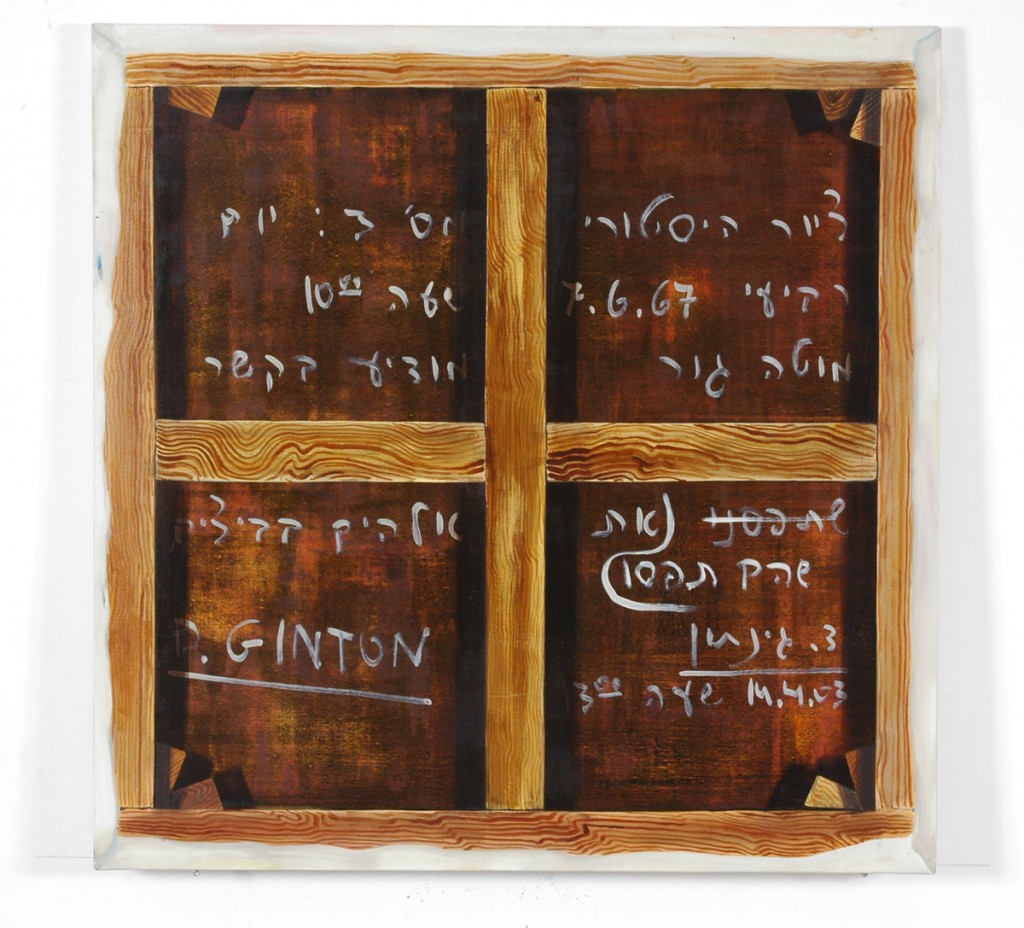
Back of painting-historical painting #3, oil on canvas, 2003
back of painting, the last painting of david ginton, oil on canvas, 2006
Back of painting-The last painting of the century, oil on canvas, 2003
Back of painting-pictures of what happens on each page, oil on canvas, 2005

This is the third time I exhibit only one type of images, the backside of a painting. In the first exhibition (Trompe-L’oeil, Yanko Dada Museum, 1996) they were photographs of paintings’ backsides from the Tel Aviv Museum collection. In the second one (The English Painter, Noga Gallery, 2002) they were paintings of the backside of imaginary paintings with texts describing the concealed “painting” on the front. Those texts were usually taken from back covers of books about art or literature, and they described and praised the book (the painting). Therefore, those texts became the embodiment of ekphrasis – verbal descriptions of paintings that at the same time turn into talking paintings.


The current exhibition, Conceptual Arcadia, is about the name of the painting. A painting is born from its name. When there is an appropriate name for a painting, I can paint its backside. Usually it is a name of an existing painting by another painter, like the Wood on its Head (Georg Bacelitz) or The Last Painting of a Century (Kenny Scharf). I painted the backside not of the original painting, but of a virtual copy I made of the original. There is no painting the name refers to, so it is in fact a painting within a painting, or a frame painting as a frame story. Through their names the paintings cover different issues concerning art, politics, or personal matters, and the texts range from minimal informative to literal citations, political “chatter” and theology. At a certain stage I decided to express verbally the ease of creation of those paintings through their names as a conceptual arcadia. This was an opportunity to settle my debt with conceptual art and to relay to my own beginning; it was done in two works. One is I after Ich by the French artist, Ben Vautier, that I saw during my first visit abroad in 1973 when I entered the art world. The French version of the painting was created in 1965. Second is the first backside painting I made after my own painting, my first painting from 1973 that was a text work, Paint on Paint…


My encounter with a painting’s backside was made by coincidence when I visited a storage room in Givon Gallery, but I have pursued it for 12 years since experiencing it as a process of iconoclasm: a painting without an image, except for frame and canvas, mainly writing. The backside of a painting is where artists tend to write their name, the name of the painting, and date. Essentially, it is also the details that appear on labels next to the paintings in museums or in books. What is the backside of a painting? What is a label without the painting? The backside is what we are allowed to see of God, and the painting is like a deity (“You shall not make for yourselves… any image”). When the linguist, Emil Benvenist, described the “desecration of God’s name”, he wrote that “the only thing we have from God is his name”. So it is with the reversed painting – all we have from the painting is its name. The name of the painting is a painting.

Secrets

Efrat Klipshtein / Secrets

Opening: 13/01/2006   Closing: 10/02/2006

Secrets, Installation view, Noga Gallery of Contemporary Art, 2006

The concrete wall, still exhibited as a whole unit, is there to separate the fragments on each side of it: both those broken from within and those broken from without. The chaos exhibited on the different canvases represents an anthology of repressed and forgotten memories of whole tools that were removed from their natural environment. Halak’s metaphors, referred to by Linda Nochlin as “fragments, ruins and mutilation echo the mourning for past grandeur as a whole, which can only be revisited through its remains amidst modernity”1.0 Those fragments beckon us to descend to the saturated earth and observe the fragmented tools – those cracks in our lives.


Halak attempts to cope with the absurdity of what he sees against the wall while expressing his yearning for unity. In a world created out of fragments and the inherent contradiction that spumes forth through the invisible cracks in the concrete wall, Halak suggests correcting a point of view — one that makes meeting with a transparent and imperfect past more feasible.


1 Nochlin, Linda, (2001), The Body in Pieces: The Fragments as a Metaphor of Modernity, Thames and Hudson

Fairies and Donkies

Eti Jacobi / Fairies and Donkies

Opening: 17/11/2005   Closing: 24/12/2005

Fairies and Donkies, Exhibition view, Noga Gallery of Contemporary Art, 2005
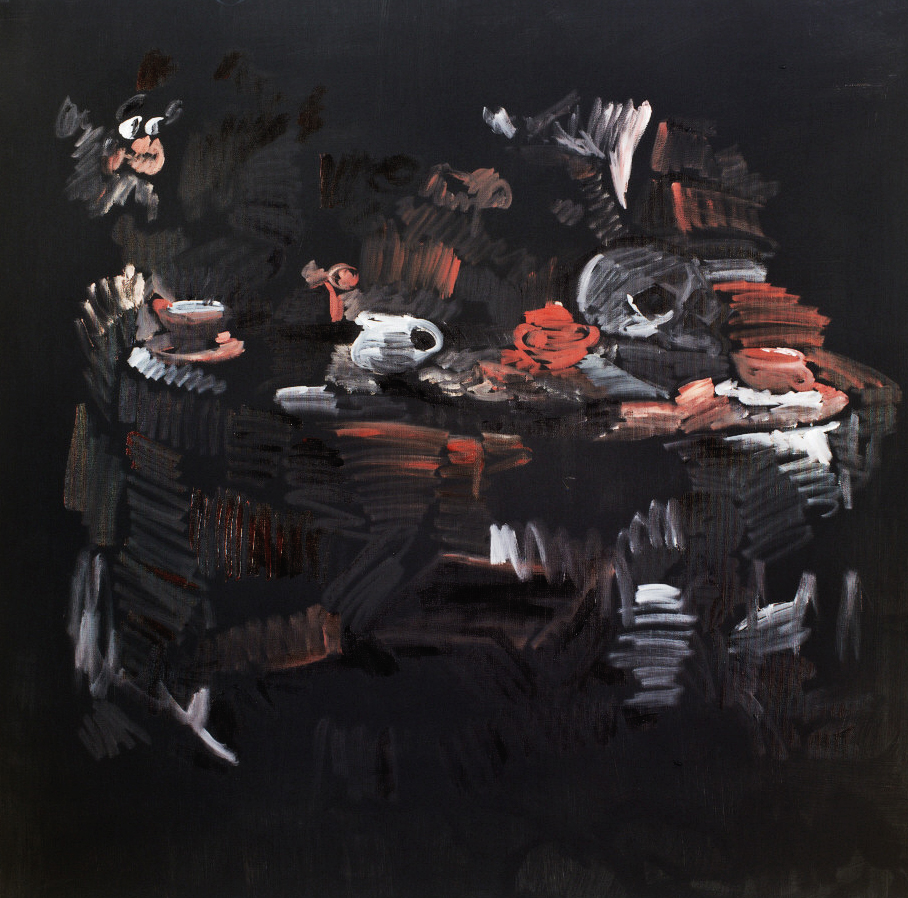
Donkeys and Fairies Installation, Acrylic on Canvas, 100x100cm, 2005
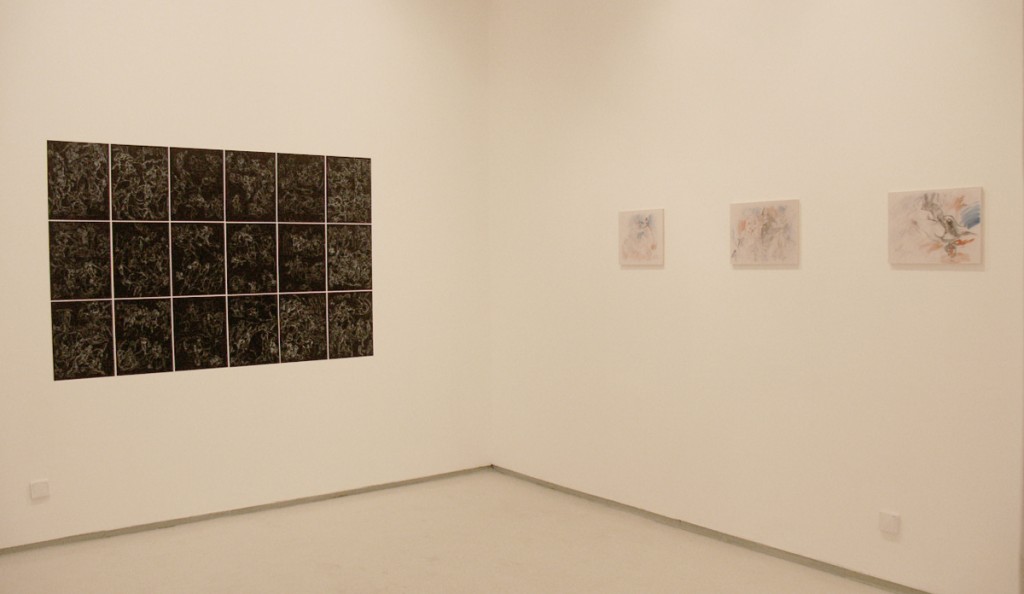
Donkies and Fairies Drawing Installation, Ink on Paper, 35x45cm, 2005

Fairies and donkeys


The main body of my work is paintings on black canvas. There is a tradition of painting which reacts to the white canvas, to a blank support.


The white is the non-color which is being stained. The non-color of my works is the Black. Of course, the logic of acting towards a blank, black background is different from the logic of acting in response to the white background (like Raffi Lavie or Cy Twombly). Nevertheless, I still take action towards the black in a way which has to do with the way these painters (re)act towards the white.


There has always been a figure of a fairy in my works. My painting is the utmost degree of stuttering fairytales.


Concerning that, there is a thought that keeps popping up in my head, a suspicion that always bothers me: that in every donkey there hides a fairy.

Berlin

Filipa Cesar / Berlin

Opening: 14/10/2005   Closing: 11/11/2005

Berlin, Installation view, Noga Gallery of Contemporary Art, 2005
aura02 copy
zoo
zoo003
Ringbahn_3

Filipa César chooses the anonymous citizen as the main character in her work: a character that is simultaneously idiosyncratic (endowed with its particular and unique characteristics) and generic (shares its existential condition with its peers). Her characters reveal themselves during banal moments of pause that intersect the daily routines in the space of the city, occasions of anonymity during which nothing apparently occurs, on the margins of the productive and functional conception of time, dominant in contemporary societies. The artist fixes both her gaze and ours on the realm of appearance, the external traces that define individuals socially, the externalisation of wealth, gestures and expressions, to suggest (and fictionalise) an inner life that remains greatly unfathomable. We are at the antipodes of a widespread critical perspective that sees the common citizen as a featureless person, devoid of qualities, standardized into his subjective world by the dynamics of contemporary life. In opposition to this, the artist places in motion a process of identification: the situations of daily routine she depicts, or fictionalises, and the strangers or actors she transfigures into characters, return the image of our own existence.


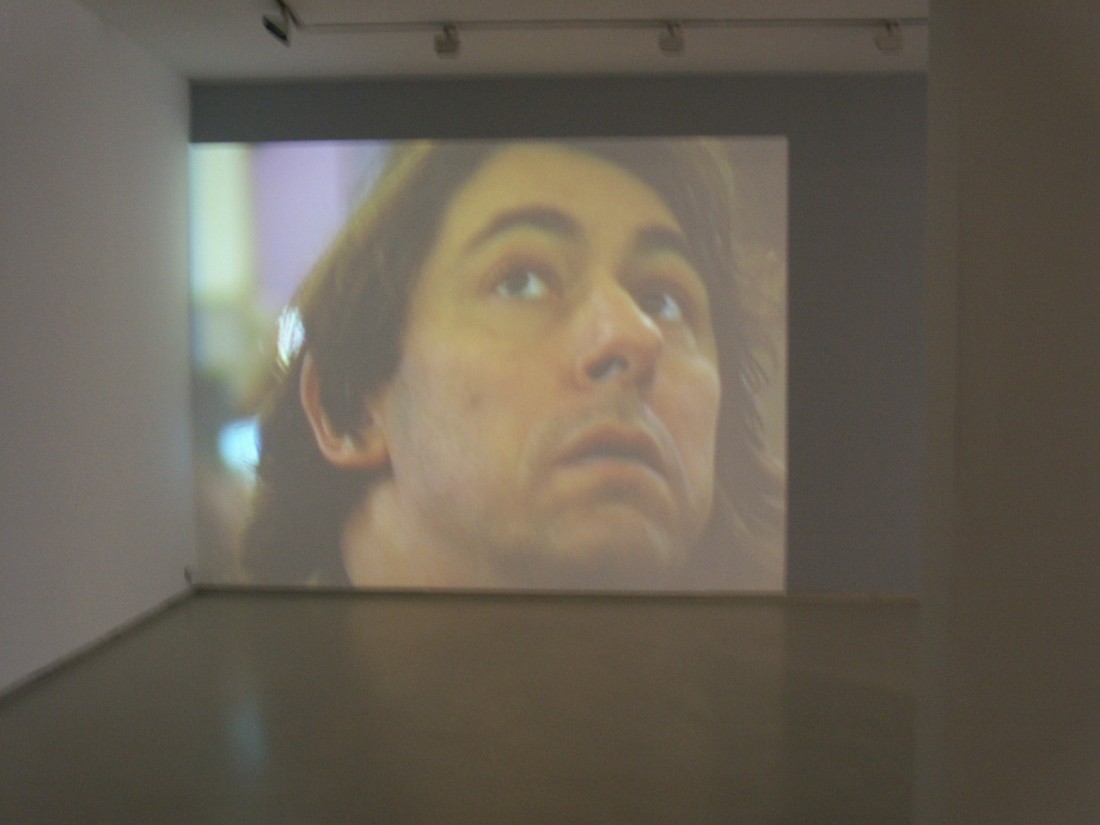
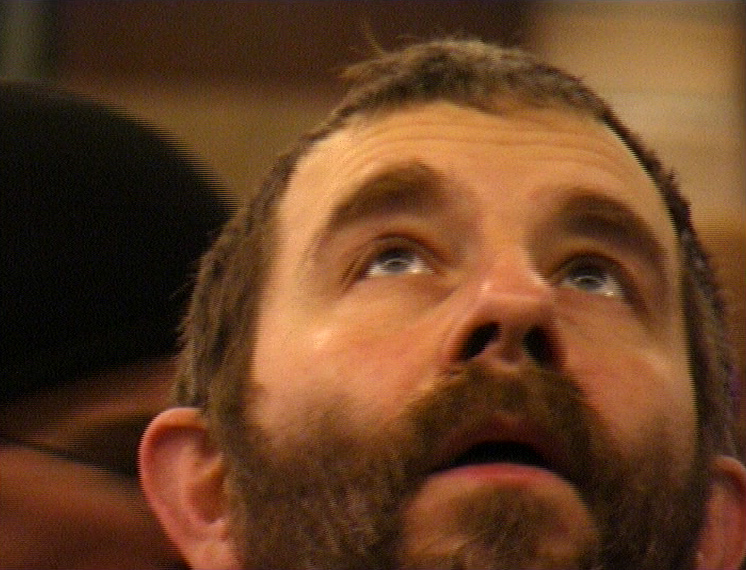
The exhibition “Berlin” features three video works:


Ringbahn is a video project that advances a two-folded insight on Berlin City’s life policies, for it is both a documentary that issues from a direct observation, and a commentary that issues from an analysis of the former through a lens of a neurological disorder. Through a comprehensive editing procedure the two layers are combined into an associative sequence where from the juxtaposition of sound and image-track sometimes an unexpected meaning arises.


Aura is a gaze from the outside at our everyday behaviour. It presents a strange situation that raises questions about the veracity of the phenomenon of an apparent group hypnotic state. The main element that is the object of contemplation in this work is the Reichstag building, home to the German Parliament. In order to address the non-sense that this protagonist organizes around it, the viewpoint is inverted —the subject who is looking at the building becomes the object.


Berlin Zoo is a video loop set in the train station and terminal interface of the same name. Several bystanders were captured by the artist’s camera as they are gradually overcome by a general state of disbelief – of shock and awe even – while staring upwards at the arrivals and departures timetables. This gallery of grimaces is intertwined with an eerie soundtrack of wind blowing and occasional squawks of birds. Berlin Zoo could be classified as a fake documentary on the contemporary wildlife of a metropolis, an exercise in modern day ornithology.

Plan B

Amikam Toren / Plan B

Opening: 08/09/2005   Closing: 09/10/2005

Plan B, Installation view, Noga Gallery of Contemporary Art, 2005
Minolta DSC
Minolta DSC
Minolta DSC
Minolta DSC

Amikam Toren is showing in his first comprehensive exhibition in Israel works from four series.

Plan B is a three dimensional parallelogram built from 1500 wooden figurines, collected from different markets, representing diverse cultures and religions. The sculpture that looks like an architectural model combines esthetical tensions accumulating to a powerful effect of beauty, astonishment and wonder.

Insomnia institute is a series of drawings created through the observation of the emerging sculpture of Plan B. Therefore, the automatic drawings draw one’s attention back to the sculpture as though capturing the empty spaces between the figurines.

Clouds in trousers are five white overalls worn by artists during their work in a studio. Toren uses an unpicked trouser as a canvas stretching it on a wooden frame; he lets his brush wander on the surface until some image appears on the fabric while cleaning the excesses of paint on the overall. The line of overalls hanging on the wall inevitably invites some unpleasant images of a slaughter house.

Armchair paintings are oil paintings that one can buy at the market and antique shops. In the center of those idealistic and kitsch paintings Toren cuts out words or sentences, thus updating the painting and recovering the lost quality. The bare wall behind the painting becomes part of it as the letters cast their shadows on the wall. The paintings represent a postmodern irony as a work of art is upgraded through its destruction.

Naomi Aviv, curator

(excerpts)

Insatiable

Orit Raff / Insatiable

Opening: 16/04/2005   Closing: 20/05/2005

Insatiable, Installation view, Noga Gallery of Contemporary Art, 2005
Untitled, Color Print, 100x127cm, 2005
Untitled, 3150x2417cm, 2005
Untitled, 3150x2436cm, 2005
Untitled, color print, 152x127cm, 2005
25

Fair-stressed Demeter

Drorit Gur-Arie


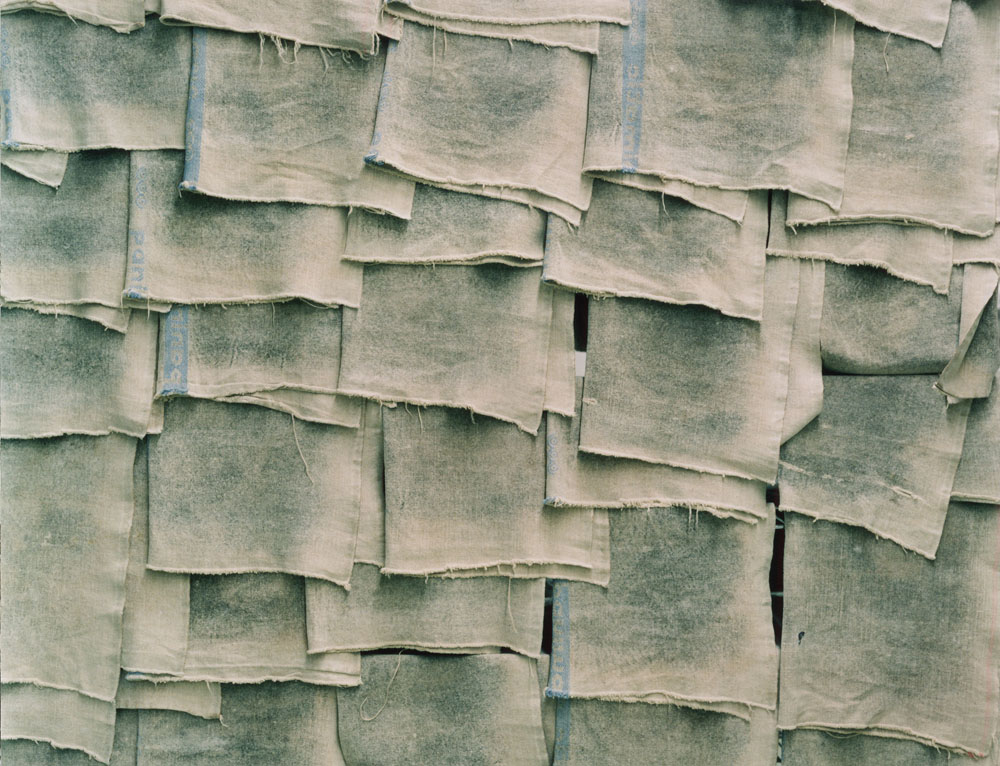
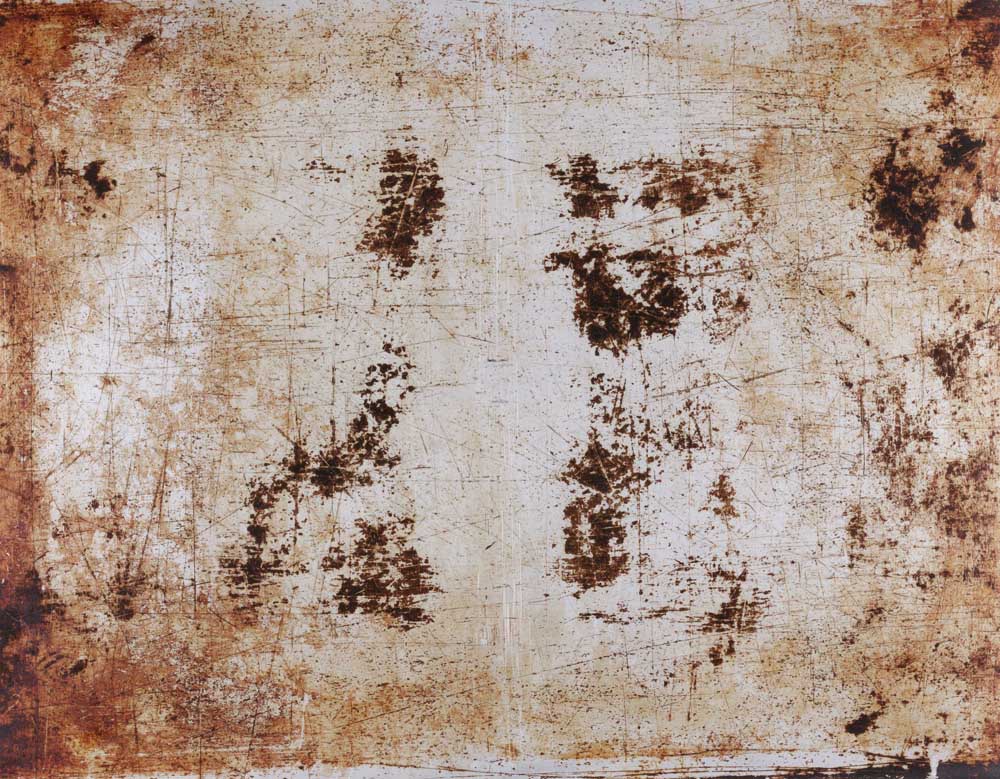
Aprons spotted with dough hanging on a white tiled wall, chubby golden bread loaves in a blazing oven, lumps of dough covered with plastic sheets swooning on huge trays, dough-stained fabrics, burnt baking trays, used rubber gloves, an oven’s dark interior, an empty industrial freezer – and, yes, a black flour bag lying like an abandoned corpse: Orit Raff’s bakery.


Bread – a word that inhabits a basic existence, a metonymy for hunger as well as satiation; Bread and Circuses – the Emperor’s bribe to the masses in ancient Rome; in western hedonistic society, where culture and gastronomy habitually flirt with each other, industrial bread is upgraded with mixtures that improve its taste infinitely and it spreads its aroma in prestigious pastry shops, a spectacle of inspiration and grace; at the same time, it is displayed on the news as the sign of an intense social struggle in the Jerusalem “Bread Plaza” in front of the Israeli Parliament, the Knesset; in Judaism, bread’s power is strengthened by dipping it in salt before saying Hamotsi (the blessing over bread), and in former times bread and salt were presented as a peace offering to all those who came through the Jerusalem gates; and yet, it is no coincidence that in Hebrew the same letters form the words bread (lechem), salt (melach) and war (milchama).


In religious rites and according to folklore bread is an icon with magic powers. In the Bible it represents a caring Providence, providing manna to the hungry people in the desert (Exodus 15:15), while according to Christianity Jesus said the dividend-carrying words: “I am the bread of life: he that cometh to me shall never hunger” (John 6:35). The Greek Demeter is one of the most well-known mythic goddesses of grain and fertility, a maternal archetype that is realized in conception and nourishment. The Homeric Hymn To Demeter describes her as the “fair-stressed awesome goddess […] of the bright fruit and golden sword”,[1] and her narrative – tales of seduction and of the twists and turns of desire, death and resurrection – was accompanied by secret, mysterious rites of purification.


“‘For me’, said Dulac, ‘there is more to bread than mix and bake, mix and bake. […] Bread is something that is alive; we must take great care with it'”.[2] A bakery is often pictured as a hellish place of fermenting yeast, heavy smells and burning furnaces, a volcanic space of soft, sensual dough lumps awaiting their turn in the oven while others swell in the fire like demons. In contrast, Raff’s photographs of the bread bakery are immersed in coldness and darkness. The groups of monochromatic images bring to mind death or purification chambers. The white aprons hang on the white tile wall like exhausted corpses, and the light baking fabrics, hanging like washing, also resemble shrouds awaiting their dead. In the past, Raff made several white on white photographic series, dealing with cleanliness and sterility: photographs of white laundry (1997-1998), a series of sparkling bath fixtures (Untitled, 1998), and an installation of bathing soaps (The Pot Calling the Kettle Black, 2002). In another work (Untitled, 1996) the artist herself goes through a personal purification rite, immersing her naked body in a white bath that suggests a sterile facility or a narrow burial casket. The obsessive preoccupation with cleanliness and dirt removal is also evident in a humoristic ready-made installation of empty rubber gloves, of the type used for cleaning (2002), and in the series of photographs Dis(located) Land (2001), in which Raff isolated spaces, mapped them and took photographic samples of intimate body remnants – hair, skin, nails – that have been defamiliarized and were left as unidentified post-mortem evidence.


In her works, Raff favors the implicit over the explicit, and her images intensify a past that seeks clarification. Like an act of detection, the artist follows with her camera traces and signs of a place or a time, findings by means of which she wishes to breath life into a frozen memory and construct a narrative from vague fragments, left behind as a present absence: the markings of furniture in an abandoned house, signs engraved on school desks or ice accumulations in an empty household refrigerator. Now the evidence line-up is augmented by dough crumbs that cling to walls and charred baking trays, extinguished ovens and rows of stainless-steel trays on which dough lumps covered in batter are stretched out, looking like rotting corpses. Raff’s observation of the bakery’s walk-in refrigerator uncovers only empty cells, referring back to the morbid, splendid glacier-scapes in her photographs of old freezers (Untitled, 1999-2000).


Writing about Andres Serrano’s series of photographs The Morgue, Stephen Bann describes, following Hubert Damisch, how the Ovidian myth of metamorphosis is visually depicted in Poussin’s Echo and Narcissus (1629-1630), where the body of the hero, Narcissus, is seen alongside the flower that perpetuates his name, the narcissus: “thus the painting is representing both death and resurrection – cold and pale flesh, and a crown of spring flowers”.[3] Bann points out a similar metamorphosis in Serrano’s glowing cibachrome surfaces, where the photographic plate adheres to the flesh of anonymous dead bodies, victims of murder and disease, and the mythological flower is nothing but the vivid presence of pink and red death wounds. The proximity of the terrifying and morbid to the spectacular and enchanting is also evident in some of Raff’s works. There is an unresolved tension in her photographs between potential vitality and beauty, and nullifying restraint. The radicalization that is fundamental to Raff’s photographic staging neutralizes the vitality implied by the image of turning live dough into bread, converting it into a clinical presence. The glowing fire that breaths life into dough as in an act of creation is stamped onto the singed limbs of Raff’s floury “death victims” like a decisive seal.


Like the photographs, the video A Roundabout (Fertility/Futility) (2004), depicting a female figure in the midst of a strange bread ritual, also puts bread back in its mythical cultural contexts, where it is associated with ritual acts. Associations of fecundity, conception and birth, impurity and lust, death and resurrection flow into the bread-stomach kneaded by the woman, who is dressed in white like a priestess. “He wrestled a gobbet of dough to the table and began massaging it […] This could be a woman. Thighs, buttocks. Deep, soulful flesh. He pressed and kneaded, using his hips. […] It tensed, relaxed, grew fragrant with its pleasure. It stretched […] then contracted into a shuddering, swollen mound. When he cut the dough into pieces and gave it over to the fire, it was very nearly a human sacrifice.”[4] The presence of bread dough as an erotic entity that combines sex and death was common in pagan rituals that sought to appease the Spirit of Grain by means of human or animal sacrifices, eaten in unbridled gorging feasts at first harvest. Some of the rituals were overtly sexual: bread loaves shaped like young girls were eaten in public feasts, as well as different types of grain, identified as male and female, symbolizing a union that yields golden sheaves.


The woman in Raff’s video, shaman-like, frantically strives to bring a stale loaf of bread back to life. Her hands tear the bread’s flesh, ravenously digging into its guts, Beuys-like, Sisyphically trying to restore the shriveled bread crust, to heal its dry skin with sandpaper, but the bread crumbles in her exertion-reddened hands. The ruptured fruit of the womb is dispersed, and the agonizing process starts all over again. A desperate act in an endless loop was also evident in the video Palindrome (2001), where Raff stacked thick felt squares inside a frozen arctic igloo and wallowed in them like an animal as she attempted to heat her body and preserve her life. She also challenged the boundaries of personal space in a repetitive attempt to realize the female body’s desire in The Moon Tastes Like Letters (2004), this time with the reflexive image of a moon caught in a bucket of water that is placed in a home territory – the kitchen.[5] Raff explores the affinity between instinct and necessity, between sexuality and urge, and in her present video her ongoing preoccupation with femininity, obsession and compulsion presents itself with archaic urgency: the manic bursts accelerate and seem to seek fulfillment of a physical hunger, a sexual hunger, an insatiable creative process.


[1]  “The Homeric Hymn To Demeter”, The Homeric Hymns, translated by Helene P. Foley, Princeton University Press, 1993, p. 2.
[2] Paul Hond, The Baker, Random House, New York, 1997, p. 226.
[3]  Stephen Bann, “Death and Metamorphosis: a propos the Morgue of Andres Serrano”, Andre Serrano – The Morgue, exhibition catalogue, Tel Aviv Museum of Art, 1996, p. 62.
[4] Paul Hond, The Baker, p. 270.
[5]  “Moonlight vision”, the way of seeing attributed to the moon goddess Artemis, is interpreted in psychological theories of femininity as enabling access to deeper levels of consciousness and widening the boundaries of perception.

The nine gates of my body

Pnina Reichman / The nine gates of my body

Opening: 20/01/2005  Closing: 25/02/2005

The Nine Gates of My Body, Installation view, Noga Gallery of Contemporary Art, 2005
YOU (detail), pen on office cards, 153x160 cm, 2004
THE NINE GATES OF MY BODY III (detail), acrilic on canvas 50x40 cm, 2004
THE NINE GATES OF MY BODY I, acrilic on canvas, 50x40 cm, 2004
Sonatina 36, pen on music notes, 30x22 cm, 2001
Sonatina, ink and silver pen on music notes, 30x22 cm, 1999

Requiem for the Silenced Body
Dror K. Levi


Pnina Reichman’s exhibition at the Noga Gallery examines the tense relations between words and images. Reichman paints as though she writes, and after seeing her exhibition, one may say that she writes as though she paints. Her painting does not originate in a clean and empty place: Reichman is associated with self conscious reflective artists; she keeps an active dialogue with the complicated problems the contemporary art discourse is concerned with.


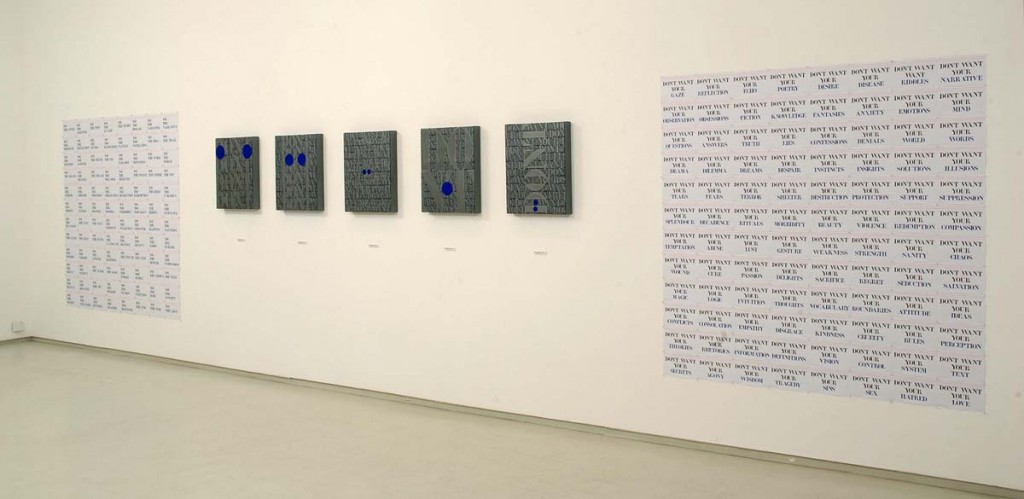
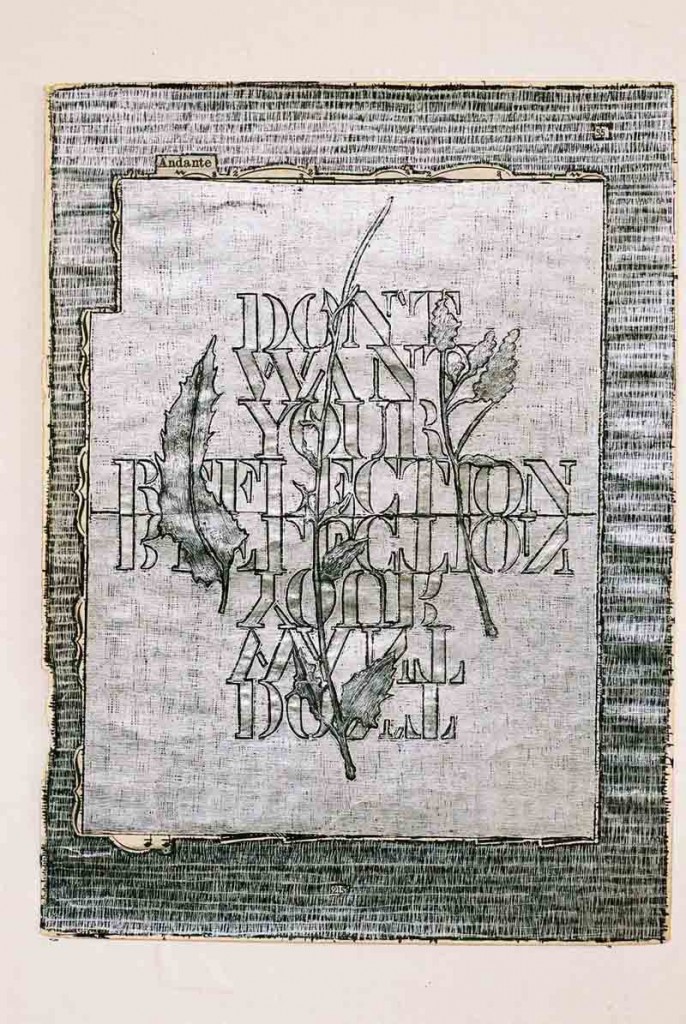
In many ways this exhibition is a continuation of her previous exhibition, “Love Letters” (1998), that explored the discourse about the other. In the latter she adopts a melancholic voice seeking an answer to the question of passion and death, while her current works convey the disappearance of a body in its allegorical sense. Her decisive and authoritative voice communicates with the I and the You. This ironic dialogue emerges through a variation on two groups of sayings replicating the words “You” and “Don’t”. The conflict between language and things between the addiction to language and the need to go beyond what it represents is resolved in a denial, in a resolute “no”.
Reichman’s picturesque writing reveals a body imprisoned in layers of words: as we peel a layer another one appears. She creates an indefinite world of typographic images that embraces the body, shuts it inside and leaves blind spots as though gaps denied an erotic meaning, inaccessible, impenetrable. The typographical discourse of the painting becomes a symptomatic code. The words and the images, they are the overt symptoms, the visual marks that cover the empty spaces, the lost; on the other hand, they protect from the empty spaces constantly present in the human experience.


Reichman’s paintings are fascinating, enigmatic, almost hermetic, but although condensed they do not freeze. On the contrary, they invite the audience to an inward journey, to an interpretation that brings forward a sensual and erotic atmosphere that does not appeal directly to the senses, but emerges from the depths. The room becomes a murmuring space, music from the depths, distant voices, traces of sonnets. The typographical discourse of the silenced body only the physical aspect of which remains, ironically, turns into an image, an ideogram, an allegory.


Dr. Dror K. Levi
Lecturer on semiotics and culture criticism,
The department of history and theory
Bezalel, Art and Design Academy, Jerusalem

Ill Pull the sky down for you

Orly Maiberg / Ill Pull the sky down for you

Opening: 02/12/2004   Closing: 15/01/2005

Ill pull the sky for you, Installation view, Noga Gallery of Contemporary Art, 2004
boat-diptych
orly5
peugeot-pink background
orly3
Untitled, oil on canvas, 100x100cm, 2004
2 figures-yellowish background

In the current series of works, Maiberg brings together the objects of her paintings of the last ten years. Her paintings examine the boundaries between truth and illusion, portraits and landscapes, the internal and external, dreams and reality, the signifier and the signified.


For Maiberg, longings are processed into something lost in Tel-Aviv, lost in time. The process travels and takes place in the gap between photography and painting. The landscape and the figures come from the family photo-album, or are taken in the present by Maiberg herself. This is realist painting reacting to life in a direct and personal manner. Thematically, Maiberg corresponds with one of the fascinating directions in contemporary discourse preoccupied with images of reality: the connection between photography and painting, in the space between life and art where everyday activity turns into an act of art.


Time is frozen in photography and painting, very present yet longs for something different, different days. The aim of painting as raw material is to put together “facts,” “memories,” and “moments;” to confront situations and places and bring them to the surface, to consciousness. This is where past and present dissolve into one another: Orly Maiberg with her father on the beach; Maiberg’s children on the beach; Tel-Aviv of the past; Tel-Aviv of the present. If in earlier works her figures were anonymous, without identity, then in the current series of works the figures receive a concrete characterization, personal and familial.


Orly Maiberg has developed in the last decade a unique and independent outlook on nature and urban nature. This outlook is distinct, uncompromising. Her estuarine landscapes are one of the most impressive achievements of the young painting in Israel. She is a graduate of the School of Visual Arts, New York. Her works have been presented in museums, galleries and art-fairs in Israel, the US and Europe.


Walking Distance

Talia Keinan / Walking Distance

Opening: 21/10/2004   Closing: 23/11/2004

Walking distance, Installation view, Noga Gallery of Contemporary Art, 2004
landscape2 (1)
the moon
pencil on paper
hole in the wall, still from video
fountain detail

The exhibit consists of video works and drawing sketches, where the video pieces are presented as sculptural objects which, along with the sound emerging from them, create the space within they are set.


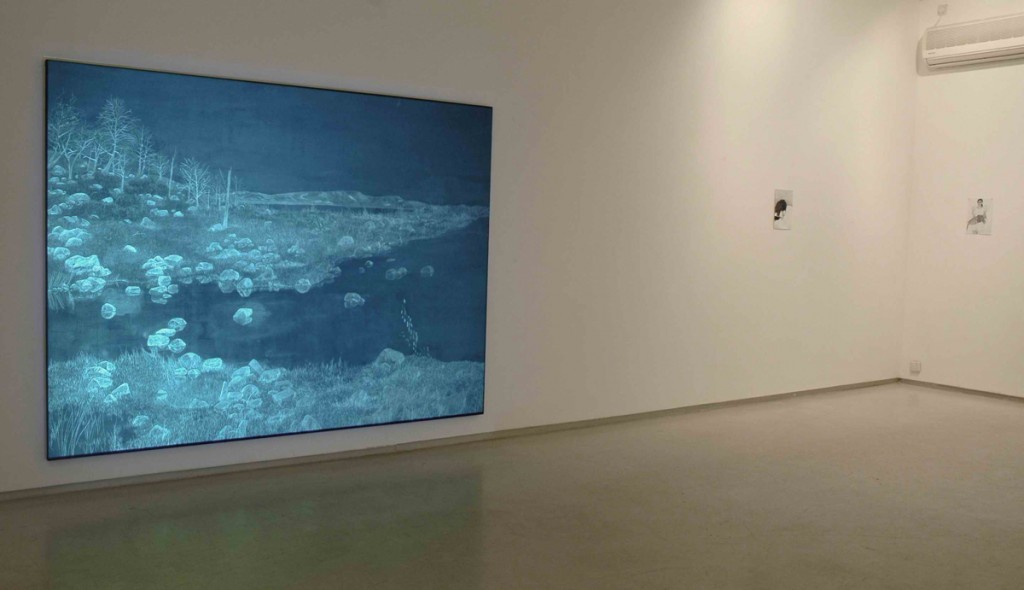
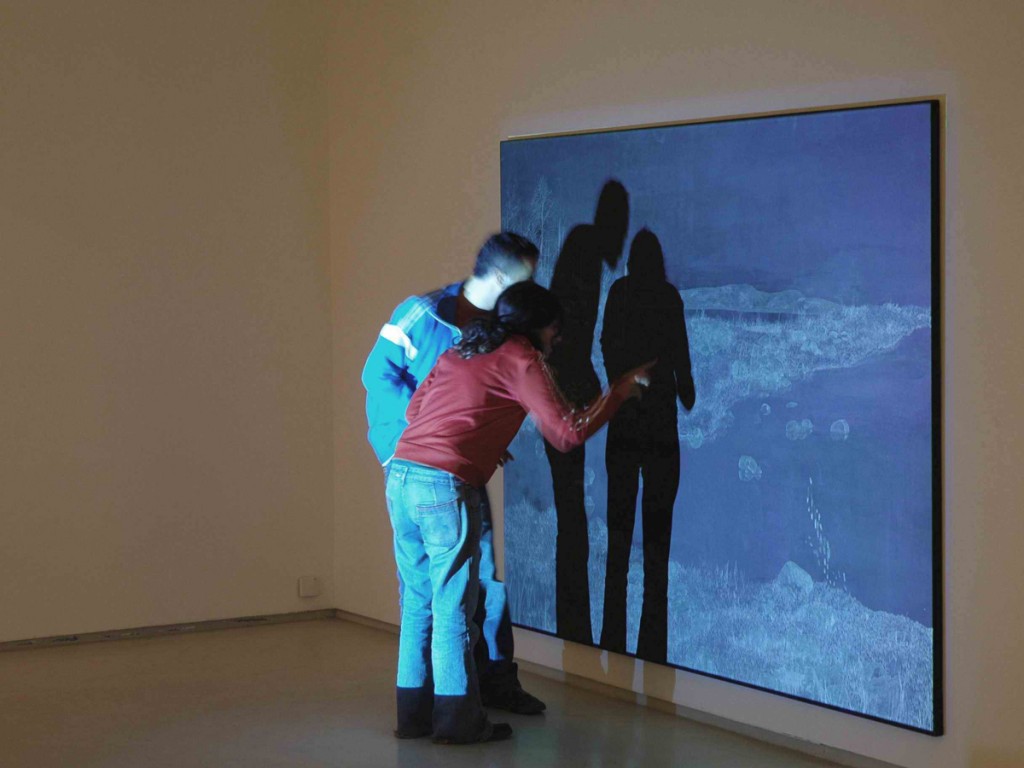
Drawn with pencil on black gouache, the landscape piece, created from the artist’s imagination inspired by two sources: the first being silver kitsch-style pictures depicting ideal places, usually fantasized locations inexistent in reality, and the second source of inspiration were Israel landscape photographs. The light projected on the drawing accompanied by the sound of a passing-by vehicle exposes the landscape itself and the spectrum of coloring variations within the monochromatic drawing.


The round hole projected on the wall was photographed on an afternoon in a public garden in Tel Aviv – it remains unedited.


The fountain, an abandoned table on which plastic cups and plates are left unattained yet the water continues to flow as a living and vibrant unit, unresolved.


All of these elements in the gallery space, along with the sketches hung dispersedly on the walls, together create fragments of the same place, a physical or mental walking distance from each other, liquid and subjective; one passes from kitsch to disaster, from beginning to a deserted plateau.


Talia Keinan (b. 1978), is currently a student in the Bezalel M.F.A program in Tel Aviv. An honors graduate of the Bezalel Academy of Fine Arts and Design in 2003, she also participated in the student exchange program in New York at S.V.A. In 2003 she had a solo exhibit in the Herzeliya Museum of Art and is winner of the Givon Prize for 2004. This is the first exposure of her works held at Noga Gallery.

Ghost

Ori Gersht / Ghost

Opening: 02/09/2004   Closing: 10/10/2004

Ghost, Installation View, Noga Gallery of Contemporary Art, 2004
Olive 16, 150x120cm, 2004
Blaze 2, 150x120cm, 2004
Untitled 17, 100x80cm, 2004
Blaze 3, 120x120cm, 2004

For the making of this work I spent a lot of time in the Galilee, among trees that were over 500 years old and more. The olive trees have got a unique significance – they symbolise the bond between the farmer and his ancestors and the land. For that reason they are at the forefront of the current territorial disputes.


I took the photographs at midday, when the bright and bleaching sun was hovering in mid sky. I over exposed the film by many stops, allowing the harsh and violent sun to attack the film and melt the images of the trees.


Later in the darkroom I attempted to rescue the details and the traces from the over exposed and therefore dense negatives. In contrast to the violent and destructive act of exposure the images that appeared on the paper were frail, delicate and gentle.