Animated Histories

Group Exhibition / Animated Histories

Opening: 25/10/2007   Closing: 14/12/2007

Animated Histories, Exhibition view, Noga Gallery of Contemporary Art, 2007

Animated Histories: Qiu Anxiong, Robert Breer, Kota Ezawa, Cristina Lucas, Jenny Perlin, Shahzia Sikander, Kara Walker


Curated by Edna Moshenson


“Animated Histories” features works of contemporary artists using various techniques of animation – classical animation, digital and computerized – as an additional facet of their drawings, paintings and installations.


The internationally acclaimed artists participating in this exhibition are:


The Afro-American artist Kara Walker, born in 1969 in USA, Shahzia Sikander, born in 1969 in Lahor, Pakistan, lives and works for over twenty years in NY, Qiu Anxiong, born in 1972 in the Sichuan county in China, studied in Kassel in Germany, lives and works in Shanghai, Cristina Lucas, born in 1973 in Spain, lives and works in Madrid and Amsterdam, Kota Ezawa of Japanese-German parentage, born in 1969, lives and works in San Francisco since 1994, Jenny Perlin, born in 1970 in USA, and Robert Breer, one of the founders of experimental cinema, born in 1926 in USA.


The use of animation in the exhibited works is a natural and fundamental development evolving from the artists’ previous works in other media. Many contemporary artists, particularly those participating in the exhibition, use this medium in a subversive way. Relying on the features we attribute to animation – magic, fun, temptation, playfulness, humor, and poeticism – they use it as an instrument of presenting alternative historical narratives and as a channel for sharp social and political criticism.


The “Animated Histories” exhibition focuses on artists that combine in their works history and myth, reality and imagination; they animate, enliven and reconstruct repressed historical periods, traumatic historical and political events and complex social situations referring simultaneously to contemporary reality.


Kara Walker’s works contemplate the history of the American South during the period prior to the civil war and the struggle to emancipate the slaves. Shahzia Sikander looks into questions of cultural uniqueness in the post-colonial and multi-cultural society, and questions of feminine identity in a post-feminist society. Qiu Anxiong explores in his animation films the changes in the landscape of his country – rural and urban as well as social and political, the transfer from traditional to modern China, the Cultural Revolution and the post-communist era. Cristina Lucas shows in a colorful animation the changes in the map of the World from 500 BC till today caused by invasions, political alliances, explorations and wars. Kota Ezawa’s works focus on how the media influence the way latest historical events are etched in the collective memory. Jenny Perlin deals in her works with American paranoia and national traumas stemming from espionage and terrorism.


In the exhibited films the artists also refer to the history of cinematography and art, to Renaissance, to return and preservation of pre-cinematic techniques. At the same time, they use traditional techniques – paper cutouts and shadow theatre (Kara Walker), Indian-Persian miniatures (Shahzia Sikander), Chinese ink and wash drawings (Qiu Anxiong), abstract painting (Cristina Lucas), pop art (Kota Ezawa), and techniques of early experimental cinema (Jenny Perlin and Robert Breer) – in conjunction with digital techniques and newest animation and drawing software.


The animation films in the show maintain links between different media, between historical periods and cultural spaces distanced in time and place. They bear a fascination with the new technologies along with a romantic elegy to obsolete techniques and ways of expression, and an attempt to animate, enliven and preserve by digital means art forms threatened by the digital revolution.


All the works included in the exhibition were exhibited in a number of solo and group exhibitions during the past few years. Kara Walker’s films are also exhibited now in her solo exhibition in the Whitney Museum in NY and in the Venice Biennial. Cristina Lucas is participating in the Istanbul Biennial. Shahzia Sikander’s films were exhibited in the Venice and Istanbul Biennials. Kota Ezawa’s film was purchased by the NY MOMA and is exhibited there. Qiu Anxiong exhibited in the Shanghai Biennial.


The works are exhibited courtesy of the artists and their galleries: Kara Walker and Shahzia Sikander, Sikkema Jenkins &Co., New York; Cristina Lucas, Galeria Juana de Aizpuru, Madrid; Qiu Anxiong, Grace Li Gallery, Zurich; Kota Ezawa, Haines Gallery, San Francisco; Jenny Perlin, Annet Gelink Gallery, Amsterdam

Paper

Group Exhibition / Paper

Opening: 06/09/2007   Closing: 19/10/2007

Paper, Installation view, Noga Gallery of Contemporary Art, 2007

Lea Avital
Dror Daum
Nicole Eisenman
Nogah Engler
Max Friedmann
Eti Jacobi
Talia Keinan
Efrat Klipshtein
Elisheva Levi
Orly Maiberg
Rami Maymon
Tal Mazliah
Liav Mizrahi
Galia Pasternak
Yehudith Sasportas
Nati Shamia-Opher
Esther Shneider
Ralf Ziervogel
Alexandra Zuckerman

Longing for the Ghetto

Meir Gal / Longing for the Ghetto

Opening: 01/06/2007   Closing: 30/06/2007

Longing for the Ghetto, Installation view, Noga Gallery of Contemporary Art, 2007
story_art_3-2
story_art_2-1
French Occupation
complete_2
complete_1

Meir Gal’s solo exhibition show at Noga Gallery of Contemporary Art is the second part in a series titled “The Story of Israeli Art”. The first part was shown in 1995 at the Tel Aviv Museum of Art.


In this show Meir Gal continues to survey and document the writings of numerous writers, critics, curators, etc. active in the Israeli art world since the 1940’s. He selects various sentences and statements, uses them as quotations and places them in a new context alongside popular images from contemporary Israeli life. By doing so Gal reframes Israeli writing about art and lays out the textual conditions under which visual artists have been operating for decades.


Also included in the show are two objects titled “Sky Shield for the State of Israel” as well as “The Complete Jewish Lexicon” and “The Concise Israeli Lexicon”.


Meir Gal would like to acknowledge and thank all the writers quoted in this show, but are too numerous to mention.

New Works

Orly Maiberg / New Works

Opening: 19/04/2007   Closing: 25/05/2007

New Works, Installation View, Noga Gallery of Contemporary Art, 2007
4, 25x30cm
154X174
12, 170x135cm
DSC_0008
001

In her current series of works, Orly Maiberg brings together the subjects of her paintings of the last ten years. Her paintings examine the boundaries between truth and illusion, portraits and landscapes, the internal and external, dreams and reality, the signifier and the signified.


For Maiberg, longings are processed into something lost in Tel-Aviv, lost in time. The process travels and takes place in the gap between photography and painting. The landscape and the figures come from the family photo-album, or are taken in the present by Maiberg herself. The paintings react to life in a direct and personal manner. Thematically, Maiberg dialogues with one of the fascinating directions in contemporary discourse: preoccupation with images of reality, in the connection between photography and painting, in the space between life and art, where everyday activity turns into artistic acts.


Time is frozen in photography and painting, very present yet longs for something different, different days. The aim of painting as raw material is to put together “facts,” “memories,” and “moments;” to confront situations and places and bring them to the surface, to consciousness. This is where past and present dissolve into one another: Maiberg with her father on the beach; Maiberg’s children on the beach; Tel-Aviv of the past; Tel-Aviv of the present. If in earlier works her figures were anonymous, without identity, then in the current series of works they receive a concrete characterization, personal and familial.


Orly Maiberg has developed in the last decade a unique and independent outlook on nature and urban nature. Her outlook is distinct, uncompromising. Maiberg’s sea landscapes are one of the most impressive achievements of the young Israeli painting. She is a graduate of the School of Visual Arts, New York. Her works have been shown in museums and galleries in Israel, the US and Europe.

Luna

Eden Ofrat / Luna

Opening: 08/03/2007   Closing: 13/04/2007

Luna, Installation View, Noga Gallery of Contemporary Art, 2007

The space is dark; 8 big barrels are standing on the floor. Each barrel is filled with water reflecting a full moon on its surface.


A video projection is screened on the ceiling which shows a spider web and a girl climbing it, trying to reach the moon in its middle. Reaching the moon, the girl disappears in it; at the same time the moons inside the barrels turn into eyes with sick-looking pupils.


The eye in the barrels blinks and slowly disappears until the water becomes black and empty. Then, big, black she-spider crawls out of the moon screened on the ceiling, and prowls around the web until everything becomes black.


The girl climbs to Luna; she climbs to the moon-eye. Whose eye? It might be her own eye or one of the eight eyes of the carnivorous she-spider, the tarantula. It might be the artist’s climb to herself, a destructive self-reflection or a self approval in denying oneself? She climbs the spider web as the mythological Arachne, the skilled weaving woman whom Athene turned into a spider. In a moment she will make it, in a moment she will see, in a moment her eye will close and with it the eight eyes of the spider, the one to offer a sacrifice and the victim.

Bear Hug

Galia Pasternak / Bear Hug

Opening: 07/12/2006   Closing: 05/01/2007

Bear Hug, Exhibition view, Noga Gallery of Contemporary Art, 2006
Horse portrait, Oil on Canvas, 45x60cm, 2006
Bambi, oil on cardboard, 28x20cm, 2005
The Tourist, 60x100cm, oil on paper, 2005
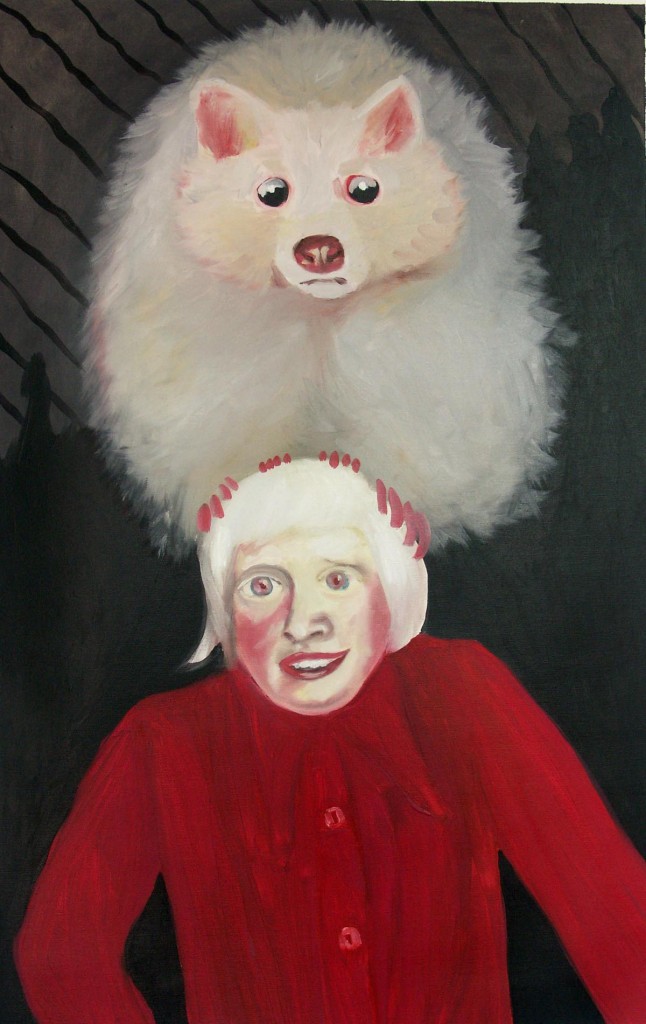
Albino boy & a Racoon, oil on canvas, 84x55cm, 2006
Athlete, oil on canvas, 145x82cm, 2006

The “Bear hug” paintings feature crowded places; cut out images implanted into the paintings. Images of figures and animals invade each others space, while completely ignoring each others presence. Every image bears its past ethology; however, once inside the collage its identity becomes confused. The image balance is disrupted by exaggerations and extensions; it regains its equilibrium within the constructed set of the painting.


Painting images that come from different spheres in the real world allows their ultimate assimilation in “death”. For me, this is one of the magnificent powers of painting: to show a history of an image, to preserve it, but also erase it – to create a new image. The new image expresses a humoristic, mocking tone coming from the weird crisscross of figures, their expressions and surroundings. The painting “puts” a circus like show – unbelievable, and absurd. Each painting is trying to tell a joke – a bad joke or a pointless gag.


A theatre show, set, image display and directing operate as milestones on the way to the painting. I cut out some pieces of the puzzle, put up a set, add lots of make up or blood stains. The flesh disappears; there are only colors imitating pink, white or brown skin. Patches of color and shine make for furs, hair and blood. The figures are frozen in the ultimate act, at the peak of pathos, forever.


The images were collected from the Internet, magazines, films and edited photographs, adapted and mashed into a collage and then into a painting. For each work, a fictitious storyboard is built with layers of drawing, photograph and color.


No painting comes out the way it was planned. The medium, size and the painting style impose their own constraints. So a small, naïve photograph of a horse galloping through a field becomes a big, flat and detached horse figure.


The body of the image, its fragility, unawareness and intimacy collapse and re-erect. The images are pulled together by links of heavy and light, over exposure, paleness and darkness. It seems that in the heat of darkness it is easier to “rape” vulnerable images. The sole authentic quality an image carries from its previous life is its expression, the very same expression for which it was chosen.


“Bear hug” simulates a chain reaction in the paintings, like a collage that is compulsive. An image is embraced too strongly until it has no choice but to surrender, to kneel before its opponent. It is an allegedly warm and tender expression of a brutal and aggressive act. And so images confront in the paintings hugging each other too strong till overtake that remains undetermined.

Repulsion

Keren Cytter / Repulsion

Opening: 03/11/2006   Closing: 02/12/2006

Repulsion, installation view, Noga Gallery of Contemporary Art, 2006
Repulsion, Still from Video, 2006

Keren Cytter’s (born 1977 in Tel Aviv, lives and works in Amsterdam) artistic practice has gained an outstanding international recognition in the past three years. Since completing her post graduate studies in the studio program de Ateliers in Amsterdam, Cytter held solo presentations at Galleria d‘Arte Moderna e Contemporanea, Bergamo (2006), Kunsthalle Zürich, Zurich (2005), Frankfurter Kunstverein, Frankfurt am Main (2005), Stedelijk Museum Bureau, Amsterdam (2004), and an upcoming solo project in Stedelijk Museum, Amsterdam (2007).  Keren Cytter is also the author of the novels: The Sunset of Yesterday (Shadurian, Tel Aviv, 2003) and The Man Who Climbed Up the Stairs of Life and Found Out They Were Cinema Seats (Lukas & Sternberg NY-Berlin, 2005). Keren Cytter has just been awarded the Baloise Art Prize at the “Art Statements” sector of Art 37 Basel. Keren Cytter’s first feature film NEW AGE will be released in The Netherlands in winter 2007.


Keren Cytter is engaged in representations of social realities through experimental storytelling in which she cultivates radical subjectivity as a challenge to the restraints and rules of genres and language, both written and cinematic. Recalling amateur home-movies and video diaries, her films and videos are made of re-composed elements of the everyday, of impressions, memories, imaginings, desires and dreams. The scripts are part of the stories themselves, and the story in turn is always a story of the clash between a (perfect) script and an (imperfect) reality.


Cytter, who writes all her own scripts, deliberately uses an over-poetic and non-realistic spoken language to enhance the artificiality of the film making process. This eloquent and expressive speech is at odds with the videos’ documentary style, which includes lots of wobbly, hand-held, out-of-focus shots, culminating in the camera getting knocked over.


The subject matter of her work is the stuff of relationships -loss, loving, Ionging, friendship, betrayal – much of it culled from her own or her friends’ lives. While the language may be bookish, the topics are pure soap opera, and the disjunction between the words and images adds to the melodramatic flavour. Repetition is an important factor in Cytter’s work, both in language and montage. Phrases are stated more than once, sometimes slightly altered, and particular shots are occasionally repeated. People re-enter the same room several times, although the plot seems to move forward normally. More layers are added visually by the use of colour, whether by stripping it away entirely to black and white or by accentuating and saturating it.


Cytter deconstructs traditional narrative structures by superimposing video clips with nonharmonized voice and sound sequences that are often doubled up with subtitles, and in this way conjures up an often surprising and always arbitrary reality. Usually produced in a cheap and simple way, the videos imitate the genre of documentaries and yet the quotes and clichés taken from popular culture, film, Pop music and trash literature expand them, propelling them into a purely fictitious world where our ability to grasp things is sorely tested.


(the text was adapted from press releases from KW 2006, Kunsthalle Zurich 2005 and Frieze 92, 2005 by Amanda Coulson).


Repulsion consists of three short films, and is based on the Roman Polanski’s Repulsion from 1965. In the original film the main character, played by Catherine Deneuve, works at a beauty salon in London and lives with her sister. When the sister is away on a trip to Italy with a boyfriend, Catherine murders her pursuer and throws him in a bath full of water. Her landlord comes for the rent and tries to sleep with her, but she kills him too rolling his body inside a carpet. When the sister returns, she finds the two bodies and Catherine unconscious under a bed. On the floor there is an old family photo with a girl that looks demented.


After seeing Polanski’s film Keren Cytter “decided to make three short movies that focused upon the protagonist and the two supporting characters. The interaction between the three characters would create tensions that led to a cruel death at the end of each movie. The characters would change parts – the killer in one movie would be the victim in the second, and the witness in the third, and vice versa. This way the three short movies would serve as three layers of one movie that had no plot. [She] recalled the actions and objects from the original movie that had left the deepest impression on [her] and decided these would be the actions presented in [her] three short movies.”[1]


The movies don’t tell any story, and the actions of the characters are arbitrary. The actors change their roles in each movie, thus creating a perfect symmetry. The movies are meant to describe the feelings of disgust, alienation and claustrophobia. They focus on a girl, who when left alone suddenly becomes engulfed by feelings of uncontrollable repulsion, suffocation that clouds all reason, and paranoia – those feelings slowly drive her away from life.


[1] From “Repulsion” by Keren Cytter, Metropolis M #5, 2006


Liquidation

Ori Gersht / Liquidation

Opening: 14/09/2006   Closing: 27/10/2006

Liquidation, Installation view, Noga Gallery of Contemporary Art, 2006
Galicia, c-print, 120x150cm, 2005
Pistine, c-print, 120x150cm, 2005
Time Slice, c-print, 120x150cm, 2005
A Long Way, c-print, 120x150, 2005
Three Winters 2, c-print, 150x180cm, 2005

Photographs titled “Liquidation” and a film named “The Forest” are two complementary parts of a single body of work, which is represented in a new Monograph titled “The Clearing”.
The works, which were created in 2005 at the remote southwest regions of Ukraine, will be shown simultaneously at two venues, the photographs at Noga Gallery while the film at the Tel Aviv Museum of Contemporary Art.


During the past year this body of work was exhibited at The Photographers Gallery, London, CRG Gallery, New York, Angles Gallery, Los Angeles, Marco Museum, Spain and will soon be presented at the Architecture, Art and Landscape Biennial of the Canaries, Canary Island.


“Crammed with memories, and at once filled with forgetting: his memories, even recent ones, were faded, they had hazy outlines, they overlapped in this effort of his, as if someone were making drawings on the blackboard, then only half erasing them, before making new ones on top of the old. Perhaps this is how a man remembers his life when he is a hundred, or how the patriarchs, who were nine hundreds, remembered. Perhaps memory is like a bucket; if you want to cram into it more fruit that it will hold, the fruit is crushed.”


(pp 213-214, If Not Now When, Primo Levi)


This exhibition features new photographic works that were created over the course of a series of journeys to the small towns of Kosov and Kolomia in the region of Galicia in southwest Ukraine.
As with his previous work, Gersht is exploring landscapes imbued with personal, intimate and historic resonance in a journey into the unknown, into the past, and into the private flitting memories that refuse to fade away.


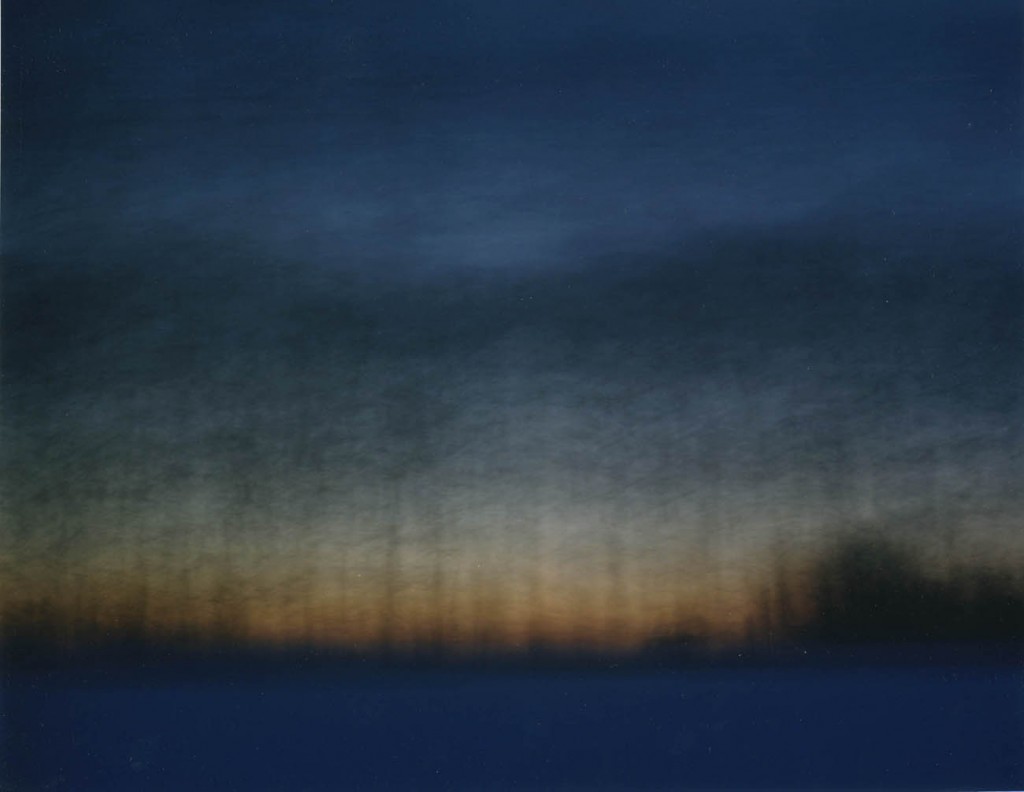
The photographs were taken in areas that were for many generations a home to prosperous Jewish communities and where once Gersht’s relatives found a brief but harsh refuge from Nazi persecution. In his photographs Gersht attempts to look at the surrounding landscape in the light of the historical events, to confront pastoral beauty with the atrocities of the past, the concrete experience with the subjective, psychological one. Consequently, the photographic process becomes a struggle between recording and erasing, describing and forgetting. In order to achieve such visual dialectics, Gersht exposed the film for long durations of time attempting to penetrate the surface and capture the essence of these places. However, the effect is reverse: the long exposures bleached the film; the light of the sun first created and then destroyed the images, erasing them from the surface of the celluloid. This process of creating and destroying aims to redefine the relationship between objective and subjective, and to highlight the helplessness of photography in relation to the past.


In addition to the photographs, Gersht also shot “The Forest”, a 13’ film,
that was inspired by the German Romantic movement, and particularly by the paintings of Caspar David Friedrich. Romanticism that was later adopted and distorted by the Nazi regime is the trigger for a discussion about culture and nature, memory and forgetting, and the marking of an epic catastrophe. In contrast to the ephemeral and gentle photographs, the visual appearance of the film is sharp and concrete accompanied by an immense threatening sound. Through such formal opposition the photographs and the film converse and complement each other.

Echo and Narcissus

Joshua Borkovsky/ Echo and Narcissus

Opening: 18/05/2006   Closing: 25/06/2006

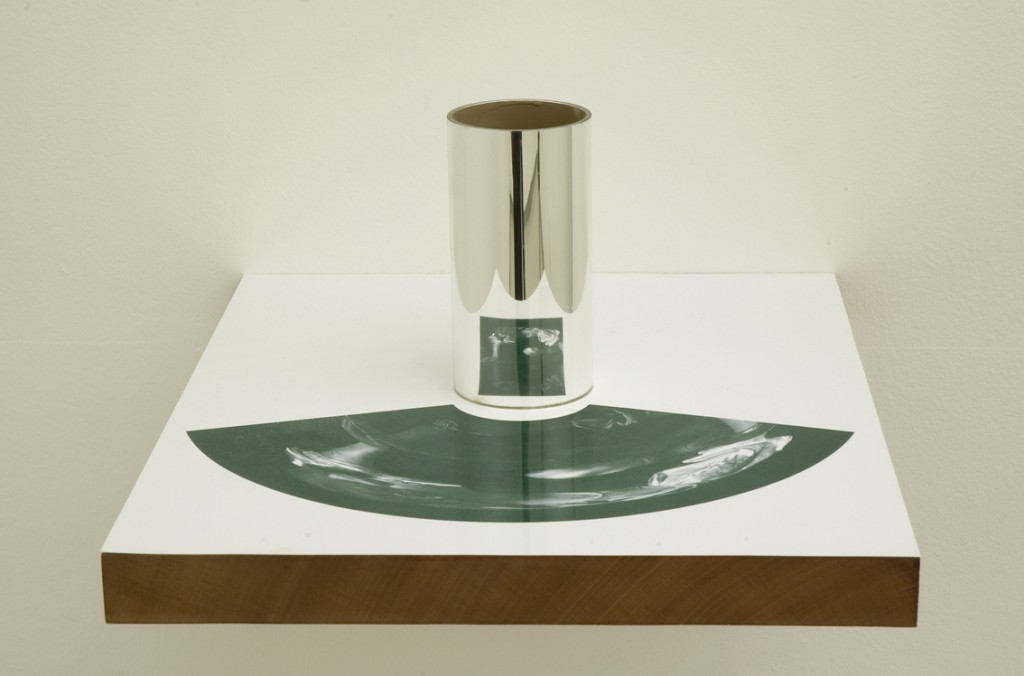
Echo & Narcissus, Mirrors, the Garden/ Anamorphoses, Installation view, Noga Gallery of Contemporary Art, 2003
Untitled, Tempera and Gold Leaf on Wood Panel, 80x122cm, 2001

In his new exhibition opening May 25, 2003, Shuki Borkovsky exhibits works from the past two years: a series of photographs from the cycle:     “Mirrors, The Garden / Anamorphoses “ and paintings from the cycle :“Echo and Narcissus”. In the cycle : “Mirrors, The Garden / Anamorphoses”  the artist makes new and surprising use of the photographic medium in order to focus the viewer’s attention on questions of vision and doubt, central to his work of the past two decades.  Those works consisted of phantasmagoric images such as the silhouettes of sailing ships and the cartographic images in his paintings of the early 1990s and, later, the images of crystal chandeliers reflected in mirrors. These paintings demanded the active presence of the viewer, a concentrated observation that led him, paradoxically, to question seeing and to doubt the truth in what was reflected.


In his anamorphic photographs of gardens, the artist deals with similar questions. The original photograph is distorted to unsettle the viewer’s certainty of seeing the thing represented thereby. An additional distortion of the photograph utilizes the moiré effect that creates a “spiraling” and “whirlpool” effect in the image. (In standard, correct, prints the moiré effect is regarded as a fault, while Borkovsky makes this distortion a fundamental value of the image.) An enigmatic photographic image is attained, which suspends the gaze while questioning “correctness” of vision and, particularly, photography as representation.  “Truth” will be revealed, magically, only by correction of the representational fault through its reflection in a curved mirror: paradoxically, “truth” appears as a reflection, as likeness and illusion. The artist, the “salt merchant”, re-turns himself and the viewer to a state of doubt.


The diptychs from the “Echo and Narcissus”  cycle (oil paint and gold leaf on canvas) maximize abstraction, concentration and reduction that characterize Borkovsky’s work. As told by its name, the cycle is encoded with figurative images. The most abstract state is also the most figurative. Narcissus reaches awareness only through his reflection, and Echo is present in the world as a reverberation, a repetition. The viewer is in position to play a major role in charging these paintings with symbolic couples of all times and with further reflections.  The viewer can be either Echo or Narcissus, or both at the same time.


Anamorphosis

The technique of distorting an image in such a way that it can be viewed in its correct form from a particular point or through its reflection in a curved mirror. When seen directly it appears abstract and incomprehensible.


The system of central perspective not only rationalizes a relationship between objects within a picture, but also establishes a relationship between the viewer and the represented images. Anamorphoses are an extreme example of this subjectivization of the viewing process. The observer is first deceived by a barely recognizable image, and is then directed to a viewpoint dictated by the formal construction of the painting. Indeed, etymological origin of the word – from the Greek  ana(again), morph(shape) – indicates that the spectator must play a part and re-form the picture himself.


The image that appears, as if by magic, attracted artists, philosophers and poets for centuries. Durer, Leonardo da Vinci and Holbein (“The Ambassadors”) all created anamorphic images. Jean Cocteau writes of the anamorphic image as that ‘No man’s Land’ where poetry and science meet.


Anamorphic images, were considered ‘wonders’ and miracles of art imbued with mystical, theological and philosophical significance.


The seventeenth and eighteenth centuries were the golden age of anamorphosis.

Cronos

Mosh Kashi / Cronos

Opening: 30/03/2006   Closing: 12/05/2006

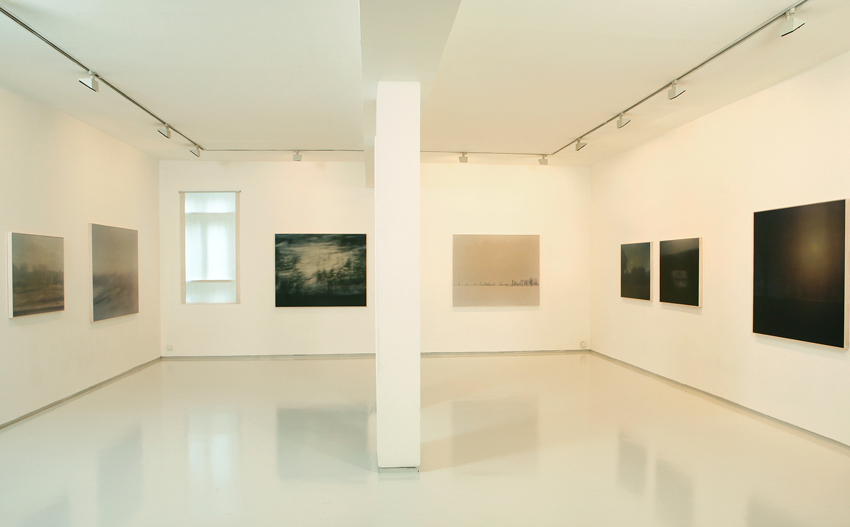
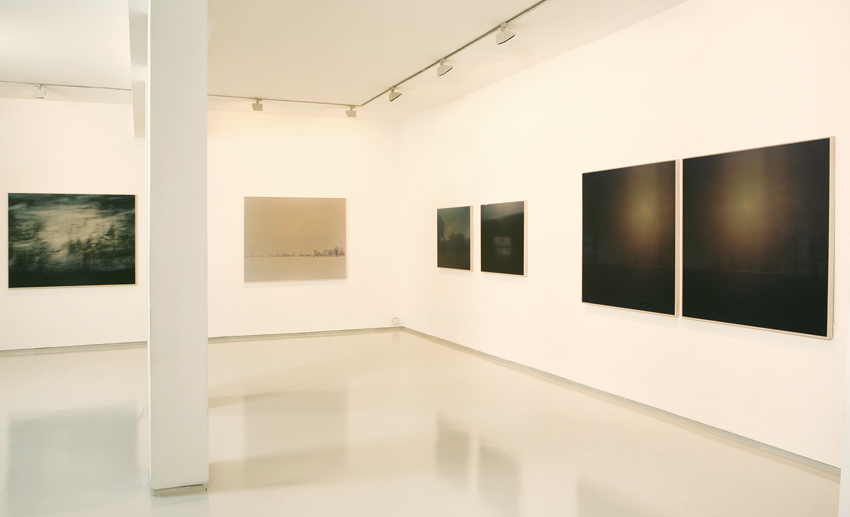
Cronos, Exhibition view, Noga Gallery of Contemporary Art, 2006
Small blurred leaves oil on canvas, 20x20cm, 2006
Sintra, oil on canvas, 90x140cm, 2006
Cronos, oil on canvas, 210x110cm, 2006
Cronos 2, oil on canvas, 80x120cm, 2005-2006
Crimson tree, oil on canvas, 60x40cm, 2005
Dark tree , oil on canvas, 40x100cm, 2006

My new cycle of works opens yet another chapter that deals with nature and flora not as a record but as a document that engages emotions on physical as well as mental levels.


Dark fields, black trees, thickets spread as a torn sheet exposing the hidden light and the background, hallucinatory trees and shadows, golden porcelain balls (that will not be exhibited) coated with pure gold, and balls with meticulously painted twigs.


Darkness as a substance provides the axis in this body of works. The horizon, the link between land and sky and the pale light that flickers like a pearl define the wide shadowy fields and the dark saturated sky above them.


A significant part of those works are the black fields (Cronos); heavy and charged, they linger as a black thick mist marking the horizon in the gallery space. The viewer moves from a black field to a green shadow, back to a dark tree and then to an endless thicket of green twigs through which glints an infinite space.


There are other works with bare sprigs on a dark background illuminated by the faint night light; they break up the dark space reaching to the bottom of darkness which is light (Sintra).


The dark, hallucinatory trees on a red background (Crimson) are far away in a red, hot atmosphere – the red, thick air wraps the lone tree that merges with the horizon of the heavy earth. The dark trees seem like stakes in the first light of dawn or the last light of day, or pines, dark with their thick and mysterious branches.


These works do not express the concrete, earthly plane of nature, but rather refer to mental imagery like the dark, weightless air that touches the heavy earth on a blurry horizon.


The blurred leaves and the almost hallucinatory branches become an allegory to the feelings of void and reality; together they reveal a fractal space free of cultural prescriptions. This reality is a fractal, a unique shape born again and again, eternally.