Origins

Toony Navok / Origins

Opening: 31/10/2013   Closing: 14/12/2013

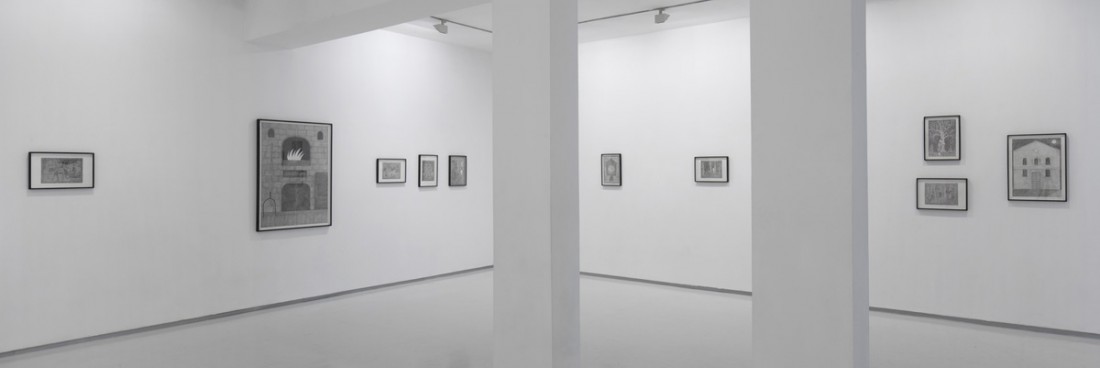
Origins, Installation view, Noga Gallery of Contemporary Art, 2013
Origin (Red), Colored penclis on paper, 160X117cm, 2013
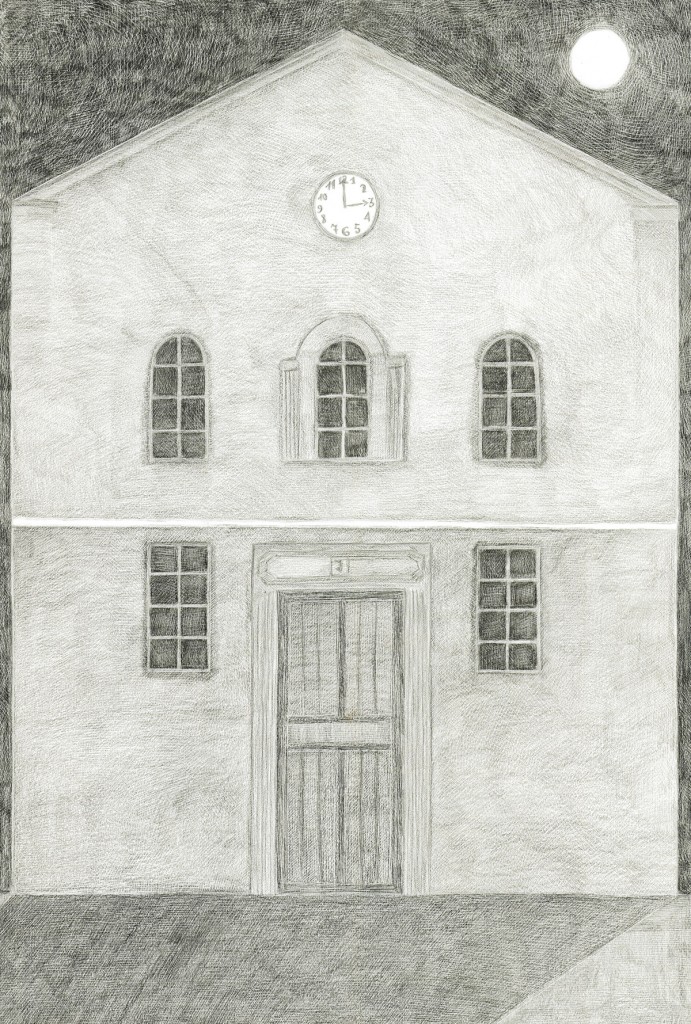
Origins, coloured pencils on paper, 100x70cm, 2013
Origins, detail 11
hilla_toony_navok_mekorot_1
Untitled, Photo collage, 72x50cm, 2013

Noga gallery is cordially inviting you to “Origins”, Hila Toony Navok’s solo exhibition. In “Origins”, Navok displays an installation which consists of sculptural environments and a colorful series of drawings.


Navok exhibits sculptural works that are assembled of multi-colored metal surfaces, pipes, aluminum poles, PVC fabric, cleaning products, and shelving units – fantastical but bodiless ventilation and cleaning systems and architectural-constructive environments with airy, drawing-like natures that range from abstract to concrete. By means of popular Israeli design codes and by using every day products in conjunction with a glance to past canonic periods, Navok examines with irony the formalistic, abstract core at the heart of the relation of our culture to cleaning, body and dirt.


In opposition to the synthetic nature of the sculptures, Navok presents a series of “Draining Drawings” – large scale toiling and colorful drawings with organically moving marks that freeze and solidify in a moment between stability and collapse. Navok’s drawings are composed of compressed and dense lines that assemble into what seems like a sculptural object, which continues her practice of investigating the affinity between two dimensional and three dimensional and between drawing and object.


Navok is an MFA graduate of Bezalel Academy of Art and Design (2009). She is a recipient of the Givon Prize for young artists from the Tel Aviv Museum (2011) and the Creative Encouragement Award of the Israel Ministry of Culture & Sport (2012). Navok has participated in various exhibitions both in Israel and abroad, amongst them solo exhibitions at the Haifa Museum of Art and at Local_30 gallery (Warsaw, Poland). She has also participated in ART COLOGNE (Germany), and group exhibitions in the Ashdod Museum of Art -Monart Centre, Neues Museum in Weimar (Germany), the Herzliya Biennial of Contemporary Art, CCA Tel Aviv, Rosenfeld gallery (Tel Aviv), Sommer Contemporary Art gallery (Tel Aviv), Rockefeller Museum (Jerusalem) and ARTLV (Tel Aviv, 2008). Navok co-curated the second Herzliya Biennial of Contemporary Art (2009) and was co-editor of the art magazine Picnic.

All Will Come to Pass

Ori Gersht / All Will Come to Pass

Opening: 31/08/2013   Closing: 24/10/2013

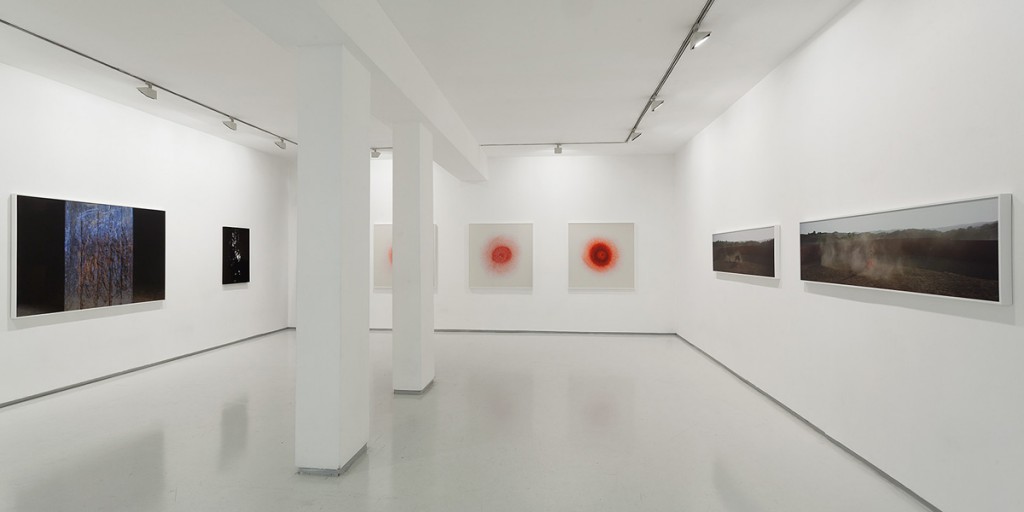
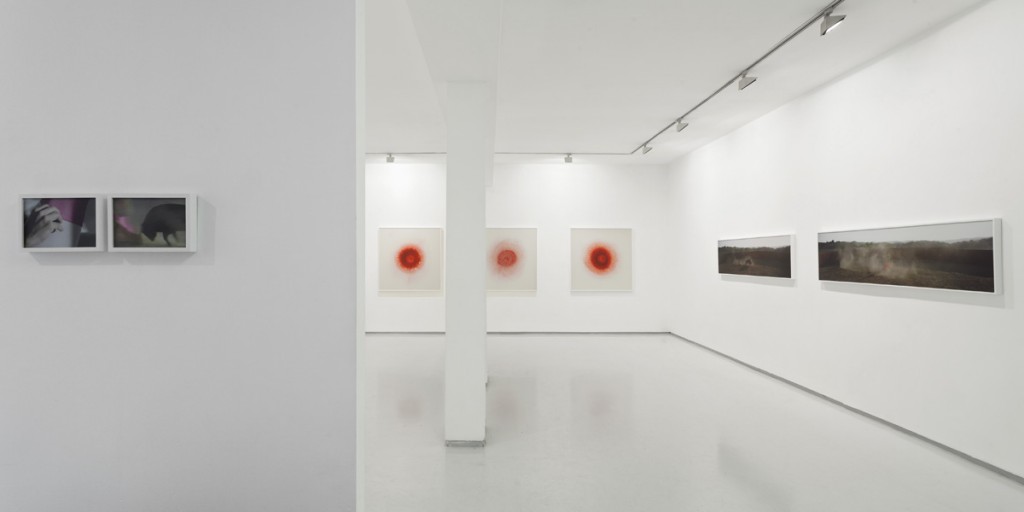
All Will Come to Pass, Exhibition view, Noga Gallery of Contemporary Art, 2013
Cell 3, Archival Ink Print, 120x180cm, 2012
Reflection, Archival Ink Print, 60x84 cm, 2012
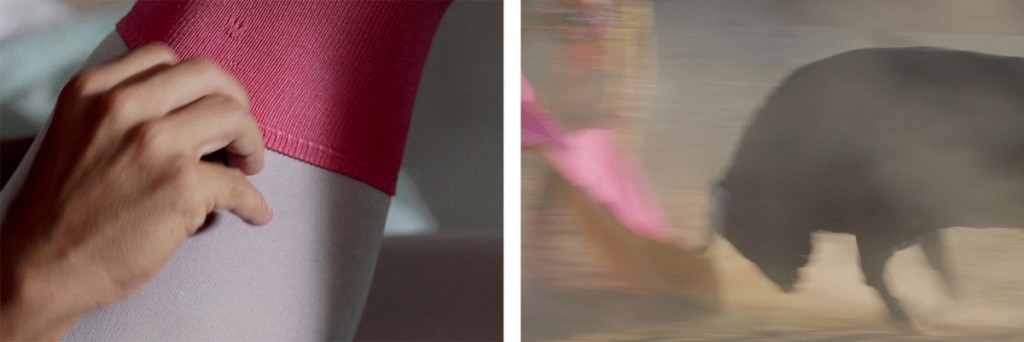
Dressing, Archival Ink Print, Diptych, 17x25 cm, 2012
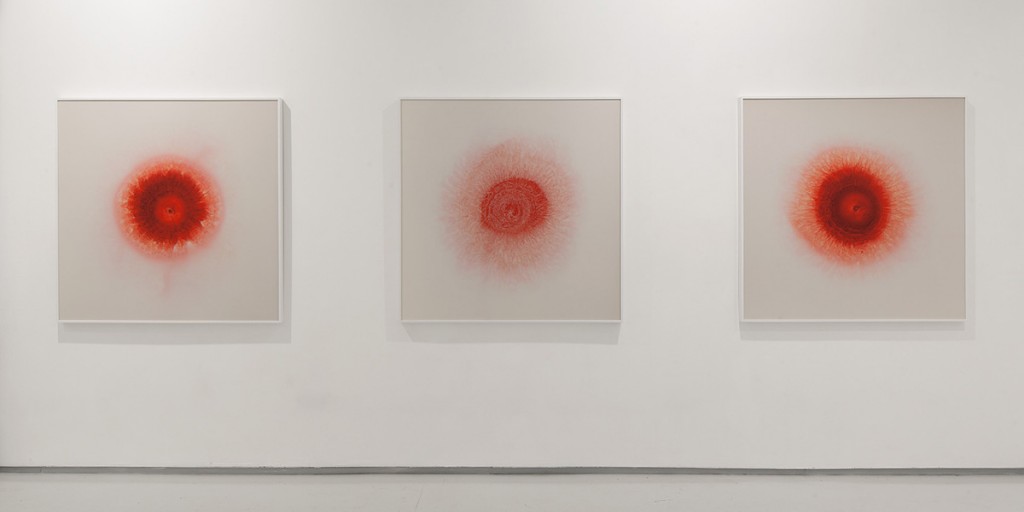
Love Me Love Me Not 2, Archival Ink Print, 120x120 cm, 2013
Liquid Assets
Emergence 1, Archival Ink Print, 50x192 cm, 2012

In All Will Come to Pass exhibition, Ori Gersht will premier in Israel a new body of work consisting of three collections of photographs titled: Offering, Love Me Love Me Not and Cells, as well as a HD film titled Liquid Assets.


In addition to the exhibition at Noga Gallery, Ori Gersht will hold a comprehensive solo exhibition at the CCA Tel Aviv. This exhibition will include three large scale film installations: Offering, Will you Dance For Me and First to Laugh.


The photographic series titled Offering was created during the artist’s visit to the Andalusia region of Spain in 2012. The photographs capture a matador’s meticulous spiritual and physical preparation, portray the bull’s holding pen, and finally bear witness to the encounter between man and animal.  As in previous works, Gersht considers private and collective histories. The photographs simultaneously inhabit spaces of volatility and harmonious elegance.


Spain established their modern bullfighting tradition in the early eighteenth century. A highly ritualized event, an impeccably adorned matador baits a bull with a cape, drawing the animal in and out and around the bullfighting ring. The event most often culminates in the bull being slain.


Bullfighting images are simultaneously seductive and repellent, vital and deadly. As primal as bullfights are, a sense of beauty is captured in its ritual, tradition, and in the continuation of its practice throughout Spain in the same way. However due to recent legislation, bullfighting is on the verge of disappearing and Gersht’s photographs therefore become a form of epitaph, a testimony to the temporal nature of tradition and cultural identity.


In this body of work Gersht continues his dialogue with the history of painting. Without taking a moral stand, the images converse with a long artistic tradition of religious iconography. Through contemporary and historical juxtapositions the photographs present a timeless space, a space that cannot be anchored, a space that hangs forever between past and present, between art history and contemporary practice.


Unlike the bullfighting images, the series Cells, 2012 depict the holding pens in which bulls are held before they are released into the ring.


The pens are considered formally and the three-dimensional aspects of these spaces are virtually erased, as the surface qualities are graphically emphasized. What becomes apparent about these holding areas are the bull’s reaction to them, as one can imagine the anxious animals ramming into the wood and mortar walls, scratching and cracking the surfaces and drawing blood as they seek to release themselves from the confined enclosure.


In relation to the photographs of Bullfighting, Gersht will present in the gallery new prints from the series Love Me Love Me Not, 2013. These photographs actively resist identification. They are highly abstract, appearing alternatively as miniature flowers or as mandalas, metaphysical or symbolic representations of the cosmos. Using a high definition camera, Gersht captures a drop of blood as it disperses through milk. Initially the blood appears as a black puncture hole, growing symmetrically and gradually outwards. It becomes a deep red as it pushes away from its inception, transforming into a pale pink before the two fluids coalesce into a single entity. The purity of the milk is at odds with the blood, an aggressive contaminant. The Love Me Love Me Not works refer to a religious or maternal heritage, to a start or a beginning that hovers beyond the image. Informed by these veiled histories, Gersht sees recollections of violence through a lens of quiet subtlety.


In the upper gallery, Gersht will present the HD Film Liquid Assets 2012, that was commissioned by the Museum of Fine Art in Boston for the exhibition History Repeating, a mid career survey exhibition that presented Gersht’s work at the museum earlier this year. In the film, what appears to be an ancient Greek coin from the museum collection gradually melts, slowly transmuting the portrait of Euthydemos II, king of Bactria. As if aging, he begins to crumble and disappear. This struggle between nature and culture, between the human hand that created the object and the natural mineral of which it is made, is fierce and continuous. Like the image of Christ on the Shroud of Turin, the face refuses to fade away. As the metal turns to liquid, ripples and waves form rhythmic patterns. Gersht associates this physical transition with the medieval efforts to alchemically transform base metals into noble ones, such as silver and gold. However, since coins have always been the most universal embodiment of currency, and have hardly changed for over two and a half thousand years, he also identifies this ancient coin with the beginning of our economic system, when cash was exchanged for commodities. Today we are at the end of this era, as coins become more obsolete and transactions almost entirely abstract.

**
Ori Gersht was born in Tel-Aviv, Israel in 1967. He received his BA from the University of Westminster, London (UK) and his MA in Photography from the Royal College of Art, London (UK). He lives and works in London.


He has previously been the subject of solo exhibitions the Museum of Fine Arts, Boston, The Imperial War Museum, London (UK), The Tate Britain, London (UK), The Tel Aviv Museum of Contemporary Art, Jerusalem (Israel), The Santa Barbara Museum, The Hirshhorn Museum and Sculpture Garden, Washington DC, The Jewish Museum, New York, The Yale Centre for British Art, Connecticut, and the Gardner Arts Centre, Brighton (UK).


Gersht is included in the public collections of the British Council, London (UK), Deutsche Bank, Government Art Collection, London (UK), the Hirshhorn Museum and Sculpture Garden, Washington DC, the Imperial War Museum, London (UK), The Museum of Fine Arts, Boston, The Israel Museum, Jerusalem (Israel), The Jewish Museum, New York, the J. Paul Getty Museum, Los Angeles, the Knoxville Museum of Art, Knoxville, the Los Angeles County Museum, Los Angeles, the San Francisco Museum of Modern Art, San Francisco, the Santa Barbara Museum of Art, Santa Barbara, the Solomon R. Guggenheim Museum, New York, The Tate Britain, London (UK), the Tel Aviv Museum of Art, Tel Aviv (Israel), the 21C Museum, Louisville, and the Victoria and Albert Museum, London (UK).

Works from the Gaby and Ami Brown Collection

Joshua Borkovsky / Works from the Gaby and Ami Brown Collection

Opening: 21/06/2013   Closing: 02/08/2013

Works from the Gaby and Ami Brown Collection, Exhןbition view, Noga Gallery of Contemporary Art, 2013
Works from the Gaby and Ami Brown Collection, Exhibition view, Noga Gallery of Contemporary Art, 2013
Mixed Media, 111X83 cm, 2011
Pilgrimage, Mixed media and a gold leaf on fabric, 50x50cm,1985-1986
Untitled, oil and grafit on fabric, 142.5x142cm, 1985
Dream Stones, 40 cm
Untitled, Tempura and gold leaf on gesso on wood, 40x80, 2002

This exhibition of early works by the artist Joshua Borkovsky, all from the Gaby and Ami Brown collection, is a continuation or a “coda” to his comprehensive show that took place, last year, at the Israeli Museum in Jerusalem.


Ami Brown is considered as one of the leading and most important collectors in Israel. He was a business man and an initiator which comprehended and dealt with art-collecting in a total manner. The collection includes more than 3000 thousand works gathered in a period of five decades. Brown supported retrospective exhibitions, catalogues and artists books. His perception was insightful, he had a vast library of art trough which he studied and revised art subjects. He lived through art and was enclosed by it.


Borkovsky’s work predominantly features phantasmagoric imagery, such as the silhouettes of sailing ships, cartographic and geometric images. This preoccupation yielded crystal chandeliers reflected in mirrors as well as anamorphic photographs of gardens and recent cycles; Echo and Narcissus and Vera Icon.


The iconic characteristic of Borkovsky’s work calls to mind the voyage towards the deepest primordial craving of the sub-conscious. The miniaturization of the expanding and distancing movements on the pictorial surface makes viewing it like peering through a small window for traces of territories and objects which have already vanished from the range of vision.


The images disappear from their point of derivation in a way that divests them even more of their identity.


Borkovsky directs the viewer to a different mode of seeing which distinguishes itself as being ²different² from a direct visual perception of the world. It demands the viewer’s active presence and concentrated observation, leading him, paradoxically, to question seeing and to doubt the truth in what was reflected.


Borkovsky paints using traditional tempera technique, as traces of an ancient artistic tradition.


This gives his work an iconic quality, while designating it as a medium of memory an objectless and abstract sub-conscious realm.


Joshua Borkovsky was born in Israel, 1952. He studied at the Bezalel Academy of Art where he teaches as a senior professor. Since 1979 he showed in 15 solo exhibitions. His work was displayed in exhibitions, such as; 12 Biennale de Paris, Musee d’Art Modern de la Ville de Paris in 1982, Israel Museum, Jerusalem in 1987, 42 Venice Biennale, Italy in 1986, 12 Biennale of Sao-Paolo, Brazil in 1991 and In Between, Ein-Harod Museum of Art in 2005. Recent Group exhibitions include; Love at First Sight, The Vera, Silvia and Arturo Schwarz Collection of Israeli Art, The Tel Aviv Museum of Art in 2000, Culture and Continuity, The Jewish Museum, New-York in 2002.


Last year he had a solo exhibition; Veronese Green, Paintings 1987 – 2012, at the Israeli Museum Jerusalem. Since 1998 he showed 4 exhibitions at In Noga Gallery.


Joshua Borkovsky has received numerous prestigious awards, amongst them; the Janet and George Jaffin Prize for Excellence in the Visual Arts, America-Israel Cultural Foundation in 1998 and the Ministry of Education and Culture Prize in 2004, Dizengoff Prize for Painting 2013.


Tigers

Jossef Krispel / Tigers

Opening: 25/04/2013   Closing: 14/06/2013

Tigers, Installation view, Noga Gallery of Contemporary Art, 2013
Untitled (Aladin Sane), oil on canvas, 60cm diameter, 2012
Untitled 2 (Picasso raising hands), filled, oil on canvas, 81x65cm, 2013
Untitlled (Diamond masks), Oil on Canvas, 145x175cm, 2013
Uuntitled (David), oil on canvas, 65x54 cm, 2013
Untitled 2 (David), oil on canvas, 65x81cm, 2013

Painting is a Made-Up Canvas


Hung on the wall of Jossef Krispel’s studio is a medium sized painting with the words: Make-Up in print, erased with an elegant brushstroke, and beneath it, as if a handwritten correction, the word: Made-Up. A cosmetic correction. Both phrases have the same meaning: manipulations made to conceal the truth and conceal the face: make-up, mask, fake (as well as: fictional, invented, fabricated). Against the walls lean paintings of David Bowie’s made up face, “the artist with a thousand faces”, who changed identities and musical styles at a breakneck pace. Fernando Pessoa, who in his writings hid behind seventy different persona’s (several of them had names and fictional biographies), said that masquerading means knowing yourself, and “What a great happiness not to be me”. In his song Quicksand (from the album Hunky Dori) Bowie sings: “Don’t believe in yourself, don’t deceive with belief”. What or who hides behind David Bowie’s thousand masks? A virtuoso musician and performer, who’s constant motion does not allow closing in with a label or finite definition, or rather a charming charlatan, empty and lacking in emotion, who juggles and deceives with his changing sexual identities?


The painting is a made-up canvas. Make-up is a mask made out of brilliant colors. On the table in the studio, near the easel lie many dozens of paint tubes, organized in lines: I count as many as twenty different greens. As well as reds, blues, flesh hues and yellows from the most highest quality and the most expensive brands: Old Holland, Gamblin, Williamsburg, and even Schminke, colors manufactured in Germany and not sold in Israel (incidentally the name in German means Make-up). The craft of the painter is that of a make-up artist, and vice-versa. The make-up artist is a painter whose canvas is the object of his observation. A thin layer of paint, flat and glittering, is laid upon the canvas with the same tools that serve the make-up artist (recently Krispel has begun painting with paintbrushes that were not meant for oil paint at all, gentle paintbrushes that bring to mind make-up brushes). The depth of the color is as deep as the make-up. If the painting is a made-up canvas/mask, then  what is the true face of the painting? The naked canvas? And how odd it is that the word Fabric is the base for the word Fabricate, meaning to invent and concoct.  And indeed, lies and fables are woven like fabrics. At its best – painting  is illusion. The face of the painting is that of a mask, which it chose to wear.


Of Dionysus, the Greek god of mask and theater, it is told that whoever saw the true face underneath his mask would die or go mad. The moral of the story being: a mask enables viewing the “face”, and we shouldn’t try to uncover what lies behind masks. And in answer to the question on Bowie: David Bowie is the sum of all his masks. There is no other Bowie, or a real, authentic Bowie behind the masks. And Pessoa did not “hide” behind seventy personas. Pessoa is composed of those seventy personas.


Jossef Krispel’s paintings are made Alla Prima, meaning paintings that are created in one session, one shot. Even when the remains of a previous painting peek out from beneath a layer of paint, it is a previous painting that was rejected and covered with a new one. In French this technique is called Premier Coup, meaning a painting in the “First Strike”, the first try. The quick painting is perceived here as an action that has the air of primacy, a display of power and perhaps even violence. This action is habituated and very stylized. I think of a swordsman dancing in front of the canvas, battling it and scathing it with a long and pointy tool, with measured and exact movements. Indeed, Krispel’s painting is a performative painting, a painting that documents and reflects a body in a quick and vigorous, yet stylized and exact physical motion. It is painting that reveres the virtuosic. The language of painting Krispel uses creates breathtaking spectacles of gleam and perfection. This is not a painting of searching, indecision and a multilayered concoction, but a painting of a quick sleight of the hand, that ends as if magic in a complete and convincing image. As a rule, virtuosic painting attempts to distance itself from the finality and humanity of the painter. A painting of this kind does not manifest signs of effort and exertion. This casual appearance requires tremendous effort from the painter, yet is not to be revealed to the viewer. The virtuosic painter should be quick, viral and seductive.


Some of the greatest virtuosos- Frans Hals, Boucher, Tiepolo, Watteau, Fragonard … but also Picasso, Manet, Warhol and Richter – are painters with self confidence, lacking complexes or existential melancholy. Their paintings occur as if magic before the viewers wondering eyes. Vital and sensual, as if asking to outwit death with their eternal youth, knowing full well that incidentally the jeering grin of death, which treats all this shallow and glittering beauty as the beauty of a flower, that by the end of the day will wither and wilt,  is reflected and stamped upon them. The excess effort for vitality and freshness creates the opposite effect. I recall the blood curling screams of the peacock in his most magnificent moments.


There is some of the Dionysian in the virtuosity with which David Bowie plays around with his characters, sexual identities and colorfulness. Because of his constant changes and transformations Dionysus is also considered the god of metamorphosis. Bowie, as a sphinx on one of Krispel’s canvases, is a metamorphosis of the hybrid essence: Half man (feminine, heavily made up), half dog. Picasso, Warhol and Richter (artists Krispel is in continuous dialogue with) have demonstrated through their careers how to reinvent yourself whenever you wish; the liberty to strip off or wear different shapes, to deceive those following you and to deny any possibility for one authentic identity. They have changing identities so as not to become a stylized and familiar brand. The freedom to paint a painting that is impersonal and synthetic denounces the option of a “natural” painting with an individual handwriting. This may be the reason why for a long time, painters have avoided signing the surface of their painting: as the signature might give in their hand writing and personal temperament.


On a second glance, I notice that the painting with the Make-Up / Made-Up inscription seems as a paraphrase to an early Ed Ruscha. I also remember that when Ruscha painted his first “inscription” paintings, he wished to assimilate Jasper Jones.


The history of painting is as that of a masquerade, taking place in a baroque mirror hall, where everyone is reflected into each other, countless times.

What the moon saw

Alexandra Zuckerman / What the moon saw

Opening: 14/03/2013   Closing: 19/04/2013

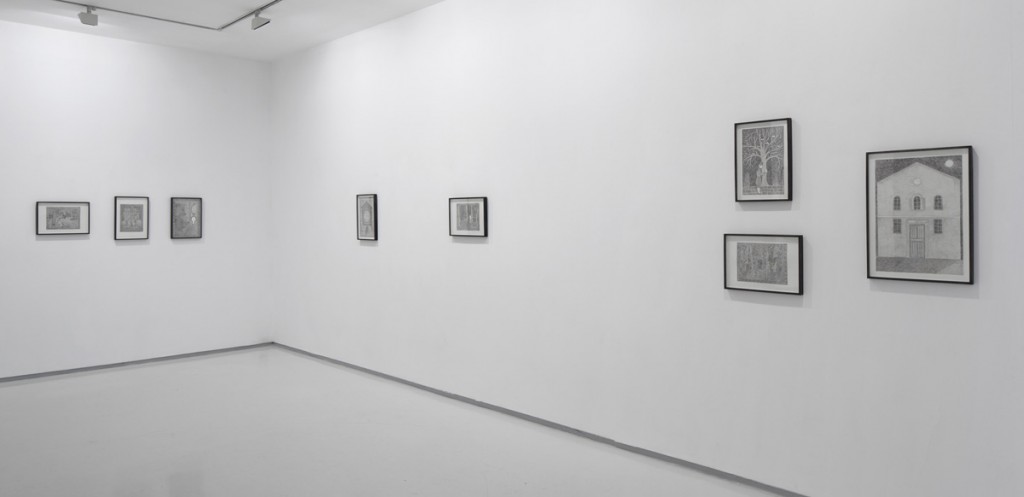
What the moon saw, exhibition view, Noga Gallery of Contemporary Art, 2013
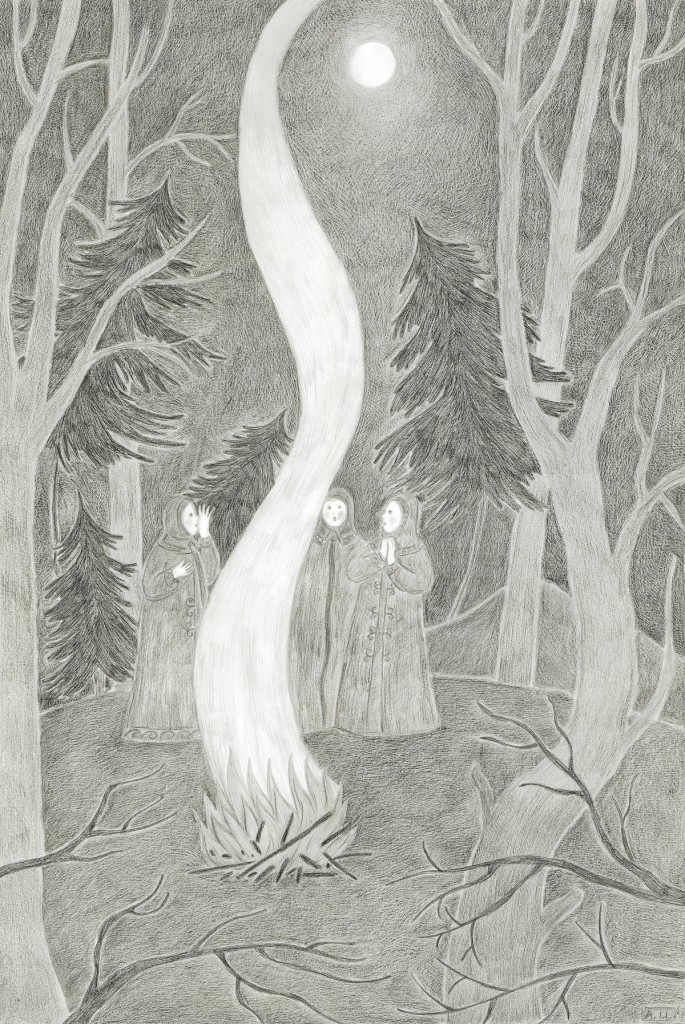
Smoke, Pencil on paper, 59.4x42cm, 2012
House number seven, Pencil on paper, 42x29.7cm, 2012
Goat crying at the window, Pencil on paper, 42x29.7cm, 2012
Girl meets bear in the woods, Pencil on paper, 42x29.7 cm, 2012
Hole, Pencil on paper, 119x84 cm, 2012
Bears looking through a hole, Pencil on paper, 42x29.7cm, 2012

A series of new black drawings are exhibited in Alexandra Zuckerman’s new exhibition. The scenes constructed in them seem perhaps as a fairy tale, or perhaps threatening, whilst moving in the space between memory and wistfulness. What has the Moon Seen, asks Zuckerman, and spreads before us what may be seen, furthermore, she points out what may only be glanced at. Opaque doors, closed spaces, a keyhole and forest animals concealed in spaces or performing on a stage, all these are exhibited in the same joyless bacchanal.


Zuckerman draws from the world of Russian fairytales she heard as a child and intentionally interweaves it with influences from the world of Russian animation and illustration. The drawings themselves deal to a large extent with the appearances; they seem as toiling work of engraving, yet they are not. The flatness is their guiding principle. Each seemingly illusionistic space reminds us that we are in a display of sorts, that there is a stage before us, a play, an amusement meant for our eyes alone. Zuckerman reminds us that the secret, if indeed exists, lies elsewhere. The moon – that sees all – is in fact the one that is seen, subjected to the gaze. The moon, just as the eggs and the feminine-childlike body, is the empty space in the drawing that overcomes the fear of space that rediscovers the impossibility, magnificent in itself, to devise a fairy tale.


Alexandra Zuckerman was born in Moscow in 1981, an immigrated to Israel at the age of ten. She graduated from her studies in the Bezalel art academy in 2006, and received an award for excellence from the Department of Fine Arts, Bezalel. She was also awarded the Sharet scholarship from the America-Israel Culture Foundation. Zuckerman has exhibited a solo exhibition in the Noga Gallery project room, in Christian Nagel gallery in Berlin, in the “Open Space” sector in the Cologne art fair, where she represented the Christian Nagel Gallery, and in several group exhibitions in Israel and abroad.

Moon Walks

Matan Ben Tolila / Moon Walks

Opening: 24/01/2013   Closing: 08/03/2013

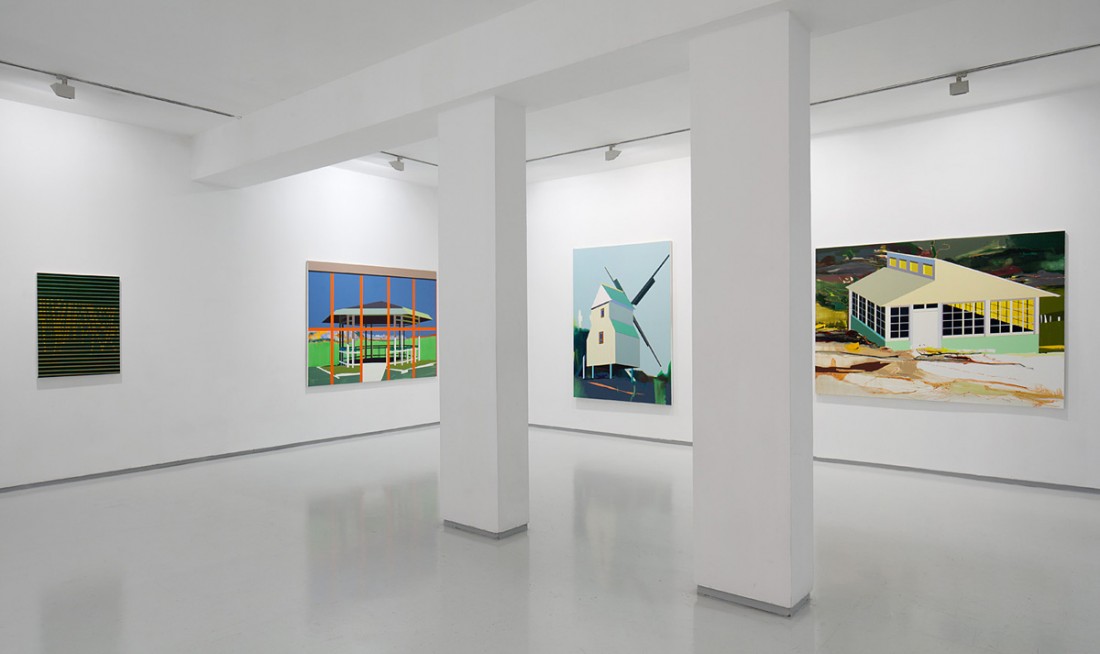
Moon Walks, Exhibition view, Noga Gallery of Contemporary Art, 2013
Windmill, oil on canvas, 190x140cm, 2012
Blue gate, oil on canvas, 115x95cm, 2012
Two moons of autumn, oil on canvas, 150x105cm, 2012
6 boxes, oil on canvas, 135x200cm, 2012
Ribbons in the wind, oil on canvas, 45x51cm each, 2012

Noga Gallery is happy to show the first solo exhibition of Matan Ben-Tolila.


Matan Ben-Tolila paints mental landscapes, as though they were exterior landscapes. He tantalizes our eyes with familiar and tangible objects, yet places for us un miss able tracks of illusion and riddle, a labyrinth, as though explicitly telling us: The image before you is in my mind and in your mind only.


A landscape stretching out, not a single soul appears. An empty space, with no possibility to place anything within it. An open and lit house – no one comes or goes, its entrances and exits are blocked. A mountain in the distance, no trail leads to it. Distant sceneries fading and collapsing into themselves. The meticulously drawn structures hold no substance, their walls do not connect to one another, and their spaces contain nothing. There is no door to enter through. There is no window to look out from.


For a moment he deceives us with colorfulness, in clean and clear lines, we are swiftly invited inside, to sit in the “Gazebo” and restfully ponder. Yet it then becomes apparent to us that the path leading up to it is blocked by a white unpainted area, an empty canvas that the artist’s hand chose to leave untouched. A momentary illusion will cause us believe that the billowing sheet in “Two Moons of Autumn” – on it are painted what seem to be perhaps moons, perhaps eyeballs – is an invitation to an exotic journey, a hedonistic search after a perfect beauty. But these two moons lead us to the ironic haiku song:


Press your eyeballs And there you have two moons of autumn [1]


If you search for beauty, search for it within yourself. Do not turn your gaze outside, to the scenery surrounding you, but press your eyes and materialize the beauty within you. Will you be willing to pay the price of pain that is entailed in pressing the eyeball? Is the search for beauty, color and magic not doomed to be a painful and agonizing process that compels us to close our eyes to the true reality that surrounds us?


In the painting “Blue Gate” we are left wondering in front of a childish playground, its simple colors and shapes show a fleeting illusion of childhood, an illusion that quickly fades while facing the two eyeballs, looking at us silently like two full moons. The metal gate threatens to turn into a guillotine before our very eyes, while they linger for another glance.


The moon, its beauty illuminating the night, does not shine its light from within itself, but is irradiated by the light of the sun. In itself it is opaque and impenetrable.


The paintings in the exhibition are full of light and color, a colorful palette, an almost “Pantone” color scale, colors hinting at the industrial and artificial. A palette that deliberately veers as far as possible from natural coloring. These colors are the making of the artist, painting a world where all the outlines and joints are his making. A creation entailing toiling preciseness, meticulous thoroughness, as though a carpenter or an expert metal worker – the making of a master craftsman.


Moon walking, the iconic treading of the astronaut walking on the moon, touching the ground, and leaping back off of it, their weight is no longer weight, their step is no longer a step. Moon walking, as Michael Jackson’s dance moves, is a deceiving walk, steps that repeat themselves with a misleading ease, where feet graze the ground, hover over it, hardly touching.


The act of painting wishes to assimilate the moon walk. To be laid on the canvas as though not painted but projected on it, as though it’s light and colors do not come from within itself, but from the gazing vision of the painter. The gaze will disappear and with it the sights, the colors and the structures.


And we, the viewers, standing between the painter’s eye and the image projected on the canvas, can only leave but a shadow of our figure; and just like it, will fade with the disappearance of the last rays of light and the disappearance of the gaze.


Tzila Hayun – creator and curator of interdisciplinary culture programs.

———————–
Matan Ben-Tolila was born in 1978, Kibbutz- Yavne.  Graduated his studies in the Bezalel Art Academy in 2006, and the Bezalel MFA program in 2010.


Ben-Tolila has exhibited in many group exhibitions, among them “Shesh-Besh” in the Petah-Tikva museum, curated by Hadas Maor. In the Lincoln center in New-York, Mani House in Tel Aviv, and more. He was twice awarded the Excellency award by the America Israel Culture Foundation, and was awarded the Presser award for Excellency in painting by the Bezalel Academy.


Circles of Time

Nogah Engler / Circles of Time

Opening: 14/12/2012   Closing: 19/01/2013

Circles of Time, Exhibition view, Noga Gallery of Contemporary Art, 2012
White night, oil on canvas, 150x120 cm, 2012
White night, oil on canvas, 149x163 cm, 2012
Belongings 5, oil on board, 60x80 cm, 2012
Belongings 4, oil on board, 60x80 cm, 2012
Fading shadows 1, oil on canvas, 60x80 cm, 2012

Nogah Engler: Ashes on the Tuileries Gardens


In the opening pages of The Rings of Saturn, WG Sebald recalls his late university colleague Janine’s passion for Gustav Flaubert, who she felt epitomised all that is great about the nineteenth-century French novel, with its predilection for obscure detail over intellectual hubris. As regards detail, Flaubert was, according to Janine,obsessed with sand and its capacity to conquer everything. He was crippled by phobias about his writing and the world around him, the effect of which he likened to sinking into sand. Sebald quotes Janine: ‘…vast dust clouds drifted through Flaubert’s dreams by day and by night, raised over the arid plains of the African continent and moving north across the Mediterranean and the Iberian peninsula till sooner or later they settled like ash from a fire on the Tuileries gardens, a suburb of Rouen or a country town in Normandy, penetrating into the tiniest crevices.’1 Flaubert’s poetic vision of a grain of sand, travelling across continents to fall by beautiful coincidence on the elegantly manicured Tuileries gardens in Paris, resonates strongly with Nogah Engler. In that vision, Flaubert pits the natural against the manmade, chance versus order. The analogy between sand and ash from a fire adds a morbid note: the idea of burned matter surreptitiously invading our everyday surroundings, of the dead mixing with the living. Indeed, Flaubert’s quote is given greater poignancy when we remember that, between Sebald writing notes for his book while recuperating in hospital (from some unspecified condition that he puts down, in part, to ‘the paralysing horror … when confronted with the traces of destruction, reaching far back into the past, that were evident even in that remote place’2) and his assembling them a year later, Janine had died – and this not long after her close friend’s (another university colleague) sudden death.3 It is as if a shift has occurred during these recollections, and Flaubert’s fears have come to represent Sebald’s.


As with Flaubert, Engler’s paintings and drawings draw power from the tension between their surface beauty and an underlying sense of ominous disquiet. If she continues to use the forest as a motif in her recent paintings, its fairy-tale seductiveness is always undermined. Trees are barren, with dark, mostly branchless trunks that show possible signs of having been scorched. Engler’s close cropping of her horizons that leaves very little sky visible – no guiding sun or moon – contributes to a feeling of being trapped in the scenes. I am reminded of the landscape in Cormac McCarthy’s apocalyptic novel The Road, in which nature takes on the allegorical qualities of despair and brutality: trees are described as ‘limbless’ and, in an extreme version of Flaubert’s dust clouds, ash has covered the entire country. ‘Barren, silent, godless’4 is how the boy describes the scene before him in the opening sequence.


Engler exploits the classic technique of chiaroscuro to juxtapose areas of dark, impenetrable shadow and swathes of eerie, bleached white that suggests, in Emergents most strikingly, that we are looking at the aftermath of some mysterious, destructive force (A fire? A bomb? An act of God?).  Yet the stark effect is always


softened by the addition of warm flesh tones and muted pastel shades in grey-blue and green. As well as the forests, Engler’s new paintings contain a number of more abstract scenes, which, for the purposes of this essay, I’ll call ‘interiors’, although their lack of explicit, real-life reference points implies that these are allegories – interiors as metaphors for psychic space. In some of the interiors, such as Belongings 4 and The corner (all works 2012), the pink skin-tones dominate as if channelling the sensuous Rococo excesses of, say, Boucher. Yet there are no lusty nudes here, no people, only the remnants of civilisation. Beauty, for Engler, has lost its innocence. It is no longer possible to re-create the idealised forms of beauty that have dominated Western art history. Instead, she collages passages of beautiful landscape from the heydays of the Renaissance and Romantic eras, which she borrows from the masters of the genre – Lucas Cranach, Bruegel the Elder, Leonardo Da Vinci, Caspar David Friedrich – as if beauty can only be quoted rather than directly represented. Yet Engler is compelled to sully even these quotations: by patches of over-painting or by adding her own passages of tangled abstraction into which figurative elements collapse or become fragmented into a Cubist kaleidoscope of entropic matter.


There are few signs of life in Engler’s work, other than the occasional glimpse of a deer or bat, or an unexpected burst of new vegetation poking through the forest soil in an otherwise inhospitable landscape. Instead, we find traces of ruins, shells of buildings just glimpsed among the trees (Emergents and Hole in the fence) or, in the case of the interiors, empty rooms or shelters where the barrier between inside and outside has collapsed – trees grow among the stacks of objects in Belongings 2 and Belongings 3; one of the walls is missing in Belongings 4, as if to suggest an open stage-set.


If the animals and new shoots symbolise the cyclical forces of nature, the ruins likewise have their own cyclical logic: they remind us that all human activity will eventually fall into ruin, and that all ruining will be followed by re-building or new growth. As Brian Dillon points out in his ‘Short History of Decay’, the introduction to his edited volume of essays on ruins: ‘The ruin, despite its state of decay, somehow outlives us.’5 What is significant about our recent times is the speed at which ruins are created compared to the centuries it took for classical ruins to reach the aesthetic state that came to be so appreciated in Western art. Two world wars accompanied by technological advances in military equipment, together with low-cost, flimsy architecture have created the sensation of an accelerated mode of decay. ‘We live now, though we might say that we have always lived, in a time of ruination,’ writesDillon.’6


Rebecca Solnit, included in Dillon’s volume, makes the connection between ruins and memory: ‘Memory is always incomplete, always imperfect, always falling into ruin; but the ruins themselves, like other traces, are treasures … our guide to situating.


5 Brian Dillon, ‘Introduction: A Short History of Decay’, in Brian Dillon (ed.), Ruins,Documents of Contemporary Art, Whitechapel Gallery and MIT Press, London, p. 116 op cit, p. 10


ourselves in the landscape of time.’7 She cautions against attempting to erase those ruins (as she claims America does), which would be to ‘erase the visual public triggers of memory; a city without ruins … is like a mind without memories’.8 Indeed, in Engler’s paintings, ruins are not memorialised or torn down but left to rot. They become skeletal, ghostly, but are never totally absorbed by the surrounding nature. Like memories, they never disappear but continue to haunt even as they grow less tangible.


Returning to Sebald, Engler is drawn to his skill at mapping the complex web of individual and collective memories, at recording how the trauma of historical events (particularly those of twentieth-century Europe) have left their marks on all our lives, whether directly or indirectly. As we saw earlier, it is extremely tricky to paraphrase Sebald: as soon as you try to explain a passage of his writing, you realise how far you need to re-wind in order to make sense of it. In his books, voices and time-frames shift constantly and become entangled in a cumulative knot of coincidences, memories and histories; everything is connected, everything has consequence. The title, The Rings of Saturn, is typically Sebaldian: it relates to the fact that the frozen crystals and meteorite particles that make up the planet’s rings are actually ‘fragments of a former moon that was too close to the planet and was destroyed by its tidal effect’.


Likewise, Engler’s paintings are difficult to fully apprehend at one glance: in some, the large scale is such that the edges fall into our blind-spot; in others, paths in the landscape (as with Passing through) seem to lead us in different directions, to lose us in the forest. There is no fixed focal point; our viewpoint is continuously fragmented as in a dream or fractured memory. Moreover, it takes a while for all the elements (Flaubert’s obscure details) – a bat, a building, a suggestion of a figure bending down but which may just be a piece of old cloth – to reveal themselves in among the different strata of the painting. Could we be looking at different topographical layers, or different moments in time represented simultaneously? In the interiors, framed images within the work could be variously interpreted as paintings, placards, mirrors, panes of glass or portals into another time or place. Sometimes, there are recognisable glimpses of quotes from Western art history – a section of a Roman frieze and a Poussin painting in Belongings 4 – but mostly there are only suggestions of figures or landscapes in the same way that she offers suggestions of previous events or traumas. As Engler says, her intuitive approach, continual layering and fragmentation produce suggestions of definitions.


In Sebald, memories are reported not just first-hand by the author or second-hand by his acquaintances, but third-or even fourth-hand as these acquaintances recount other people’s stories. In this way, memories are kept alive but mutate and become tainted with others’ agendas as they become increasingly disengaged from the original source. Holocaust survivor Primo Levi knew only too well the dangers of the mutant nature of memory when he wrote in The Drowned and the Saved, his last book: ‘The memories which lie within us are not carved in stone; not only do they tend to become.


Rebecca Solnit, ‘The Ruins of Memory’, extracts from Storming the Gates of erased as the years go by, but often they change, or even increase by incorporating extraneous features.’10 In Sebald, all paths eventually return to thoughts and memories of exile and the Second World War, whether walking along the east coast of England in The Rings of Saturn, or meeting fellow exiles in The Emigrants, or, like the protagonist in his last fictional book, Austerlitz, following a trail of photographs for clues to his family’s past. Like Sebald, Engler is compelled to revisit her family’s tragic history during the war, the trauma coalescing around one particular site that recurs in many of her works; either literally as the dense, brooding forest or abstracted into the psychologically charged interior scenes.


The forest echoes the landscape around the village of Kosov in what is now Ukrainian Galicia, where her father, grandfather and uncle hid for two years and eventually escaped the Nazi occupation of the area during which thousands of Jews were murdered, including her grandmother. Engler eventually went to track down her family’s hiding place in 2005, relying only on word-of-mouth recollections. Having built up the place in her imagination through a lifetime of being told about it, she was surprised by the reality she found: it was visually less dramatic (the mountain was not as dominant as she imagined), and life seemed to go on there as if nothing had taken place only one generation ago. How could people, so apparently hospitable, have been party to such barbarism? That duality of human nature, the propensity for man’s inhumanity to man (a constant preoccupation of Levi’s, too), finds its visual equivalent in the dichotomies present in all Engler’s paintings: beautiful/bleak, light/dark, nature/manmade, interior/exterior.


Engler’s vision of Kosov is not only mediated through other people’s memories, her own imagination and later experience, but also through art history and photography. With hardly any family photographs of the area, Engler’s imagination had been free to fill the visual void. But the fact that she took 600 photographs during her visit suggests that it was somehow impossible – too late – to compensate visually for the earlier void. It is tempting to see those areas of light and dark in her work as the painterly equivalents of photographic over-exposure or under-exposure – the failure of photography to adequately capture reality or memory.


Engler works through the problem of memory through the difficulty of its visual representation, both on the level of an individual trying to find an image or visual locus for a traumatic family event, and, on a wider, philosophical level, as a means of sharing experiences collectively and empathetically. Her paintings often contain traces of an underlying geometric or grid structure that provides an illusion of order. In the landscapes, a grid is created through the deployment of linear, leafless trees that act as symbolic markers of depth and space. In the interiors, order is created through the arrangement of existing infrastructure and objects – like corners, rugs or panes of glass – or the introduction of a geometric shape like the semi-circle that bisects Belongings 1 and neatly contains all the elements below it (an idea borrowed from one of Rembrandt’s last self-portraits, Self-Portrait with Two Circles, 1665-9). These grids suggest the process of mapping: not just geographical space or the changing of scale, but – as Sebald tries to do with words – the process of translating memory into
10 Primo Levi, The Drowned and the Saved, Abacus, London, 1989, p. 11 another, more fixed, concrete form. Engler talks of her grids as relating to the archaeology of the painting, as if the painting were an area marked out for a dig, each square waiting to be combed, its contents exhumed. Areas of densely worked surface invite the viewer to imagine what lies beneath; the swirl of mysterious matter that dominates the foregrounds of The corner and Emergents would seem to imply that the process of excavation had already begun, that a layer had been peeled back and we were faced with its as-yet unidentified contents. In Hidden ground, a large pit appears in the middle of a clearing, at the very centre of the painting. Could it be the foundations of a new building or might it instead refer to the hiding place of Engler’s relatives? The ambiguity points to a metaphorical reading: the black hole of memory and forgetting, a pit of shame, a godless abyss or existential void. It takes a while to notice the presence of a second pit further away – a spectral double or mirage. These voids are everywhere, unavoidable, threatening to swallow us, our memories, our images. Philosophers from Heidegger to Derrida use the ancient Greek word ‘kh.ra’ to describe this type of in-between, womb-like space that is able to receive all but paradoxically defies meaning.


In Memoirs of the Blind, Derrida proposes the idea of the ruin as self-portrait. For him, the act of trying to capture one’s own image is always already an act of memory; an ‘impossible self-portrait whose signatory sees himself disappearing before his own eyes the more he desperately tries to re-capture himself in it’.11 For Engler, memory defines us. Perhaps it is not coincidental that she chose to borrow a semi-circle from Rembrandt’s self-portrait as an artist approaching old age and facing his own mortality. Although Engler never explicitly portrays the human form, her work is always an attempt to capture the bitter contradictions of being human and the final, impossible task of depicting memory.
Jennifer Thatcher is an art critic and lecturer based in Folkestone.

11 Jacques Derrida, ‘Memoirs of the Blind’, extract from ‘Memoirs of the Blind: The

Self-Portrait and Other Ruins’, 1993, in Dillon, p. 43

Video Art Manual

Keren Cytter / Video Art Manual

Opening: 25/10/2012   Closing: 07/12/2012

Video Art Manual, Installation view, Noga Gallery of Contemporary Art, 2012
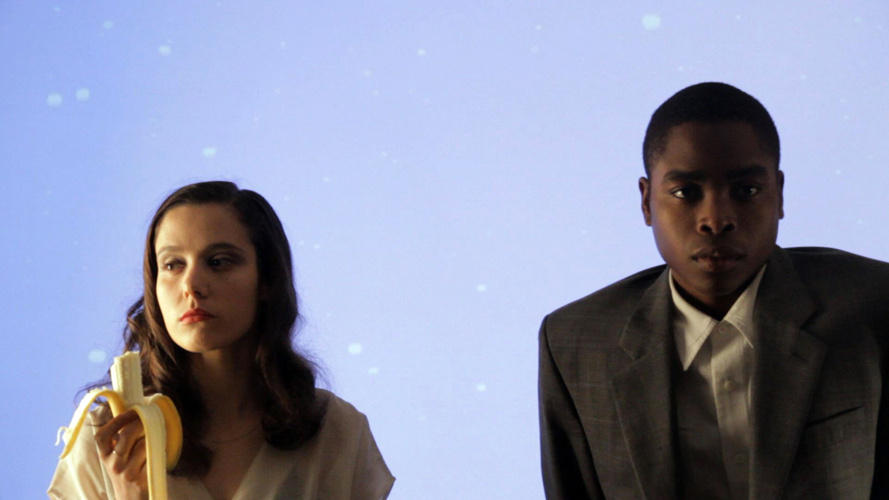
Video Art Manual, Still from video, 2011
Vengeance, Still from video, 2011

Noga Gallery is pleased to announce our third solo show with the internationally renowned artist Keren Cytter (*1977). In her exhibition Video Art Manual, Cytter presents her latest films: a premiere of three episodes from a multi-part series titled Vengeance (2012), and a film titled Video Art Manual (2011)


The exhibition’s title is taken from one of Cytter’s works Video Art Manual. In the film Cytter offers a historical analysis of video art and its development the last forty years, focusing on the conditions of how contemporary video art is produced, installed and consumed. The 15-minute work is a sardonic — and perceptive — take on video art and film, as well as their tropes, the same conventions the artist winkingly uses in her own films.


In the 3 episodes of the work in progress film titled Vengeance, Keren Cytter, who recently moved to New York, comes to terms with her own currently changing life situation. In particular, she takes up the US TV-format of the “daily soap” and processes classic themes of drama in personal relationships: love, envy, betrayal, and vengeance.


In contrast to older Cytter works such as The Date Series (2004), these new video episodes are less existential in nature and seem almost comical. What is also new about the exhibited films is their elaborate production. While previous works were often characterized by an intimate interior, Cytter stages these new episodes in the rich settings of Staten Island and New Jersey. The scenes were filmed at 15 different places, including restaurants, hotels, parks, apartments, and streets. A total of 50 actors, most of them professionals, fulfill their social functions with blank faces. They provide a projection space for the beliefs and stereotypes of each viewer.


Cytter takes up the concept of “friendenemies”, which has become popular in American soaps: two women, previously friends, get caught up in a perfidious contest in their daily office life, turning them into bitter rivals. In this conflict, both women are like puppets; driven only by the pressure of competition and the obsession with perfection. Not only the characters seem interchangeable, the story also stays intentionally superficial to grant the viewer a low-threshold access into the events. As opposed to previous Cytter films, the trivial dialogs of the series are not supplied with subtitles. The artist reviews impressions and clichés of the US American society, which have become part of our collective memory – not least by daily soaps such as Dallas or The Denver Clan. Cytter examines cut and dried patterns deeply rooted in pop-cultural visual memory and analyzes the influence of mass media on behavior patterns and prejudices in contemporary society.


The text about Vengeance was written by Natalie Keppler (translated from German)


Keren Cytter was born in Tel Aviv in 1977. She studied at The Avni Institute in Tel Aviv and received her degree from de Ateliers in Amsterdam. Cytter’s work has been featured in solo exhibitions at the Stedelijk Museum, Amsterdam; Hammer Museum, Los Angeles; Moderna Museet, Stockholm;Tate Modern, London; Witte de With Center for Contemporary Art, Rotterdam; Museum Moderner Kunst Stiftung Ludwig, Vienna; KW Institute for Contemporary Art, Berlin and Kunsthalle Zürich. Her work was included in the 53rd Venice Biennial; Found in Translation, Solomon R. Guggenheim Museum; 8th Gwangju Biennale; Manifesta 7, Trentino; and Talking Pictures and K21 Kunstammlung Nordhein-Westfalen, Düsseldorf. Cytter currently lives and works in New York.

ED

Shahar Yahalom / ED

Opening: 23/08/2012   Closing: 19/10/2012

Ed, Installation view, Noga Gallery of Contemporary Art, 2012
20x28
Untitled, colored pencil on paper, 20x28.5cm, 2012
21x30002
Untitled, pencil on paper,16.5x23cm, 2012
Untitled, ink on paper, 2012

In the exhibition: Tree incubator (Live statue), drawings, video work, and tattoo machine drawings on silicon.


Following the opening night of her exhibition Shahar Yahalom will leave for New-York, for MFA studies at Columbia University. Yahalom is the winner of the Young Artist Award of the ministry of Culture and Sports for 2012. Among other venues she has exhibited: final nominees for the Gottesdiener award exhibition at the Tel Aviv Museum at 2011. On 2009 she exhibited at the Herzliya Biennial and Art TLV.Biennial.


“…Following past exemplary shows in which Shahar Yahalom masterfully created objects and installations that corresponded with the contemporary art discourse, in her present exhibition she examines the borders of the high road of the art discourse in which she conducted herself so naturally. The exhibition ED raises the possibility of the turn towards perversion. This possibility is found in canonic aesthetic doctrines that see in the artist one to whom the law, the example or school do not constitute a barrier, but rather a leverage.


… Beyond the description of the artist’s action of drawing, the word “drawing” in Hebrew applies to different forms of drawing, such as literary notes, supply lists, or any other type of list in which something is written, jotted down, leaving a mark. In Hebrew the name of Shahar Yahalom’s current exhibition ED encapsulates within it at least two meanings of “Drawing”. On the one hand it is vapor, which is at once visible yet will soon dissipate. Similarly to the random scribbling of the grocery list that will soon be forgotten after it will be replaced with the groceries themselves. Yet it also keeps the meaning as a witness that will remember and remind of the occurrences.”


-Taken from the ED exhibition text “Five Remarks on Drawing” by Efrat Biberman.


A conversation between Nechami Gotlib and Shahar Yahalom


Question: What brought you to create an incubator for a tree?

Answer: The incubator originated as a thought of an object, a collage of ready-made objects. One of the images used as a source for the work is a photograph of the first space shuttle to land on the moon, Apollo 11. The space shuttlecraft seemed to me as a collection of junk pieces, and it wasn’t clear how such a thing managed to reach the moon. The fantasy that guided me was taking a Sycamore tree, whose origin is in North America, there is a difference in its behavior in Israel and at its natural habitat abroad, so I wanted to build it a space or “space craft” – a space constructed from many elements. The tree is physically too weak to sustain the fantasy, the incubator suffocates it rather then allowing it to live. There is use of every bit of air in the space, there is no one consolidation point. Near the tree sculpture/ incubator there is a Styrofoam sculpture that creates a sort of glacier and snow or ice flakes. Above the tree, there is a lamp that is a source of energy.


Question: The use of “ready made” in your works is new. In the previous works there was always a wish to “invent” something.

Answer: That’s right, in this exhibition there isn’t an expression of freedom in the sculptural work. In this case I didn’t want to invent, but rather to combine things, create objects that are not sculpted.


Question:  Why not sculpt?

Answer: In my previous works, and especially in the work “Raspberry Land” that was exhibited in the Tel Aviv Museum, the sculpting was very physical, erupting, grand and full of passion, abounding in creation, not taking into consideration anything besides itself. This exhibition is the complete opposite; it brings out a will to think from the other side of the ball. It’s a struggle not to sculpt. There is use of living and breathing material as the tree and the air that creates the interactions on its own – A living sculpture.


Question: And the video work “Window Over Dead Body”?

Answer: The video is a window, a diversion, the escape of a glance. This was taken in a dissection room (the room in which autopsies by medical students take place), the gaze of the living upon the dead. The gaze is constantly attracted to the light sources, the window, the light, the outdoors. The gaze is diverted to the conditions rather then the object.


Question: The work “Map” is a drawing done by using a tattoo machine on silicon surface, what brought you to this type of work?

Answer: The drawing is impressed upon the material, penetrates it, enters through it. It does not exist merely upon the surface.

Bathing Season

Group Exhibition / Bathing Season

Opening: 02/07/2012   Closing: 10/08/2012

Orit Raff, Untitled, lambda print, 127x152cm, 2006
07
06
05
Eti Jacobi, Untitled 13, acrylic on canvas, 100x100 cm, 2011
02
03

Bathing Season


Participating Artists:

Lea Avital

Eti Jacobi

Orit Raff

Shirley Shor

Shahar Yahalom

Natalia Zourabova

Alexandra Zuckerman


At the end of the bathing season “there is a suffocating smell from afar”. Does Tamuz (marking the beginning of the bathing season) hold a different promise? It seems that the works in the exhibition display a bit of both. An aura of pastorality and situations full of delight, pleasure and much beauty lingers over the pieces. Some works are accompanied by a breath of fresh air, of freedom and rejuvenation, yet at times also contain troublesome and threatening situations, hinting at danger.