Calling

Bettina Bach / Calling

Opening: 25/06/2004   Closing: 30/07/2004

(ME) CALLING, Installation view, Noga Gallery of Contemporary Art, 2004
Foto: Achim Banck
Foto: Achim Banck
Foto: Achim Banck
0001n4
0001D2

Bettina Bach has built her own universal in which the description “wordless” is of great importance. Her world is made out of harmony and peace of mind where every verbal or textual description would harm the complex-intimate atmosphere she creates. (Actual Art, Jan. 2003).


The objects that Bettina Bach uses are “simple everyday things found on the street, at the bottom of drawers, the last threads off the spool. Leftovers from the market, from around the house, the remains of memory and existence”. (Alissa Walser, Collagene Fragmente). The composition of all elements creates an atmosphere of reminiscence.


The concrete transform to something volatile, elusive. Bach is fascinated by unexpected situations which results are surprising. By unplanned process she creates a “world” full of associations; the components of installation are unified, consolidated and directed by the nature of the space.

New Works

Gilad Efrat / New Works

Opening: 13/05/2004   Closing: 18/06/2004

New Works, Installation view, Noga Gallery of Contemporary Art, 2004

Gilad Efrat – Works 2004


Its hero, Tancred, unwittingly kills his beloved Clorinda in a duel while she is disguised in the armor of an enemy knight.
After her burial he makes his way into a strange magic forest which strikes the Crusaders’ army with terror. He slashes with his sword at a tall tree; but blood streams from the cut and the voice of Clorinda, whose soul is imprisoned in the tree, is heard complaining that he has wounded his beloved once again. (1)


The exhibition is held in three spaces:
The display window: through a slit in the covered window a self-portrait painting can be seen; the main room: a group of works in various dimensions, all oil pastel on paper. The small room upstairs: three paintings, oil on linen, depicting Ansaar Prison after a photograph by Roi Kuper (Roi made a series of images of the prison in April 2002).


In the territorial games of the gallery space, images of the prison are squeezed into a small backroom. Images charged with political and public meaning simultaneously demonstrate the power of the concrete space, and the mental prison: a labyrinth of restrained expressivity.
In contrast with this space, the oil pastels express yet more persuasively the expansion of mass when it grips concrete images, a kind of faceless body, a type of realistic look at a fragment, a piece of skin, or a peek into the inner body.


The images of the prison do not let go, and like an open eye in the gallery space, they give silent witness to the symbiotic relationship between private and public space.


(1) The story is taken from Gerusalemme Liberata (Jerusalem Delivered) by Italian Renaissance poet Torquato Tasso.

Crimes of the Heart

Marilou Levin / Crimes of the Heart

Opening: 12/02/2004   Closing: 20/03/2004

Crimes of the Heart, Exhibition view, Noga Gallery of Contemporary Art, 2004
קרש גיהוץ-התעמלות אמנותית
קופסת תכשיטים
משענת מיטה-דובי
איזה כיף בחוץ לארץ
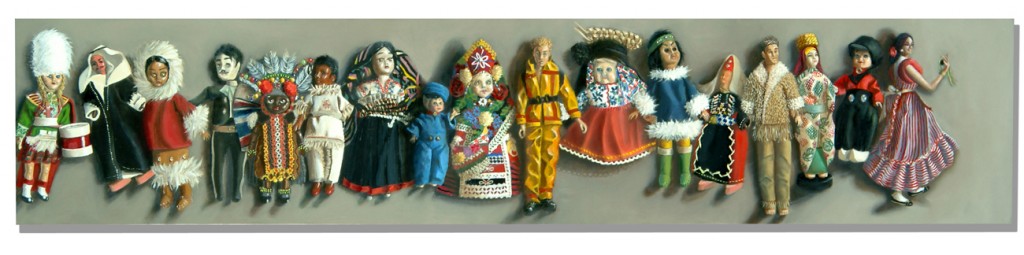
אשה פאזל
DSCF0143

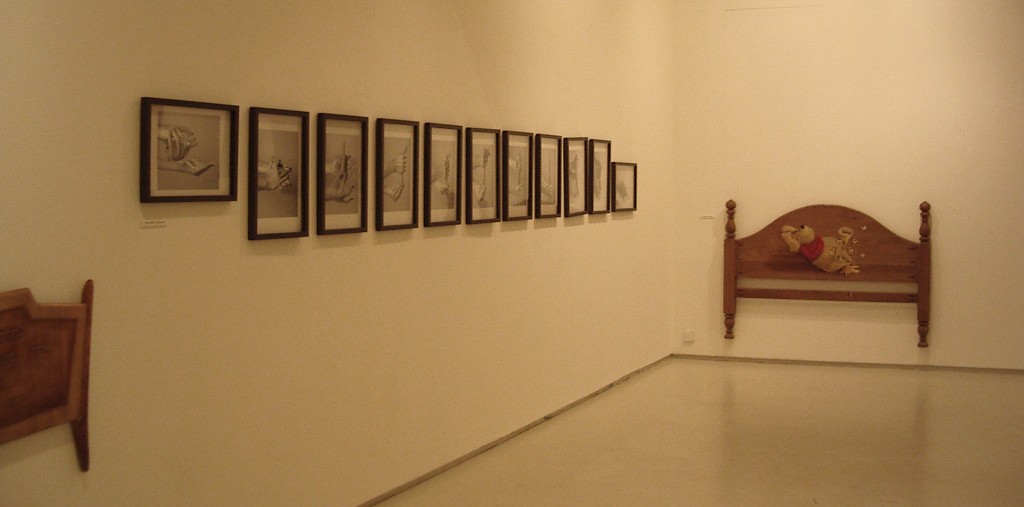
The name of Marilou Levin’s new exhibition is taken from the play “Crimes – Heart” (by Beth Henley, 1979). At the core of the play are the confessions of Babe, the protagonist of the play, which describes a failed marriage, her romance with a 15 year-old black boy and her attempts to murder her husband when the romance is discovered. For the first time in her life Babe tries to connect with her true feelings.


In the exhibition, the video work “Crimes of the Heart” shows Marilou Levin playing the role of Babe continuously repeating the story of the attempted murder. The play deals with social norms, issues of choice, and the ability to maintain freedom of choice in the face of social norms and demands. These are questions that have appeared throughout Levin’s work, to mention a few, “I have expectations”, I’m happy for you”, “go home”, and more.


In a sophisticated connection between the worlds of childhood and adulthood – expressed for example by an innocent portrait of Pooh Bear that is turned into a female bear lying on her back, honey dripping from between her legs, a swarm of bees feed off her vulva – Levin reveals erotic, animal elements, even in seemingly innocent situations. From this cynical, ironic, dryly humorous standpoint childhood memories, parent-child relations, male-female relations are examined.


The exhibition includes a series of eleven black and white photographs, video, and oil paintings on different supports.

Intercontinental

Atsmon Ganor / Intercontinental

Opening: 02/01/2004   Closing: 06/02/2004

Intercontinental, Installation view, Noga Gallery of Contemporary Art, 2004
map-asia
Nigeria-and-Chad
peeing-2
map,piness, nose-2

INTERCONTINENTAL


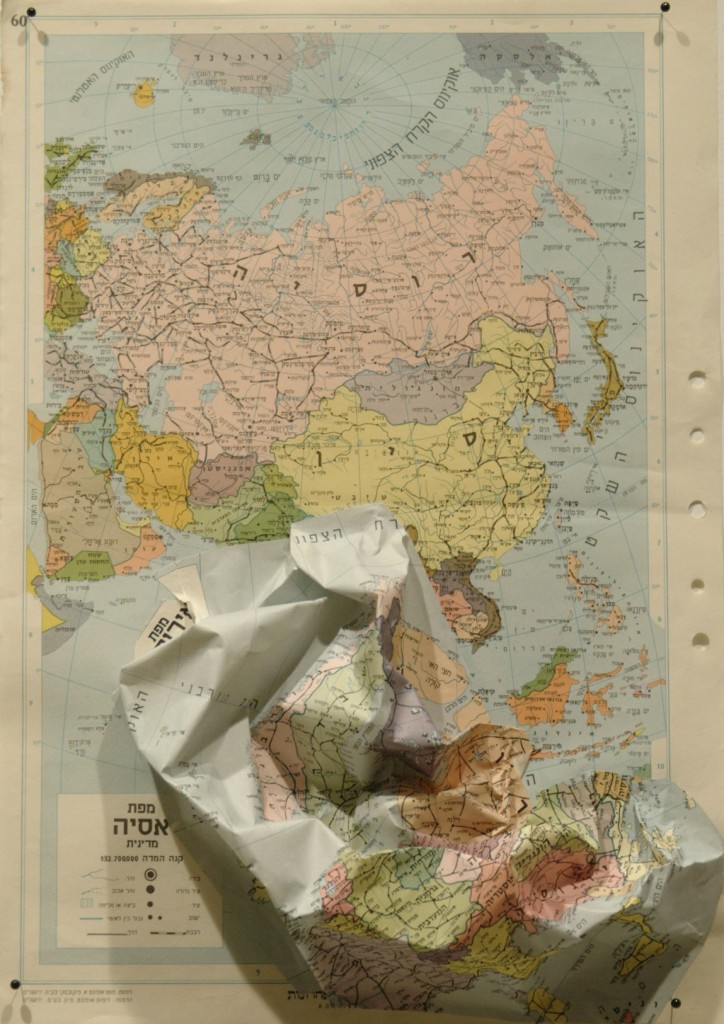
In ‘Intercontinental’ Atsmon Ganor exhibits two types of works – a large video projection of his animation: ‘Multiple Heads’ (Canada, 2002. 16.19 minutes in a seamless loop), and a series of more than 30 map assemblages. These were created from the pages of the Yedioth Aharonot Atlas that was published in the 60’s. The maps were distributed to the Yedioth Aharonot newspaper readers in the weekend issues as a promotion that maintained an educational aspect: “know the world.”


In a series of simple acts of cutting, tearing, creasing and folding Ganor re-assembles the maps. He creates a fictional, 3  dimensional topography: a new hybrid world that is born from a mixing up of borders and geological formations. Suggesting the utopian and the catastrophic, these topographical landscapes appear as a marvel and at the same time as an unsettling event – as an expression of inner restless tectonic forces and folds. The ‘mountains-lumps’, the ‘island-humps’, the ‘continent-growths’, from a distant horizon, send an echo of  the topography of the human body, without being mimetic.


The acts of folding and creasing are translated in the animation ‘Multiple Heads’ to a curved narrative; one that conjoins the sensual with the disturbing and the ridiculous with the poetic.  In various scenes, violence and tenderness appear as two faces of one coin. They determine the ‘psyche’ of this piece: a superimposition of political, physical and mental borders in a constant exchange that involves both a conflict and consolation.


The spatial and territorial is transformed from one scene to another. The flat surface of the screen or the lines of the geographical map change to become a sensual/sexual interiority, or an abyssal depth. The ground seems as an elusive element. It is constantly established and destroyed in the conjunction between reality and fantasy.  Space is emphasized not only by different lines of direction and movement, but also by the particular story lines. These involve absurd interactions between various images such as heads, body parts, animals, chains of mountains, geographical maps and words. The story lines delineate themselves in a rhizomatic manner.  Splitting one from the other, multiplying in unpredictable directions, they make any moral or end impossible.  Following the circular structure of Multiple Heads, the end point meets the point of origin.  At this meeting point what is revealed is that the end is the origin.

Liberty

Dorit Cypis / Liberty

Opening: 05/12/03  Closing: 31/12/03

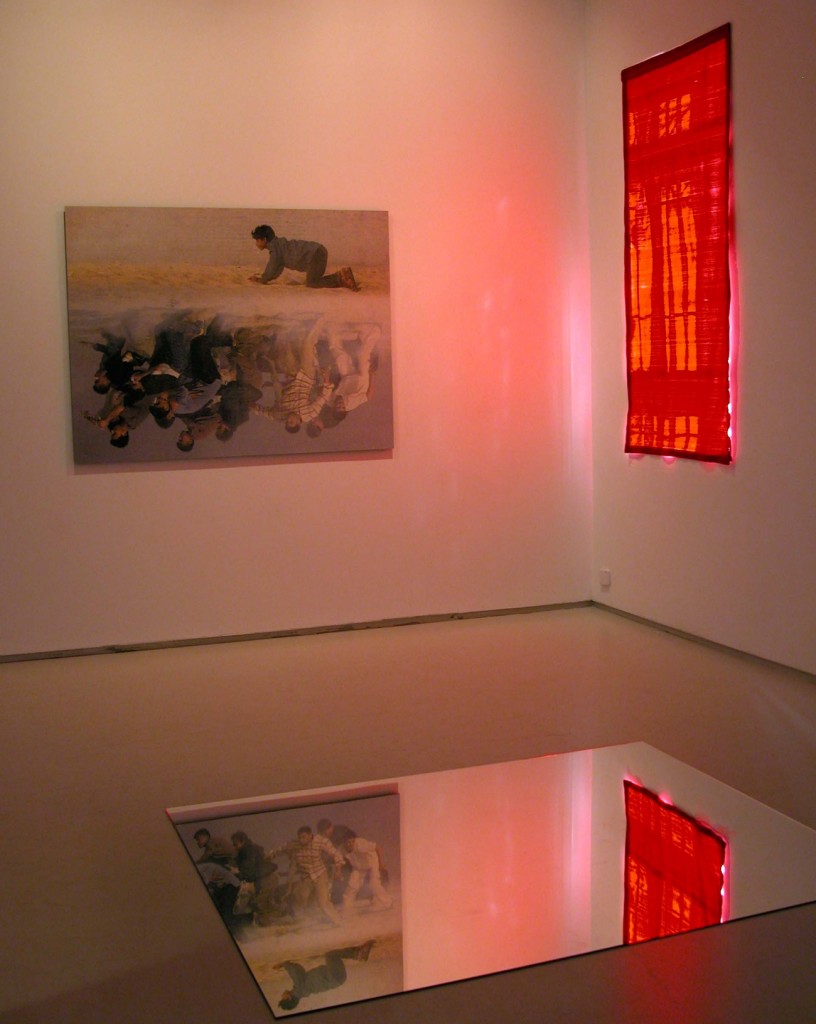
Liberty (leading the people), Installation view, Noga Gallery of Contemporary Art, 2003
7 sound-of-time

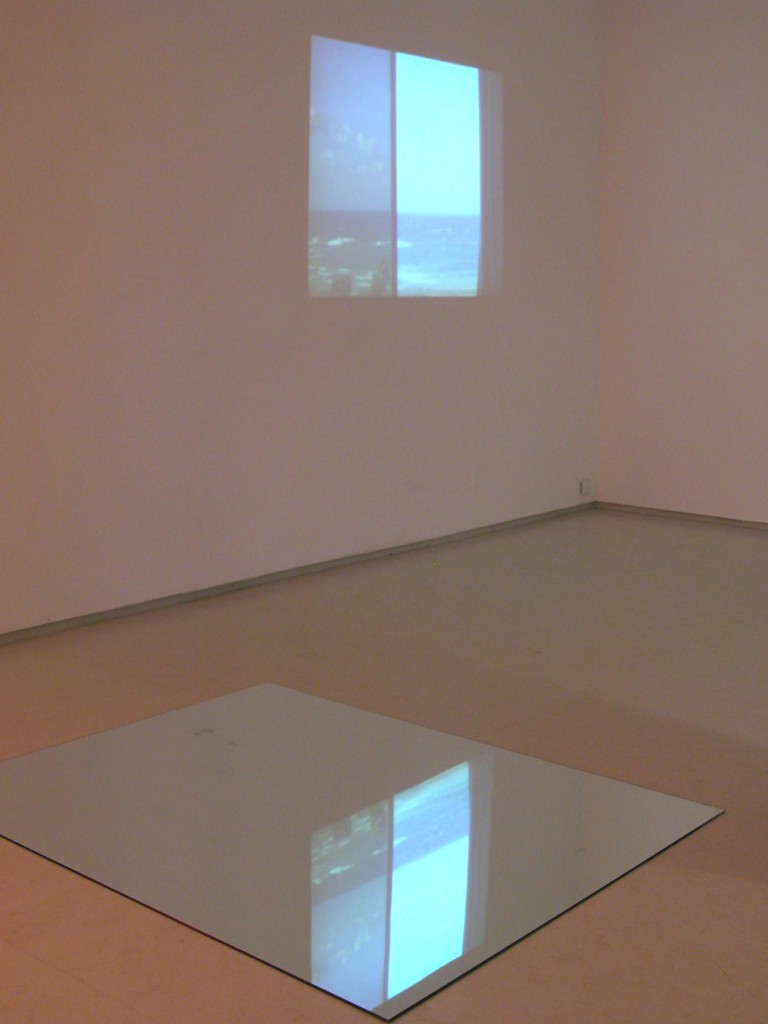
Liberty (leading the people), by Dorit Cypis, borrows elements from her recent installation The Sound of Time, (Optica  Gallery, Montreal, Canada, 2003), and extends them to adapt to the current environment of Noga Gallery, Tel Aviv, Israel.


Liberty (leading the people), a reflection on Eugene Delacroix’s romantic/classical painting Liberty Leading the People, 1830, is a poetic evocation of longing, loss and mourning…all inner emotions associated with unrequited desire for freedom, a “freedom” seemingly within reach and inevitably beyond our reach. It is a desire which propels human beings no matter what our cultural heritage, no matter what our gender, class and race lines.


At Noga, all the elements placed in the gallery, the architecture and the viewers reference each other. Two images, one still, the other in movement, and a mirror on the floor all share the same proportions. The still image, a photograph cut out from the Los Angeles Times in 2001, has been transformed to destabilize its political intention into one evoking a personal memory of mythological proportions.  Whose memory? Whose history? The image in movement, a video projection of curtains caught  in a fierce gale negotiating the containment of a window frame, is relentless in its physicality, bodyfull in its movement and motivation to be free. The curtains hang in a hotel room, Tel Aviv, Israel. The mirror, reflecting there where it is not, catches dislocated glances of everything present within the architectural space of the gallery. Glances, which are seen only by the viewer’s moving body, make the viewer complicit in the act of looking.


While in Israel, as compliment to her exhibition at Noga Gallery, Cypis will be spending time observing the conciliation strategies at play in the Palestinian/ Israeli village of Neve Shalom/Wahat-al-Salam. These concurrent activities will inform the future expansion of Liberty (leading the people) for the upcoming exhibition Imagine a Nation, 2004,  Los Angeles County Museum of Art.

Landscape – Place, Non Place

Group Exhibition / Landscape – Place, Non Place

Opening: 30/10/2003   Closing: 29/11/2003

Roi Kuper , Untitled, Color print , 80x80cm , 2003
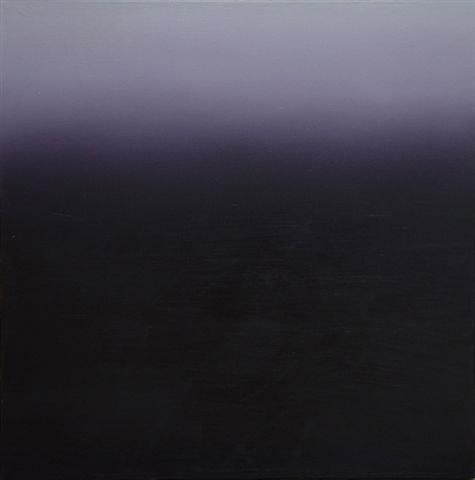
Mosh Kashi, Purple, Oil on canvas, 80x80cm, 2003
Ori Gersht ,Some place, C print ,100x80cm 2003
Orly Maiberg ,Untitled , Oil on canvas, 96x145cm, 2003
Gilad Efrat, Rujum Miri ,Oil on linen, 75x120cm, 1998
Maya Schindler , From Teletabies Series, Mixed Media on Paper ,72x52cm, 2002

Landscape – Place, Non Place.


Participants:


Ori Gersht
Roi Kuper
Gilad Efrat
Mosh Kashi
Orly Maiberg
Maya Schindler
Smadar Eliasaf
Hila lulu Lin


The term of “Place” contains an ambiguity. It refers both to the perception of the place and to a representation of it. This can be an actual place or a non-place The works all confront questions of the gaze, the language. It includes painting, photography, and video. The artists carry on a complex mutual relationship with the geographical, cultural, and ideological surroundings.


Touching on local myths, history, and culture, they discuss questions of land and territory, growth and stillness, nature without humankind. At times the gaze examines the surface from close-up, or takes a view from far away, as in aerial photography. At times it is the seemingly simple gaze of direct photography, touching the banal or imagined to describe the obvious, at others, the artists define visual and mental dialectic images from within the layered thought processes that provide a wide range of conceptual meanings.

Spilts

Meirav Heiman / Spilts

Opening: 03/07/2003   Closing: 08/08/2003

Splits, Color Print, 2003

Gaze Body Earth / Hadas Maor


Meirav Heiman’s new series of photographs was taken over the past year at various places throughout Israel, especially in the Negev and the Jordan Valley. Shivtah, Ramon Crater, Yechiel Hills, Nachal Hed, Tze’elim, Urim, Nachal Chadav; unsettled areas with similar topographic characteristics such as areas of exposed earth, rocky hills, lone trees and different types of scrub. Yet despite the above, the fundamental deciding factor within the framework of the series is different, and is expressed through the repeated presence of a woman’s figure that appears in each and everyone of the photographs.


During her work on the series, Heiman traveled to different places throughout the country (1), placed the camera, set the frame, and positioned herself wearing a leotard in front of it, her legs spread wide facing the camera and her back to the open view.


Heiman’s decision to thus poistion herself in relation to the landscape creates a basic situation where she dominates the environment through the presence of her body, through her pose, and through the foreign colorfulness that she brings with her. But at the same time, the specific pose she has chosen places her in the landscape horizontally, spread out, present but also stuck. As it is not a simple position, and it does not allow any movement, it transforms her, to a point, from being an active subject dominating the landscape into a passive object located in it.


And thus, more than Heiman casts her gaze and photographs over the landscape, she turns her gaze directly toward the camera and photographs herself. Her presence becomes a central element within the photographed frame, in terms of the composition as she traverses the frame, in terms of the strong coloring of her leotards, and many cases, because of her defiant gaze that insists on interaction with the spectator by delaying the option of passing his/her gaze onto observing the landscape itself.


Heiman’s work combines two or even three different disciplines of action. On the one hand, she works within the framework of one of the oldest photographic genres, the genre of photography documenting distant sites and/or unique places, by relying on the unique characteristics of the photographic medium that Roland Barthes so adequately defined in the context of the concept “it was there” (or alternatively, “I was there” (2)). This photographic praxis possesses an obvious dimension of perpetuation and makes use of the photograph as witness.


However, if the sites or figures photographed in this framework, from the dawn of photography to this day, had a clear photographic and existential purpose (by being part of the lifestyle and culture of some place, or alternatively, by being external visitors who succeeded in getting there (3)), then Heiman’s presence in the frame of these photographed landscapes, at first glance, is indecipherable and puzzling.


On the other hand, her work does not settle comfortably into the photographic genre that places women in landscapes through reliance on familiar associative and archetypal connections, primarily the idea of connection between nature and femininity or the formal comparison between the topography and textures of landscapes and the physical forms of the female body.


The central reason for discomfort comes from the fact that Heiman combines contemporary notions linked to the praxis of staged self-photography. A photographic praxis that is linked to and demands taking a position in the public space and an autonomous positioning in the stratified sphere of the politics of identity.


In this regard it is interesting to note that the element of the spread-legs position, which appeared in Heiman’s early work, has been interpreted and given a clearer meaning in the framework of her present work – a meaning that breaks through the borders of the feminine/erotic/pornographic/gender discourse (4). Amongst other reasons, this meaning also springs from the essential difference between a standard spreading of the legs and the issue of physical ability to perform a split, as is appears in this series, for the split position is an achievement oriented act, that in its very nature asks to be recognized and valued not only in the cultural sense.


The parallel between the element of the physical stretch and the element of territorial conquest in the work connects to the dimension of alienation that Heiman’s presence creates in the landscape. This strengthens the dialectic sense of strangeness/belonging raised by the work.


Heiman – daughter of a rooted Zionist family, whose grandfather was one of the settlers of the 1940s and ’50s and was active in the Jewish Agency – deals in this series withthe problematics of her physical and ideological relations to concepts such as belonging, land, territory, and state, amongst other things; she pours into her photographic praxis a contemporary political dimension in both nationalist and gender terms.


***

There is no doubt that the preoccupation with local landscape, urban or natural, has become central to Israeli photography since the mid-nineties of the twentieth century (5). Most of the photography created in this context in the last few years has relied on the principles of typological photography, as formulated in the footsteps of and in relation to the German school of photography, and through a worldview that sees photography as a natural option for realizing analytical, reflexive, and discursive processes.


It can be said that the turning of the gaze to the local landscape has become a contemporary act, in some ways, even a characteristic one of building mutual relations with the local geographic, cultural, and ideological surroundings. Taken to an extreme, and it can be said that for those who grew up in Israel against the background of the Yom Kippur War, for those who matured and formed their adult identity in the presence of the Lebanon War, the Intifada and the Al-Aqsa Intifada, the action of operating a contemporary photographic gaze – adhering or critical – is an alternative and new option, perhaps the only one, that permits the questioning of place, of Israeliness and of identity without settling into a pre-constructed mode of nationalism; an option of constructing a relation with the place, but doing so without sanctifying it.


But it is specifically against the clear typological orientation of the local praxis that the unusualness of Heiman’s work stands out. Despite the fact that the series was photographed with a medium format camera, which permits, in principle, a potential for organizing the photographic field and achieving high-quality prints, yet it does not fit into the fundamental formalistic definition of typological landscape photography. In this way, for example, Heiman often places the camera opposite the sun, leaving areas in total shade, does not necessarily take care to line-up the perspective or sharpen the depth of field, etc.. While doing so, she provides an alternative to both the severity of the typological photographic gaze and to the imagined objectivity it is supposed to create.


And thus, the stratified dialectic formed through her work process touches photographic, political, and gender aspects simultaneously. Her work is saturated with sensuality but also with irony, with criticism, but also with childishness. She touches political charged and complex issues of conqueror/conquered, but does so without placing herself in any familiar dichotomy (man/woman, religious/secular, Jewish/Arab, etc.), to the point that it seems as if the dimension of extremity existing in her work permits her to emphasize these opposing aspects, to touch the perversion but also the absurd, and to build within them a harmonious, unique and strange situation.


Notes

(1) Meirav Heiman’s journeys to different photo sites were made in collaboration with Roi Kuper, friend and well-known artist, who helped her execute the photographs.


The issue of utilizing various professionals in the artistic framework, and even more so, the issue of possible collaboration between different artists, is in itself deserving of an extensive and in-depth discussion, but this is not the place to expand on it.


(2) Beyond stating the concept “it was there” Barthes expands and claims that the art of photography can never deny that the thing was there, and that the essence of the photograph was to confirm the existence of that which it represents. See Roland Barthes, Camera Lucida: Reflections of Photography (Noonday Press, 1982).


(3) For example, in Falu Zivlin’s work “Women in the Rishon Lezion Sand-Dunes”, c. 1927 or Elia Kahvedjian’s “By the Well”, 1935, and also Michal Heiman’s manipulation of existing photographs in the framework of her work “Michal Heiman Test (M.H.T.) No. 2”, 1998.


(4) In this context it is important to note work by artists such as Sarah Lucas (“Self Portrait with Skull”, 1997) or Tracey Emin (“I’ve Got it All”, 2000), for example, who made conscious and intended use of the spread-legs position directly in front of the camera lens in their works.


(5) During the second half of the 1980s the principle local photographic emphasis was on what was called at the time “personal photography” or “manipulated photography”, on the one hand, or magazine photography on the other. In both cases the praxis existed under the shadow of the struggle for the legitimization of the photographic medium in the wider artistic field. In contrast, in the second half of the 1990s, it is possible to identify the full-scale and definite return to direct photography in fashion, advertising, journalism, and in art.

Mirrors, the Garden/ Anamorphoses

Joshua Borkovsky / Mirrors, the Garden/ Anamorphoses

Opening: 22/05/2003   Closing: 27/06/2003

Mirrors, the Garden/ Anamorphoses, Installation view, Noga Gallery of Contemporary Art, 2003

Joshua Borkovsky


Mirrors, the Garden/ Anamorphoses
Photographs


Echo&Narcissus
Paintings


Shuki Borkovsky exhibits works from the past two years: a series of photographs from the cycle : “Mirrors, The Garden / Anamorphoses “ and paintings from the cycle : “Echo and Narcissus”. In the cycle : “Mirrors, The Garden / Anamorphoses” the artist makes new and surprising use of the photographic medium in order to focus the viewer’s attention on questions of vision and doubt, central to his work of the past two decades. Those works consisted of phantasmagoric images such as the silhouettes of sailing ships and the cartographic images in his paintings of the early 1990s and, later, the images of crystal chandeliers reflected in mirrors. These paintings demanded the active presence of the viewer, a concentrated observation that led him, paradoxically, to question seeing and to doubt the truth in what was reflected.


In his anamorphic photographs of gardens, the artist deals with similar questions. The original photograph is distorted to unsettle the viewer’s certainty of seeing the thing represented thereby. An additional distortion of the photograph utilizes the moir? effect that creates a “spiraling” and “whirlpool” effect in the image. (In standard, correct, prints the moir? effect is regarded as a fault, while Borkovsky makes this distortion a fundamental value of the image.) An enigmatic photographic image is attained, which suspends the gaze while questioning “correctness” of vision and, particularly, photography as representation. “Truth” will be revealed, magically, only by correction of the representational fault through its reflection in a curved mirror: paradoxically, “truth” appears as a reflection, as likeness and illusion. The artist, the “salt merchant”, re-turns himself and the viewer to a state of doubt.


The diptychs from the “Echo and Narcissus” cycle (oil paint and gold leaf on canvas) maximize abstraction, concentration and reduction that characterize Borkovsky’s work. As told by its name, the cycle is encoded with figurative images. The most abstract state is also the most figurative. Narcissus reaches awareness only through his reflection, and Echo is present in the world as a reverberation, a repetition. The viewer is in position to play a major role in charging these paintings with symbolic couples of all times and with further reflections. The viewer can be either Echo or Narcissus, or both at the same time.


Anamorphosis:
The technique of distorting an image in such a way that it can be viewed in its correct form from a particular point or through its reflection in a curved mirror. When seen directly it appears abstract and incomprehensible. The system of central perspective not only rationalizes a relationship between objects within a picture, but also establishes a relationship between the viewer and the represented images. Anamorphoses are an extreme example of this subjectivization of the viewing process. The observer is first deceived by a barely recognizable image, and is then directed to a viewpoint dictated by the formal construction of the painting. Indeed, etymological origin of the word – from the Greek ana(again), morph(shape) – indicates that the spectator must play a part and re-form the picture himself. The image that appears, as if by magic, attracted artists, philosophers and poets for centuries. Durer, Leonardo da Vinci and Holbein (“The Ambassadors”) all created anamorphic images. Jean Cocteau writes of the anamorphic image as that ‘No man’s Land’ where poetry and science meet. Anamorphic images, were considered ‘wonders’ and miracles of art imbued with mystical, theological and philosophical significance. The seventeenth and eighteenth centuries were the golden age of anamorphosis.

Bedroom eyes

Orly Maiberg / Bedroom eyes

Opening: 10/04/2003   Closing: 16/05/2003

Bedroom eyes, Exhibition view, Noga Gallery of Contemporary Art, 2003
SCAN10
SCAN12
SCAN16
SCAN11
SCAN3
SCAN6
SCAN2

A bedroom as a representative of the most intimate part of “a home”.

A good browse at one’s home is a legitimate act, but looking into one’s bedroom will consider peeping.
Peeing involves an act of a stolen glance, as of invading private territory, an intimate territory with oneself and with the other.


Territory in which one finds oneself between sleep and awakens, between conscious and unconscious, dearmworld and realty.
In this series of bedroom paintings, exposure and disguise play almost an equal role. As light falls, it reveals not necessarily our glamour’s moments but captures those who are banal, taken out of the erotic context.As if were scenes out of a movie they might end on the editor’s floor.


The relationship of the viewer – painter is ambivalent.  At times the viewer like the painter immersed in the scene neglected of the peeping standpoint. It’s a relationship of a close intimacy.  At other times, it can be of distance and alienation. We are always reminded of this dual relationship of temptation and rejection.

Summer Day

Roi Kuper / Summer Day

Opening: 24/02/2003   Closing: 28/03/2003

Summer Day, Exhibition view, Noga Gallery of Contemporary Art, 2003
Pool, Color print, 126x126cm, 2003
Fog #1, Color print, 126x126cm, 2003
Meoyan, color print, 126x126cm, 2003
Fog #4, color print, 126x126cm, 2003
Desert #3, color print, 126x126cm, 2003
Agam, color print, 126x126cm, 2003

Roi Kuper’s new series of color photographs was created over the past year in Switzerland, France, and Israel. A big storm in the Alps, clinging stillness in Provence, a drying lake surrounded by mountains, a vineyard encompassed by fields of thorns, a barren desert, a rock pool, mist swirling around the Alps, and all of it – like synchronized breaths, an echo of loneliness, a local hallucination.


These are complex and charged landscapes that divide into two under the clear, bright sky. This division draws toward the warmth of initial inspiration opposite a landscape pretending to be dead and forms of alertness and strength, of emotional release from the tension. Eternal passion.


The works examine a world that seems to desire nothing, to be involved only with itself, a world shrouded by contradictions where one has to act with total silence, where there is no place for a wish, where there is a state of static hallucination, total silence. The desire is outside the internal labor that, through the knowledge of selective memory, guides the observation to a supposition of the heart and from there to understanding, to the domain of contemplation.