Four Seasons

Keren Cytter / Four Seasons

Opening: 22/10/2009   Closing: 04/12/2009

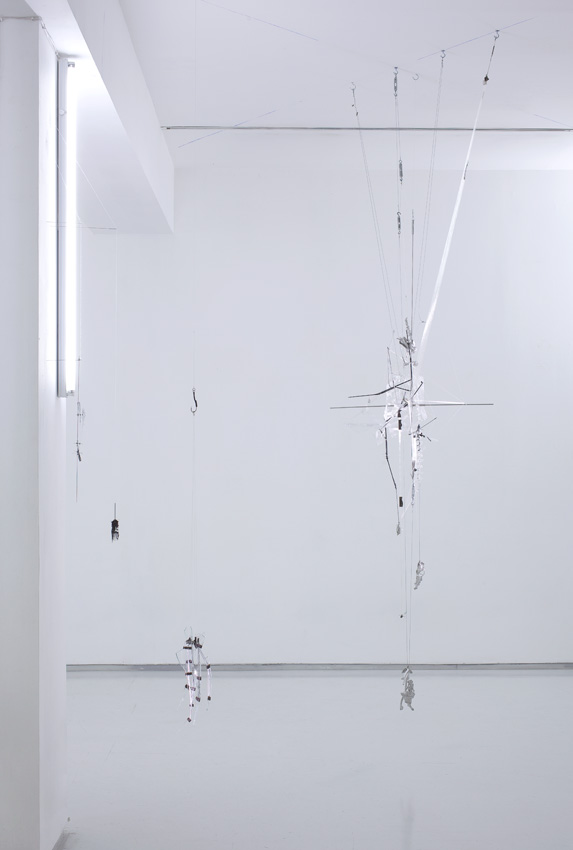
Four Seasons, Installation view, Noga Gallery of Contemporary Art, 2009
Four Seasons, Still from Video, 2009
Dead Man, marker and pencil on paper, 74x58cm, 2007

Keren Cytter is showing two video works, Four Seasons (2009) and Les Ruissellements du Diable (2008), and a selection of drawings in the Project Room.


The film Four Seasons (2009) opens with a neo-noir celebration of late-Hitchcock-meets-1980s-kitsch: a record plays dramatic music by Ferrante & Teicher; thick fake blood drips onto white tiles; snow whirls through the apartment and a lone woman climbs a dark, smoky staircase.


As the film unravels, conflicting narratives are revealed, switching between the stories of Stella, a tragic tale of heart-break and domestic murder, echoing Tennessee Williams’ A Streetcar Named Desire (1947), and Lucy. A voice-over describes the building using its architectural elements as metaphors for human behavior. Climaxing with a series of spontaneously combusting objects – birthday cake, Christmas tree, record player – Four Seasons is a homage to all that is fake, showcasing visual cliches, lo-fi special effects and deadpan delivery. Yet, somehow, Cytter creates a sense of poignancy rather than of cynicism.


Four Seasons is not purely a deconstruction of the mise-en-scene, a comic pastiche or a cinematic critique. Rather, it forms a complex exploration of perception and memory; layers of language and image create a hierarchy of interpretation that is reliant upon collective and personal cultural signifiers.


Cytter’s work emphasizes only multiple fragmented moments of feeling. Cytter flouts her style clashes manipulating these cultural tools with results that range from the banal to the sublime, from the embarrassingly comic to the vulgarly surreal.


Adapted from Kathy Noble, Frieze Magazine 123, May 2009


Les Ruissellements du Diable (The Devil’s Streams), refers to Cortazar’s story, “Las Babas del Diablo” (“The Droolings of the Devil”). Cytter’s video, trails a photographer chasing an infatuation through the reality of a photograph. Via emotional projection, the photograph and the TV screen are his sole connection to Michelle, a translator on television. Both characters eventually realize they do not actually exist while the empty nature of the photograph remains. Softer than her usual approach, Cytter’s solitary focus in The Devil’s Streams complements the mood of the Asian music throughout the film allowing scenes, characters, gender, and stories to seamlessly collide. Re-presented through her poly-vocal and deconstructed approach to cinema, the stories and conventions she alters find a new relevance to contemporary times.


Cytter applies Cortazar’s self-conscious narrative by lifting lines from the text for a reflexive voiceover musing on its own unreliability. The two onscreen performers, a man and a woman, externalize the conceit by explaining the story to the viewer—and to each other—as they simultaneously act it out.


Cytter is at her best when pushing the material to extremes: match cuts that meld the two characters (the man picks up a cigarette from an ashtray, the woman puffs it) and shock effects (graphic footage of male masturbation) that ensnare both the audience and the filmmakers in the characters’ circular voyeurism. And yet, what is most remarkable about the video has less to do with Cortazar’s “The Devil’s Drool” than with his novel Hopscotch, which offers the reader alternate paths through the chapters. With Les Ruissellements du Diable, Cytter has managed to create an emotionally intact narrative completely devoid of a beginning, middle and end. The characters watch TV, smoke, sulk, jerk off, meet in the park, spill a bottle of water, and hold hands in a series of self-contained but interrelated shots that could be reshuffled without losing coherence or disrupting the structure—or so it would seem.


Adapted from Thomas Micchelli, The Brooklyn Rail, January 2009


Keren Cytter (b. Israel, 1977) currently lives and works in Berlin. Her work has been exhibited in numerous museums, galleries, and international biennials.

Recently she was chosen second among “Top 100 Emerging Artists” by the Flash Art magazine, and received the first-ever Absolut Art Award:


http://press.absolut.com/templates/PressPage____7458.aspx


Latest shows featuring her work include “Making Worlds,” the 53rd Venice Biennial, Italy, and the New Museum Triennial – “The Generational: Younger than Jesus,” New York, NY, “Television Delivers People” at The Whitney Museum in New York; “50 moons of Saturn,” The second Turin Triennial, Italy; The Yokohama Triennial, Japan; “Open Plan Living,” Art TLV, Tel Aviv, Israel; Manifesta 7, Trentino, South-Tyrol, Italy; The second Moscow Biennial, in Russia; and the Lyon Biennial, “The History of a Decade That Has Not Yet Been Named,” Lyon, France

-80

Shahar Yahalom / -80

Opening: 03/09/2009   Closing: 09/10/2009

-80, Installation view, Noga Gallery of Contemporary Art, 2009

-80°C is the temperature at which bodies are stored while waiting for the future life – an encoded extension to the future – as well as embryos and organs for transplantation. The exhibition space is planned to serve as an experimental lab or a refuge of an alchemist/architect/philosopher busy with creating a new reality by sorcery and calculation: every sculpture may be translated into a mathematical equation.


Jacques Derrida defined the term ‘deconstruction’ as a method and not a style. An attempt to attribute Shahar Yahalom’s work to any style seems forced, and one should rather focus on her method. The majority of the compositions in the exhibition are based on two poles – one vertical and the other horizontal making together a cross (in the architectural connotation*), an unhesitating static structure. The strong juxtaposition of two intersecting axes lies at the base of architecture since the early ages. Postmodernism has undermined this stability by breaking angles and conventions.


At the center of a human skeleton there is a cross-like bone called sacrum (‘holy’ in Latin) and ‘krestetz’ in Slavic languages (‘krest’ = ‘cross’). According to the Zohar book, at the time of resurrection the lower part of the sacrum, usually identified with the coccyx (etzem ha-luz), will expand to four directions to form the body anew. The sacrum is the Foundation Stone of the human body, responsible for its posture; however, in art as in anatomy the physical stability does not depend on the structure alone but on the flow of life itself. Without it the structure will collapse.


Thus, the center poles are well positioned, and the artist may now begin her dance. She scatters other axes in the space as broken arrows. The small details hang on the axes, holding on to them, while their form becomes less geometrical and more organic.


Does the artist rely here on chance creating a chaotic structure and letting it grow as it pleases? It is indeed and intentional coincidence. In this intelligent way a plant occupies its designated space, feels it and sends its tendrils in every direction.


The exhibition space seems spellbound; otherwise how did the artist set these impossible sculptures? The space is pierced, unraveled, dissected, sliced, drawn with strings, straggling on hooks, alluring with its transparent screen traps, An astute pleasure.


Perhaps there is no magic here, but rather the gravitation laws were changed? The artist created a universe with two moons as in a recurring childhood dream. A heavenly duplicity as opposed to an earthly duplicity – the exhibition is designed according to a principle of duplicity, and from a certain point the view is repeated.


Perhaps the afterlife is here? The bones of fish from the Chernobyl area are curled as tendrils. Will the new world be created as a result of a crisis? In Chinese the word ‘crisis’ is composed of two ideograms: one means ‘danger’ and the other ‘new possibilities’.


The artist is fascinated with Gothicism, with the structure of a cathedral and its emptiness as opposed to the sculptural images. Yahalom sticks to daring perpendiculars and diagonals that strive to stretch the boundaries of matter and spirit and to defy the skies. The gothic creatures are not in the exhibition, but their presence is duly felt. Stubbornly they creep into the space leaving behind marks of claws on the glass. They scratch the slides with sharp beaks chucking their excretions here and there and wink from every corner.
Derrida rejects the confrontation of the tradition with the avant-garde. The contemporary age enables the two poles to collaborate – no more rebellion of the avant-garde against the tradition but coexistence. Yahalom is true to this philosophical view, but in her work she does not discard the visual art for philosophy that would have conceptualized the sculpture. She is devoted to her work, reminding of a craftsman sculptor; she does not order but skillfully carries out her own creation.


One literary character used to say: “children and good pipes one should make by himself” – to which I would add – good sculptures as well.


*The success of the campaign of Christianity was affected, among other things, by the catchy logo – the cross.


Miriam Gamburd

Ivory Dawn

Mosh Kashi / Ivory Dawn

Opening: 23/04/2009   Closing: 05/06/2009

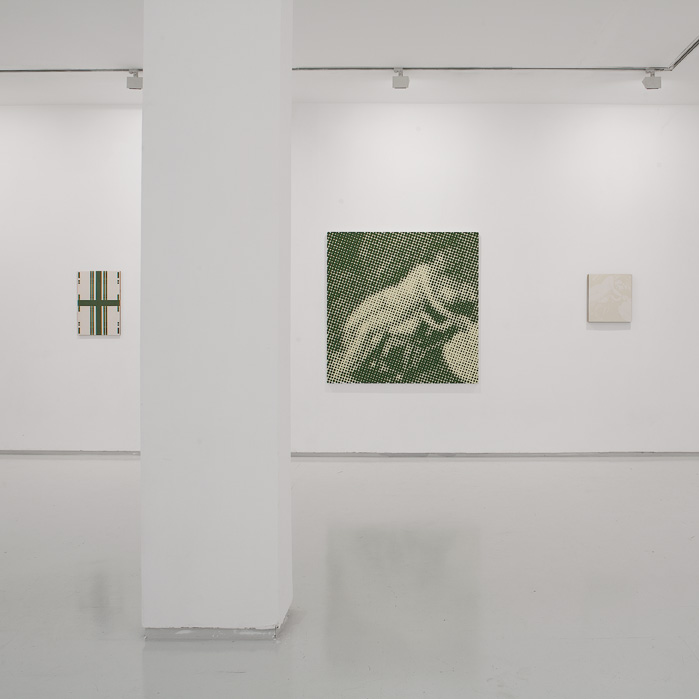
Ivory Dawn, Exhibition view, Noga Gallery of Contemporary Art, 2009
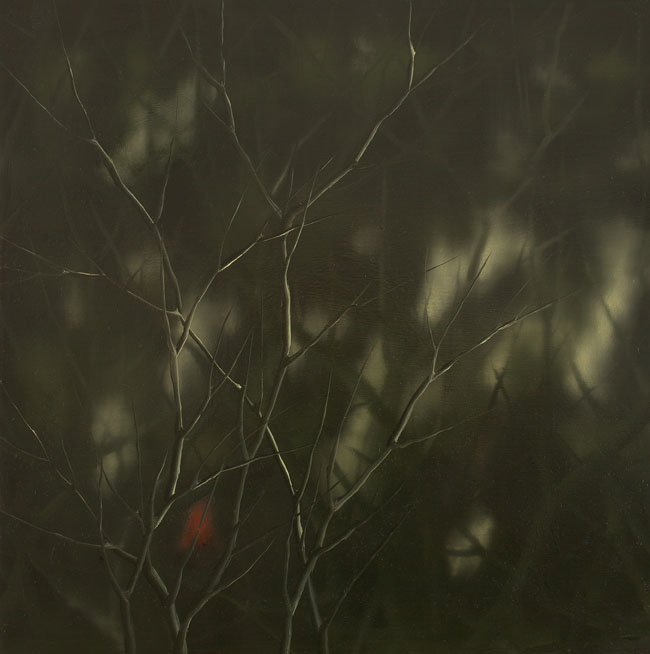
Forest Green (Red), Oil on canvas, 80x80cm, 2009
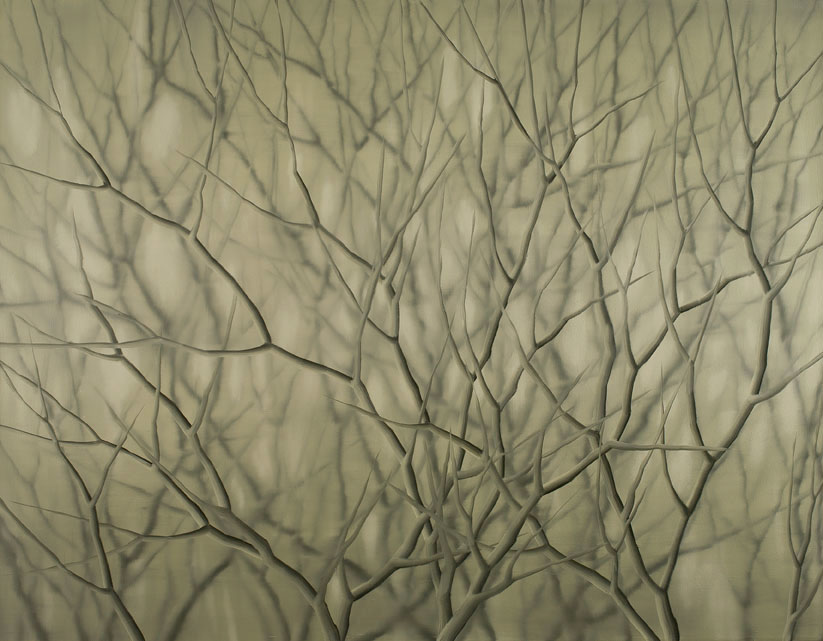
Silver Forest, oil on canvas, 180x140cm, 2009

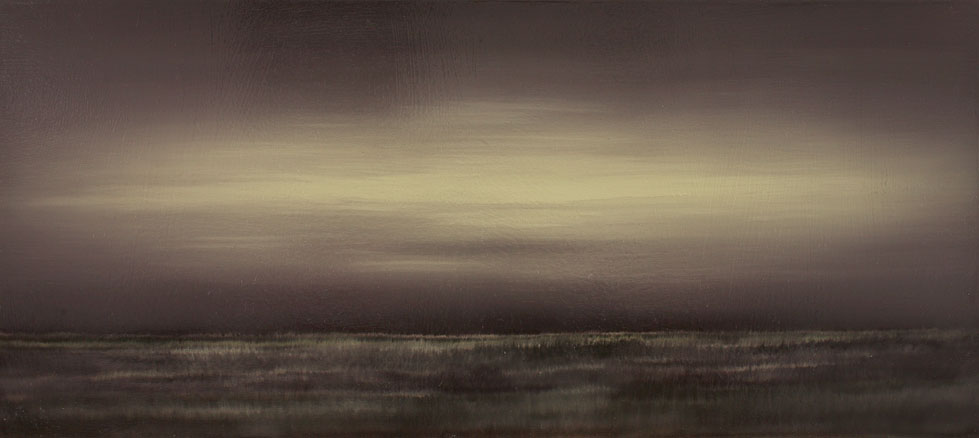
Mosh Kashi exhibits meticulous oil on canvas paintings, loaded with suspense and inward concentration. Kashi’s metaphoric world goes the distance into an undefined space of botanical imagery, gloomy fields and nocturnal spaces. Kashi builds a world of stylized nature from thickets of splitting branches to barren field landscapes. A series of small fields that portray an ivory light in the core of the sky, a brief aperture- a light opening and capturing a glimpse of the great body of nature.


With a virtuoso brush technique Kashi has developed the thicket image- an endless entanglement and splitting of branches, leafless and grey. The thicket is dense, prickly and illuminated from within the darkness. The nature in his drawings is not natural and flowing, but rather frozen and tangled. Side by side, lunar landscapes in which the light flows, or darkness accumulates, giving it a meditative suspense.


Human presence is reduced from Kashi’s paintings in a symbolic way, to the gaze of the outside viewer, busy deciphering the tensed events of the painting. The contact of darkness and light induces in his works an undefined time-sense which is neither day nor night, dusk or dawn. The vague light which falls on the dark fields, the measured lighting that exposes a field part delicate as fine hair in a sudden flash of first or last light, the twigs flickering from the dark green thicket, carrying an allegory of the paintings light source as the skies hanging on an endless dawn.


The paintings in this exhibition indeed offer a deeply rooted affinitiy to romantic painting but also wishe to examine the objects of painting, in the saturated light, the fertile material, the object of desire concealed in the ordered appearance of things

Tracing Echoes

Noga Engler / Tracing Echoes

Opening: 05/03/2009   Closing: 17/04/2009

Tracing Echoes, Exhibition view, Noga Gallery of Contemporary Art, 2009
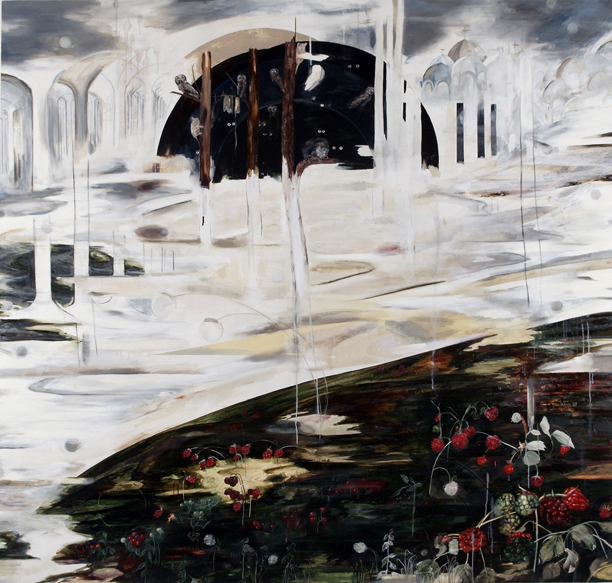
Night and day, oil on canvas, 190X200 cm, 2009
Landmarks II, oil on canvas, 210X170cm, 2006
The Digger, oil on canvas, 150x120cm, 2008
Black Boat. oil on canvas, 127x103cm , 2009
Barking, oil on canvas, 183X171cm, 2009

Nogah Engler’s painting language is a fragmented and a broken one, which builds a new enchanting world from ruins. The paintings’ themes are mainly landscapes, what she refers to as “simultaneous landscapes”; mental regions which mix with actual regions. Places and times which split and re-unite, break and heal, vanish and appear. Utopian places and dark places are bound together.


Her paintings embody the fragility of existence and the ultimate dichotomy of life/death that lies at the heart of the natural order. Although never directly depicted, the human presence is always implied. The oppositional elements of her subject matter are effectively manifested through Engler’s painting technique. She constructs a complex illusory space of interconnected zones of paint combining translucent washes of oil and color with areas of beautifully drawn, tightly rendered detail set against open voids of raw, blank canvas. By systematically creating and negating large areas of the painting’s surface, Engler speaks as much to what is not seen as to what is revealed through tangible objects and situations. The negative space is activated as a means to go behind physical presence and figurative interpretation to reach concealed human narratives.


Nogah’s personal biography is present in each and every painting. As a second generation to holocaust survivors, as one that grew up on stories about Europe, “that place” became an inner scope, a place that constantly exists in the awareness, a place which she always imagines and also wakes from in dread. She found those landscapes which she imagined in works of Renaissance painters such as Lucas Cranach, Peter Bruegel and Jan Bruegel. Into these landscapes she cast her memories from the other stories.


Nogah Engler’s new body of work began with a journey made into the heartland of the Ukrainian Galicia region in 2005. Drawing on written and word-of-mouth accounts left to her by her grandfather, she tracked down the village of Kosov and the dwelling where her father, uncle and grandfather remained in hiding for two years during the occupation and systematic massacre of Jews throughout the villages in the area during World War II. Although the final realization of a place long-imagined enabled some emotional catharsis, it has only worked to further intensify her infatuation with a landscape that remains forever beautiful yet endlessly tarnished by its own history.


Across an organic process of development and experimentation, the landscape paintings moved to other regions, with the story’s events in the background. There are elements of pastoral beauty which is uncovered underneath the surface or presents an apocalypse-like landscape. Each painting approaches this theme from a different angle and perspective and there is a cumulative effect in the gallery space. From tangled scrublands criss-crossed with frozen forests, burnt down forests, fallen trees, broken fences, paths seem to lead toward one fateful mountain. Throughout, animals, serrated mountains, sharp rocks, huts, architecture shadows as a sign of human life passed by, scorched grounds, all of these are mute witnesses. By their side, flowers and berries that fight the odds and bloom through the permafrost stand as a hopeful testament to nature’s unswerving ability to re-generate and renew. Day follows night and life inevitably begins again.


Nonetheless, as an Israeli living in Europe today she finds herself living simultaneous lives. The echoes of a place where one is physically absent reverberate inside incessantly. This echo splits one’s existence and renders it belonging and not belonging. This is an effort to create a utopian place out of the recognition of utopia’s failure. The effort of catching the echo is the one of building a new personal identity, which tries to unite the worlds.


When she finished her Art MFA studies in 2004 at Chelsea School of Art, London, Nogah Engler was chosen by the Times Magazine as one of the six artists to follow and one of 25 artists selected by Art Review. Since then she exhibited solo and group exhibitions in Europe and Israel and was awarded the 3rd Castellion Prize for painting and the Celeste Prize for painting in 2006. Her works are included in important collections in Israel and abroad.


Simultaneously to the Noga Gallery exhibition, Nogah Engler will exhibit at “Wondrous Worlds”, an exhibition at the Helena Rubinstein Pavilion, starting March 12th.

Failures

Kader Attia / Failures

Opening: 15/01/2009   Closing: 27/02/2009

Failures, installation view, Noga Gallery of Contemporary Art, 2009
Rochers Carres
kader_17
kader_16
kader_14_print

For several years now, I am questioning fundamental issues through Art, conducting my researches on these topics always in the light of philosophy, psychoanalysis and poetry. I always try to view my work in a dialogue, which questions the fundamental issues of the existence, and what binds them. It shall often be considered in the spatio-temporal context (geography and history), it was produced in.


Spending my childhood between France and Algeria has led me to feel close to Oriental and Arab philosophy, as well as to Western philosophy. My father, who has immigrated to France from Algeria in the 70’s, has always told me: “The most important thing, when you emigrate, is not the place where you come from or where you go to, it is the journey.”.


I have had to develop an “ergonomic of the mind”, to always be between two things, rather than feeling trapped in one side or the other. This obligation to “go back and forth” has led me to never feel comfortable in the same place, in the same position, and by extension in the same state of mind. I apply this duality of thought to my artistic process. I have always been more interested in hybridism than in opposite sides. I feel that Human Being should come back to this flexible space, which separates any extremely different issues, even if in between the virtual and reality.


In The Order of Things Michel Foucault demonstrates how all representations of things neither depend completely on our culture, nor totally on the scientific rules that define them, but also on the space between these two extreme notions, which is experience. This experience affects our perception of the world more than we would like to believe.


The experience of an artwork that you perceive through its historical content, its “archive”, is, in my opinion, more than an objective iconological notion contained in its boundaries, but rather what subjectively binds us to the artwork. It arises from an intimate dialogue that works like a “sonar” between the artwork and the individual, and produces a personalized echo deep inside each one of us.
 

This experience binds us to the work in time as well as in space, in a dark, untouchable, but true way – I mean beyond the myth of form, and in an “in between” space, in which poetry can exist. This space, which is similar sometimes to a boundary, sometimes to a limit, sometimes to what binds and separates space and time, void and fullness, “ethics and aesthetic,” is the essence of all these opposite sides. At this level of the origin, poetry could exist.


I like to believe and see that, in contrast to prosaic daily life of Human Beings, this poetry brings us back to our deepest and natural instincts. Edgar Morin says, that human life interweaves poetry and prose. Prose represents the boring activities, necessary to make a living, like going to work everyday, reading emails, etc… Poetry corresponds to the natural activities, for which Human Being has always been prone to: sleeping, eating, making love, “consumation”, as Georges Bataille would say. We have to live poetically . Unfortunately, Man lives on Earth prosaically. Poetry should not be only written, it must also be lived and thought

Vera Icon

Joshua Borkovsky/ Vera Icon

Opening: 30/10/2008   Closing: 05/12/2008  

Vera Icon, Exhibition view, Noga Gallery of Contemporary Art, 2008
Leda and the Swan 8, Ink Injection on Paper, Framed, 110x110cm, 2008
Leda and the Swan 6, Oil on Canvas,140x140cm, 2008
Vera Icon 6, Tempera on Gesso on Wood, 60x40cm, 2008
Vera Icon 3, Tempera on Gesso on Wood, 60x40cm, 2008

“Painting celebrates no other enigma but that of visibility.”


Merleau-Ponty, Maurice, Eye and Mind


In his new exhibition Joshua Borkovsky exhibits new paintings from the Leda and the Swan (Homage to Tintoretto) cycle and paintings from the Vera Icon cycle.


Borkovsky’s work predominantly features phantasmagoric imagery, such as the silhouettes of sailing ships and the cartographic images in his paintings of the early 1990s. In later years, this preoccupation yielded crystal chandeliers reflected in mirrors, anamorphic photographs of gardens and the recent paintings of the Echo & Narcissus cycle.


Borkovsky’s art demands the viewer’s active presence and concentrated observation, leading him, paradoxically, to question seeing and to doubt the truth in what is reflected.


The same is true of the paintings on view in the present show. The paintings from the Leda and the Swan cycle (oil on canvas) and the paintings from the Vera Icon cycle (Tempera on gesso on wood) continue the characteristic abstraction, concentration and reduction in Borkovsky’s work. It is a painting that in the words of Maurice Merleau-Ponty, the French philosopher and thinker, “comes from the eye and addresses itself to the eye”. But it is also a painting that enables, confirms and simultaneously doubts seeing; the viewer is not certain what he sees, what its meaning is, and what the “true” image is. Echoic of Rashomon, the viewer remains uncertain – what is seen, what was really there, what the “true” image, the Vera Icon, is and if it is possible at all. The doubt that is eminent to these paintings and their creation becomes the viewer’s doubt, every viewer at any time.


* Vera Icon – “true image”: a concept, originally from Latin and Greek, that deals with the questions of the possibility and veracity of representation –of the divine representation in particular and any representation in general. This concept exists since the beginning of Christianity signifying the true presence of Christ through images known by their Greek name as acheiropoietos – not made by hand. One example is St. Veronica’s Vernicle (by erroneous etymological connection the name Veronica was associated with Vera Icon).

Folding Time

Ori Gersht / Folding Time

Opening: 04/09/2008   Closing: 24/10/2008

Folding Time, Exhibition view, Noga Gallery of Contemporary Art, 2008
Fallin Bird, Still from video, 2008
Untitled 11, 100x100cm, 2007
Untitled 7, 240x180cm, 2007
Pomegranate, Still from Video, 2006

The exhibition Folding Time will present for the first time the still life film trilogy titled ‘Pomegranate’ 2006, ‘Big Bang’ 2006 and ‘Falling bird’ 2008 alongside the photographic works from a series titled Blow-Up 2007.


In this body of work, Gersht explores relationships between photography, film and technology, revisiting fundamental philosophical conundrums concerning optical perception, conception of time and the relationships between the photographic image and objective reality.


All three films were shot with high definition, high speed camera technology and are based on old masters still life compositions. Whereas such paintings attempted to preserve motionless moments frozen in time, Gersht’s compositions are obstructed by fast and violent interventions. In ‘Pomegranate’, a film that references Juan Sanchez Cotan’s 17th century still life and Harold Edgerton’s high speed stroboscopic photography, a high velocity bullet flies across the frame in slow motion and obliterates a suspended pomegranate, bursts it into open and wheels it slowly in the air like a smashed violated mouth spraying seeds.


The peaceful image transforms into bloodshed. In ‘Big Bang’, a Dutch flowers still life painting suddenly explodes to the intensive sound of war sirens. The explosion disrupts the scene, which subsequently transforms into a silent, slow moving cosmic downpour of colorful flowers, particles and dust. In ‘Falling Bird’, a film based on Chardin’s still life, a hanging pheasant is suddenly unlashed of its string, free falling toward a mirror like black surface, collapsing into its own reflection, on impact the bird penetrate the liquid surface and in doing so triggers an epic chain reaction, reminiscent of a geological disaster.


In relation to the film trilogy Gersht developed a group of large-scale photographs entitled Blow Up. These depict elaborate floral arrangements, based upon a 19th Century still-life painting by Henri Fantin-Latour, captured in the moment of exploding. Gersht´s compositions are literally frozen in motion, a process dependent on the ability of the advanced technology of photography to freeze-frame action, something inconceivable to the Old Masters. This visual occurrence, that is too fast for the human eye to process and can only be perceived with the aid of photography, is what Walter Benjamin called the ‘optical unconsciousness’ in his seminal essay ‘A Short History of Photography’.


Gersht´s films and photographs allude to the inherent shadow of death and decay hanging over old master still life and vanitas paintings. However, technology has aided Gersht in creating contemporary versions, bringing the concerns of still life masters into a contemporary context. By basing his films and photographs upon paintings within the long-established art historical tradition, Gersht draws attention to the painterly nature of his work which closely resembles these iconic masterpieces. Yet they are distanced due to the instantaneous digital process which translate every second in reality to a minute on film in the case of the moving image pieces and in the photographs, captures each shattering still life at a speed of 1/3200 of a second and stores the information immaterially as data on a hardrive until each is transcoded into a film or fabricated as a C-Type print, returning the image to the world of two-dimensional artworks.


Throughout this exhibition peacefully balanced compositions become victims of brutal terror, revealing an uneasy beauty in destruction. This tension that exists between violence and beauty, destruction and creation is enhanced by the fruitful collision of the age-old need to capture “reality” and the potential of photography to question what that actually means. The authority of photography in relation to objective truth has been shattered, but new possibilities to experience reality in a more complex and challenging manner have arisen.

The Rope

Lea Avital / The Rope

Opening: 19/06/2008   Closing: 31/07/2008

The Rope, Installation view, Noga Gallery of Contemporary Art, 2009
Untitled, Foamed Concrete, 25x40cm each, 2008
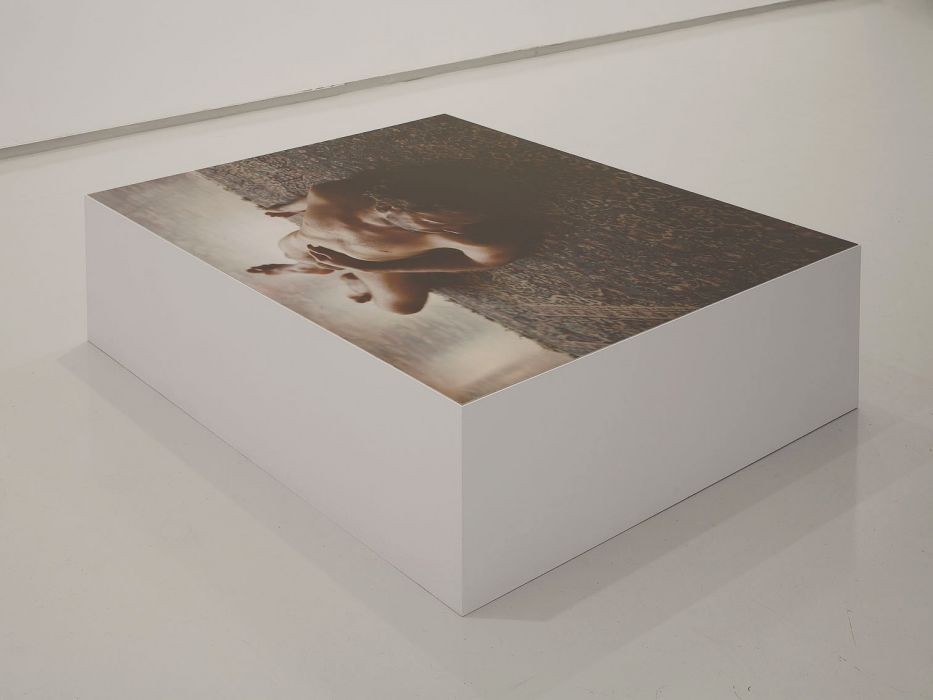
Distance, C-print, wooden Box, 100x104x35cm, 2008
Unseen, Styrofoam, 200x40x40cm, 2008
The Rope, Synthetic Rope, Wax, 2008
Drawing from 'the rope', Marker on Paper, 54x42cm, 2008

Who resurrects who out of obscurity: my work resurrects the tree or vice versa?


On my studio wall hung a photograph of a tree for quite some time. I had taken this photograph while traveling in Brazil a few years back. As you can see, the grand tree has been there for ages. The tree is dry, and looks like it is constantly turning around its axis; out of its trunk, branches are spiraling outwards (and inwards) as they flash their green leaves.


In this tree, located all alone on its own on the sandy shore—almost as if it were shipwrecked long ago, drifted onto this obscure and deserted coast—I find the duality of the monumental and the central against the peripheral and the neglected. For the tree is larger in size than a person, its presence, while it bends sideways, is both commanding and authoritative, and it is clearly acknowledged and recognized against the vast and sandy landscape; obviously immobile, the tree is charged with powerful motion. But, it is also easy to consider how distant, remote and concealed from the human eye the tree is; it is natural, secretive and hidden: spiraling back-downwards, forever concealing, and recollecting its ever expanding existence back to its root.


It is further easy to detect the latent energy with which each and every one of its elements is endowed; all of them aiming to burst out free, flashing before the eye as if they were omens, forecasting a powerful storm yet to unleash its devastating powers. Once more, on the other hand, the grand power and motion are held back; the motion is fixed, frozen as if it is contained within the frame of a single moment in time—encapsulating perhaps an ancient memory, the lesson and wisdom of forgotten storms of the past.


What I look for in my exhibition is a similar duality. Perhaps my exhibition is but this lonely tree off the shores of Brazil

Tree House

Nati Shamia-Opher / Tree House

Opening: 14/03/2008   Closing: 24/04/2008

Tree House, Installation view, Noga Gallery of Contemporary Art, 2008

Footprints of a figure


Traces of habitat


Nati Shamia Opher exhibits a complex installation. Its space might be an inside or a refined outside inhabited by different objects that merge between in and out, landscape and furniture, object and body.


An image of a dismantled tree with a tree house on its branches is spread unpicked on the gallery floor.


The tree parts are wrapped with felt, as though reunited; its joints are reconstructed by the hands of a specialist into a branched nervous system; its branches create a new weave that grows and takes over the gallery floor.


Near the tree a puddle carpet lies on the floor: its parts are a multiplied imitation of puddles that often appear on asphalt during winter. The carpet is a source of water – an imaginary infrastructure for a possible existence, for life.


The third object is a shadow of a mountain: a structure of light colored felt pockets stretching towards the ceiling like cells of a beehive – a potential layout for collecting and storage.


A possible place for being and, perhaps, for a safe existence of the body.


Nati Shamia Opher

What of the Night

Eti Jacobi / What of the Night

Opening: 31/01/2008   Closing: 07/03/2008

What of the Night, Exhibition view, Noga Gallery of Contemporary Art, 2008
Landscape with a Boat, Acrylic on Plywood, 110x120cm, 2007
Running Man, Acrylic on Plywood, 120x80cm, 2007
Landscape with a Man Running, Acrylic on Plywood, 80x120cm, 2007
Landscape in the Rain (Andromeda), Acrylic on Plywood, 80x120cm, 2007
Detail - Landscape with a Man Running, Acrylic on Plywood, 80x120cm, 2007

In the exhibition “What of the Night”, I present paintings of a lake in the forest during a moon lit enchanted night, filled with lovers,demons and floating fairies.


The landscape itself is freely based on the works of Nicholas Poussin. Through the epic painting of Poussin, full of talent gorged with the technical abilities of a master, I try to release a fairy-like act, made with little devious picturesque tricks. Using these elements, down to almost the lowest level of the ability to paint, I ask to stay loyal to the event of youth; through the moment I discovered the great painting, the art