Sea of Galilee

Orly Maiberg / Sea of Galilee

Opening: 10/05/2012   Closing: 22/06/2012

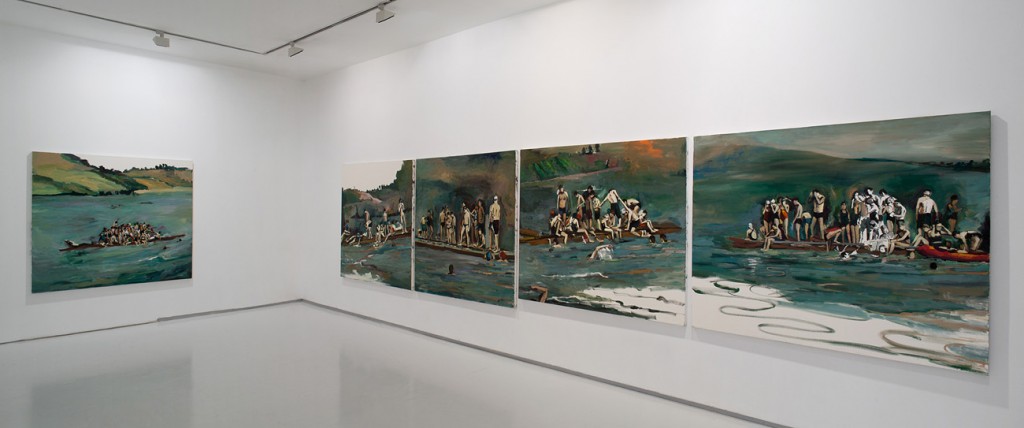
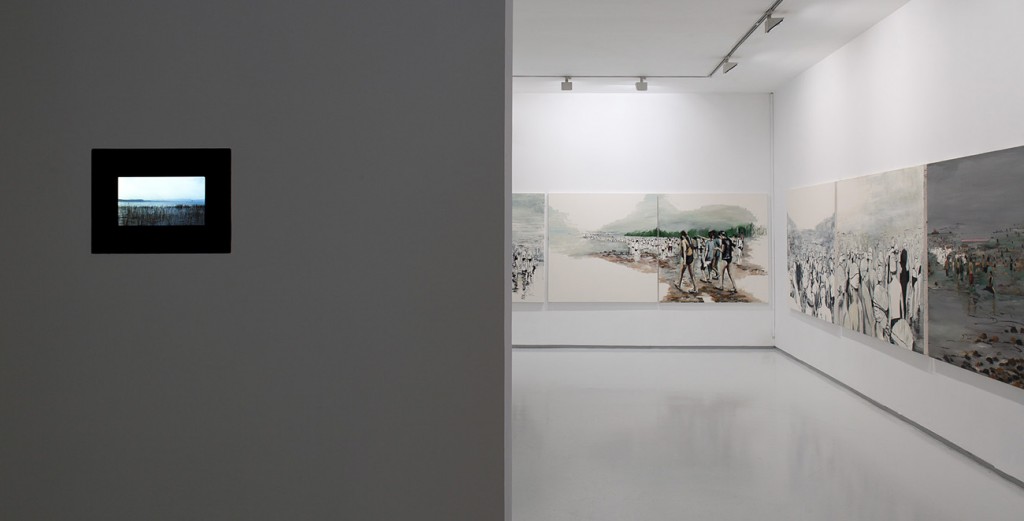
Sea of Galilee, Exhibition view, Noga Gallery of Contemporary Art, 2012
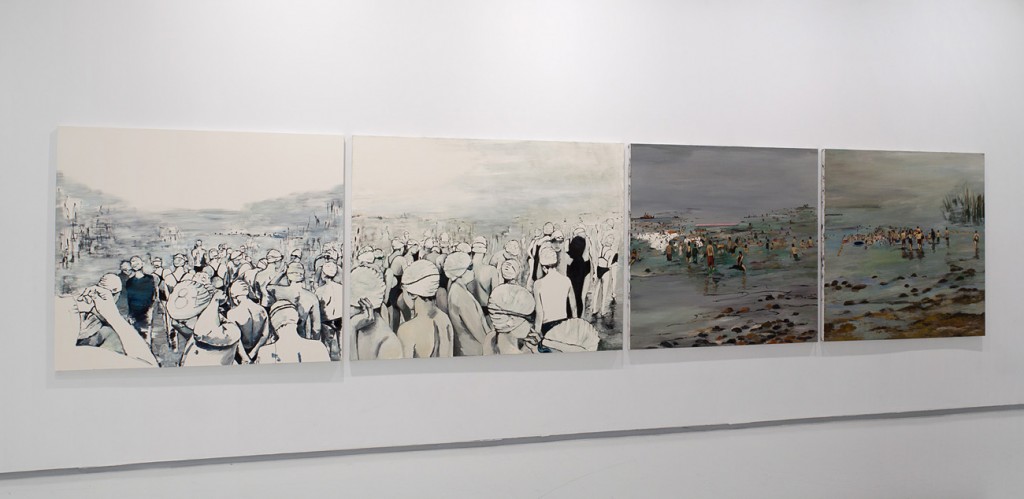
Untitled 4, oil on canvas, diptych, 2x140x100cm , 2012
Untitled 21, oil on canvas, 140x140cm, 2012
Untitled 15, oil on canvas, 150x150cm, 2012
Untitled 6, oil on canvas, 100x100cm, 2012
Untitled 3, oil on canvas, 140x180 cm, 2012

In her new exhibition, Sea of Galilee, Orly Maiberg returns to the sea.  But the sea is not the same sea.  It is not the expressionist, devouring sea, nor the gentle twilight sea of Tel Aviv-Jaffa, so familiar to us from her earlier exhibitions.  This is the Sea of Galilee with its religious, cultural and national symbolism as well as a mecca for sports, holidays, fun.


What begins as the popular sporting event of swimming across as a means of instilling in us a feeling of common national goals –- so precisely described by the Marxist historian Eric Hobsbaum –- suddenly changes.  It turns into defeat, persecution, escape, exile, into a search for a safe haven


The swimmers who begin their trek as sport become nothing but nameless survivors in its midst. They are crowded on rafts, elbowing one another on makeshift boats, trying to escape to an unknown future.  Their identity – if they have one – is given to them in the form of their number in the competition, whose rules have changed and now it is nothing but a trap.  The shores of the Sea of Galilee are not the shore that is visible on the horizon, nor the shore that is left behind, but a parallel shore – undesired one.


We leave them thus, abandoned to their fate, men and women with their roots in water, a mass, moving from here to there, from there to here.


– Ilana Bernstein

Misunderstood

Group Exhibition / Misunderstood

Opening: 22/03/2012   Closing: 03/05/2012

Hennessy Youngman, Misunderstood, Exhibition view, Noga Gallery of Contemporary Art, 2012
Wolfe von Lenkiewicz, Misunderstood, Exhibition view, Noga Gallery of Contemporary Art, 2012
Misunderstood, Exhibition view, Noga Gallery of Contemporary Art, 2012
Talia Keinan, Misunderstood, Exhibition view, Noga Gallery of Contemporary Art, 2012

Misunderstood

Curated by: Reply All – Yasmine Datnow and Maïa Morgensztern

Artists: Rina Banerjee, Talia Keinan, Wolfe von Lenkiewicz and Hennessy Youngman

The continuous growth of the technology of information and communication has changed people’s knowledge and understanding of each other; what were once commonly held stereotypes have been fractured by globalised experiences. A proliferation of information creates a reordering of beliefs and

this shift lead to misrepresentation and misunderstandings.


Misrepresentations of normality lead to the Uncanny and the displaced references that occur also blur any sense of self. This brings the potential for a new world order. As a shift takes place, identity issues arise. Communication between individuals becomes skewed, which emerge as duplicitous and enable artists to play with their audience through whimsical interactions. All these events encourage self proclaimed taste-makers to constantly challenge notions of taste.


As a result people learned behaviors are contest by illusory correlation, (the perception of a relationship between two variables when only a minor or absolutely no relationship actually exists). The various ways in which misinterpretation is visually manifested and where a sense of order can be rebuilt beyond this issue are explored through the work of Rina Banerjee, Talia Keinan, Wolfe von Lenkiewicz and Hennessy Youngman calling into question Taste and its connotations. The audience’s dialogue with the work evokes a reassignment of value by an ever-changing, self-elected class able to diffuse and shuffle information at speed.


Brooklyn based artist Rina Banerjee (Born 1963, Kolkota) moved with her family to the UK and then to America. In 1995 she completed an MFA at the Yale University School of Art after abandoning her career as a polymer chemist. She has a love of materials and enjoys theatrically re-staging their inherent meanings in sculptures and drawings, paintings and videos.

Like an alchemist Banerjee draws on her experiences growing up in different places, bringing items that act as cultural signifiers together in curious and enchanting compositions. The works have a magical feel and tell stories; their titles give a mythical introduction to the artist’s thought process. Her watercolor works explore a dream-like world where strange beastly but oddly endearing creatures are suspended in time, surrounded by hybrid flora and fauna. Sometimes a more sinister undercurrent pervades, giving us

a feeling that beneath the glimmer and shine, darker secrets lurk.


The work of Talia Keinan (Born 1978, Israel) is in constant flux. Her use of a variety of media refers to the existing realm that lies between reality and fantasy. The space she creates can be viewed as a world of its own, where sound unveils an obscure memory, and projected video on a drawing generates imaginative places. By navigating the space, the viewer initiates a dialogue between objects to create a private and associative experience. The materials are transformed as a personal narrative unfolds, creating an invented and autonomous world. Within her drawings and collages this alternative world remains for us to explore.

Wolfe von Lenkiewicz’s (Born 1966, Britain) chief artistic concern is the appropriation of language and mythology. He boldly experiments with hybrid visual combinations that straddle the murky borders of the shocking and offensive. His art historical intervention demonstrates our complacency towards imagery, namely those iconic works through art history. Our knowledge of them has become so much second nature that we take them for granted. It is not until they are disturbed that we realize how much confidence we place in them. The history of art can be understood as comprising of changes from one mode of visual representation to another. The difference is the highly contemporary and extreme nature of Lenkiewicz’s subject matter. The works demonstrates that no image is sacred and thus the artist is free to disseminate subject matter as he sees fit.

Hennessy Youngman (Born 1985, the Bronx) is a self taught art historian, who tutored himself about art and the inner-workings of the art world whilst working as a security guard at the Metropolitan Museum of Art, New York.


Youngman appears in direct-address to the Internet at large in online episodes of a series titled “Art Thoughtz” which began in early 2010. Most often, Youngman takes on the role of art or cultural critic while speaking about topics concerning art, race, gender, and popular culture. In his video monologues, Youngman becomes a tutor to an audience of hopeful artists in search of success. By explaining traditional art concepts and relating them to pop culture and real world examples, he is able to expose issues and conflicts within contemporary art society. A scheme is perpetuated, through Youngman and the “Art Thoughtz” videos, of following an often sympathetic character, one who is apparently outside the art world, attempting to understand and permeate a seemingly exclusive cultural society.


Curators:

At the beginning of 2012 Yasmine Datnow and Maïa Morgensztern started the company Reply All, having collaborated on projects for the previous 2 years.

Reply All is an agency specializing in curating, teaching, broadcasting and consulting for contemporary art, design and culture. Previous projects include the critically acclaimed group exhibition JaffaCakes TLV, a show in London featuring 7 artists from Tel Aviv. Ongoing projects include the radio show ‘Culture FRL’ for the radio station FRL (French Radio London).


Prior to their collaboration, Yasmine Datnow received a BA in the History of Art and Architecture at the University of East Anglia and an MA in Contemporary Art at Sotheby’s Institute. She became Modern Collections Coordinator at White Cube (2000-2004) and was an Independent Art Consultant and Curator (2004-2012).


Maïa Morgensztern received a BA, MA and M.Phil in Art History from La Sorbonne, Paris IV. She later became Art and Auction Manager at Robert Wilson’s Watermill Foundation, New York (2005-2008), Manager of the Ikepod by Marc Newson pop-up store at Phillips de Pury, London (2009) and Cultural Editor for French Radio London (2010-current)


Times in Acrylic and Oil

Natalia Zourabova / Times in

Opening: 09/02/2012   Closing: 15/03/2012

Times in, Installation view, Noga Gallery of Contemporary Art, 2012
Playground 2, acrylic on canvas, 120 x80 cm, 2010
Last Evening, acrylic on canvas, 290x190cm, 2011
Ester Skating, Park Jaffa, oil on canvas, 90 x 253cm, 2012
Crossing Sderot Yerushalaim Dereh Eilat, oil on canvas,94x195cm, 2011

My new exhibition, “Times in Acrylic and Oil” reveals achievements in painting and drawing distinctive from my last period of work.  The essence of the exhibition communicates the continuous moment of observing nature and space and the appreciation of the perpetual presence.


The work refers to the Israeli motif; today’s human life, its surroundings and its products. All my works are inspired by the people and landscapes in my local habitat, specifically in the Tel Aviv area and the Negev desert where I use to live and work. I found these new elements stimulating from the day I immigrated to Israel years ago. These paintings touch on memory, of what has been seen, lived and experienced. They are paintings about the present and emphasize the thrill of being in the moment. They are a celebration of timelessness.


The name of the exhibition refers to the technical foundations of the painting, the materials which I have consciously chosen to work with during the last few years.  The choice of material (acrylic and oil) is essential and has contributed to the arrival of my conclusion:  which specific language and material will direct me to the objective.


The Acrylic period is based on my digital, computer drawings taken from personal memories. They show the static, almost plastic, gigantic and story filled world that is closed from the inside. The Oil period is based on sketches from nature and aims to develop a new visual language in which there is a return to subjectively human ways of looking and picturing the world. This new period refers to unconscious knowledge and direct emotions that one experiences from the observation of nature.


Within this process I found myself working on elongated formats, suggestive of cinema screens or sheets of infinite papyrus which ancient people used in order to write texts that could be unrolled further and further. My choices in technique of lines, hatching, stains together with the very narrow arsenal of colors, almost all primary colors: yellow, red, orange, blue, green, and violet, is reminiscent of the simplicity or almost childish method of drawing by felt-tip pens. These works are less verbal than the Acrylic works. They are the result of describing the world in a million yet very simple signs and symbols.


Habitat

Group Exhibition / Habitat

Opening: 12/01/2012   Closing: 02/02/2012

05
04
01
02
03

Habitat


Participating Artists:

Nino Biniashvili

Talia Keinan

Gosia Machon

Amit Mann

Dragan Prgomelja


“Habitat” – the natural environment in which an organism lives, a geo-physical environment in which each present living organism has its survival needs fulfilled. A habitat is then a designated area: a home, other interior spaces, public territories, gardens, city squares as well as dream rooms. It is a space in which one can grow and potentially develop. Five artists from Germany and Israel aim at exploring their own personal habitats: The project aims to create a visual narrative, developed by the examination of each of the artists’ personal habitat. Their works inspect the personal habitat from its territorial context, how it is observed from afar, and their subjective sensations in it and around it. This exhibition and a book, published by Bookieman, are the outcome of this process. About Bookieman. Bookieman is an independent publishing house, funded by Nino Biniashvili and Omri Grinberg. Bookiemans’ focus is limited editions of artist books, with an emphasis on collaborations between writers, poets, illustrators, photographers and designers. Its focuses are on poetic, critical and thorough content.


Group Exhibition in the Project Room
This project is supported by the Ministry of Culture, City of Hamburg


“Habitat” – the natural environment in which an organism lives, a geo-physical environment in which each present living organism has its survival needs fulfilled. A habitat is then a designated area: a home, other interior spaces, public territories, gardens, city squares as well as dream rooms. It is a space in which one can grow and potentially develop.


Five artists from Germany and Israel aim at exploring their own personal habitats: The project aims to create a visual narrative, developed by the examination of each of the artists’ personal habitat. Their works inspect the personal habitat from its territorial context, how it is observed from afar, and their subjective sensations in it and around it. This exhibition and a book, published by Bookieman, are the outcome of this process.


About Bookieman:

Bookieman is an independent publishing house, funded by Nino Biniashvili and Omri Grinberg. Bookiemans’ focus is limited editions of artist books, with an emphasis on collaborations between writers, poets, illustrators, photographers and designers. Its focuses are on poetic, critical and thorough content.

Motel

Oren Ben Moreh / Motel

Opening: 22/12/2011   Closing: 27/01/2012

Motel, Exhibition view, Noga Gallery of Contemporary Art, 2011
Stop, Pastel on Paper, 100x150cm, 2011
Firey, Pastel on Paper, 70x100cm, 2011
Drawing Room 2, Pastel on Paper, 70x100cm, 2011
Black Magic, Pastel on Paper, 70x100cm, 2011
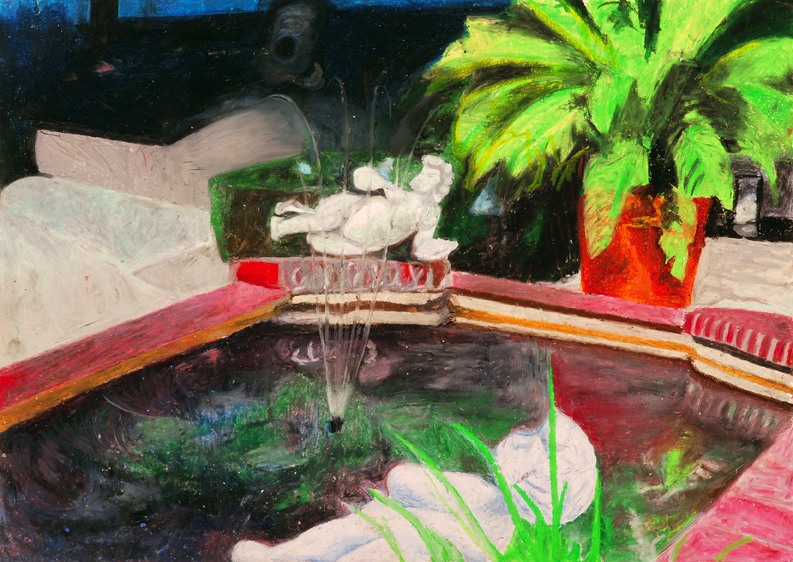
Fountain, Pastel on Paper, 70x100cm, 2011

Have you already seen Oren Ben Moreh’s paintings? Maybe in a moment. In any case, you’ve come in, and that’s pleasing. Because these paintings, which have been revealed or will be revealed to you in a moment, draw you in to the remote regions of the human mind, to those moments that manage to elude the brain’s synapses. To moments of a partly chilling, partly welcomed quietness. In a cold and warm or warm and cold painting. But, did the painting invite you to enter? Did the painting let you gauge it in the moment of encounter? Because the paintings, seemingly, are concerned with things that anyway do not pertain to you: an elusive moment of meaningless prevarication, waiting for something whose time has already passed, things that disappear because no one sees them. Here is not home sweet home. Here is the intimacy of the other. And maybe you are familiar with the painting’s intimacy, which stems from the voyeuristic gaze into the private realm, that privacy that is concealed by and constructed from the layers of paint – what seems exposed actually demands excavation and discovery, since the painting in fact conceals more than it reveals. Maybe it is not necessarily love at first sight.


Have you asked yourself about the women appearing in the paintings? Or is that actually clear to you? Is there something feminine in the paintings? Maybe in the fact that they prevaricate and mull things over, bursting with a raging storm of yes or no? And maybe here something and nothing live under one roof, masculine in its insolence, in its charisma? Either way, like a dolled up lady, the paintings are heavily, suffocatingly made up – layers of makeup cover all the pores, making it impossible to breath, impossible to distinguish between a streak of light and a lighting fixture.


True, there are no borders in Ben Moreh’s paintings, but in spite of that, and maybe precisely because of that there is a struggle. And what a struggle! One territory in the painting features the occupied territories, so filled with paint that it peels off the paper, and on the other side – gentleness, painterly cunning that tries to create clear images. But these images too seem restrained, not to say ashamed, for having dared to raise their heads and emerge from within the painting. Like these images, the painting too has not made up its mind yet whether it wants to be revealed or to remain mysterious – the insolence of the color, the opaque glow of the pastel, stand as a counterweight against the painting’s qualms.


The inevitable result of this struggle, which is at the heart of the painting, is death. And indeed, you can think of Ben Moreh’s painting as a made-up corpse. It shows a ceaseless concern with death and the space it creates, with the lack that is highlighted by death rituals and by the consciousness of death that flickers without warning into people’s lives. Often you can ignore this concern, but not here. This is painting that resists the advertisement, the instant, the self-flattery and the information superhighways that dominate art. Honest painting, which looks death straight in the eye without wrapping it with tiresomeness and kitsch, and that doesn’t wish to shout or glorify the naturally underpowered.


Against this background, you might want to notice the small details, how much consolation they offer, the single cup that holds all the consolation (however small), painted in front of the figure’s blurry face. How material are the fire and the background, like the Cliffs of Moher struck by the ocean waves, and yet how airy and light. Flowers sent to spread joy but destined to wilt momentarily, the landscape paintings that dream of the pastoral – all everyday objects whose presence is meant to make life easier; a corporeal world, full of matter, that tries to lift the spirit. Like the paintings themselves, these objects are completely material, but they evoke all thatpersists in a human being’s spirit – not in the sublime but in the human, in the living.


If you like, you can say that these paintings reside in the twilight zone, and they do indeed wonderfully produce such a twilight zone. In fact, the paintings keep subtle balances – in color, texture, images, composition – in order to linger as long as possible in this twilight zone and emphasize its importance. You too might want to join them, lingering for a moment inside your vacillations, identifying with this sense of indecision and letting your mind wander aimlessly. To leave the safe ground of reliable knowledge.


Matan Daube


Double World One World

Egill Saebjornsson/ Double World One World

Opening: 28/10/2011   Closing: 02/12/2011

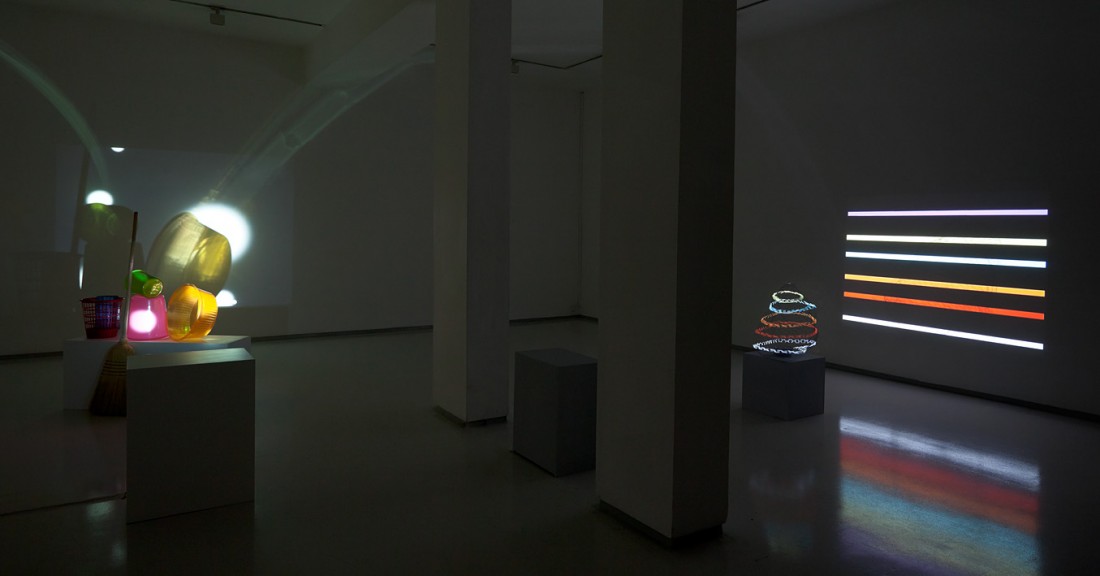
Double World One World, Installation view, Noga Gallery of Contemporary Art, 2011


Egill Saebjornsson was born in Reykjavik, Iceland, in 1973 and lives in Berlin. Solo exhibitions include shows at theKunstlerhaus Bremen,Watermill Center New York, Museum Fur Gegenwart Hamburger Bahnhof, Berlin, Reykjavik Art Museum and HISK, Ghent. Saebjornsson was shortlisted for the 2010 Carnegie Art Award (international touring exhibition until May 2011). In 2010, Saebjornsson exhibited at Gottingen Kunstverein, Frankfurter Kunstverein, Neuer Sachsischer Kunstverein and Biennale for International Light Art, eastern Ruhr area, Germany.


Egill Saebjornsson’s video installations bear witness to a complex background across a range of media. His recent video installations have developed out of earlier painting and performance work where music and imagery blend, almost alchemically, and where mundane objects are brought to life as they are amalgamated with art. Egill’s art is a witty mix of genres where 19th-century tableaux vivants find their way to Sesame Street. Although humor and absurdity play a significant role in his work, they always have an underlying seriousness to them in which the artist’s logic and existential thoughts can be noted.


Saebjornsson arranges his found objects to form a series of tableaux onto which light is projected. However, the video projectors not only make visible the items that have been placed in the room on white pedestals; they project a second image layer onto them and the walls of the exhibition space, creating layers of other light, forms, and colors in movement, allowing the objects to take on new dimensions when seen through the flickering light images, playing with perception and meaning.


Falling Petals

Ori Gersht / Falling Petals

Opening: 01/09/2011   Closing: 20/10/2011

Falling Petals, Exhibition view, Daily News, Installation view, Noga Gallery of Contemporary Art, 2011
Falling Petals, Exhibition view, Noga Gallery of Contemporary Art, 2011
Speck 04, archival pigment, 39x40cm, 2010
Hanami02, archival pigment, 120x150cm, 2010
Isolated, archival pigment, 120x180 cm, 2010
Night Fly 01, archival pigment, 120x80cm, 2010
Coming Down 01, archival pigment, 100x150cm, 2010

Floating Petals – Japan 2010

For many centuries cherry blossoms were, and still are, highly significant in Japanese culture. The rich and complex meanings of these blossoms constitute a matrix of interrelated concepts, associated with renewal, the celebration of life and good fortune, but also predicated by the ephemeral nature of life, death and rebirth.


In other words, the symbol stands for process and relationships, not an isolated concept. In the 19th century, with the beginning of the Meiji era, when Japan begun its modernisation, militarization and colonial expansion, the symbolic meaning of the cherry blossoms was re-appropriated for nationalistic and military purposes. It is precisely because cherry blossoms stand for life, predicated by death and rebirth, that the Japanese military were able to tip the scales and exploit their symbolism in terms of death instead of life. For the imperial state, the virtue of cherry blossoms was not the life force represented by the petals as a full flower, but was instead the premature fall of the virginal petals as symbols of the sacrifice made by the young soldiers, since to die without clinging to life was a concept later introduced by the state to convince Kamikaze soldiers to plunge into death.


The symbolism of the cherry blossoms was transformed from full blooms as a life force to individual falling petals as a representation of the sacrifice of soldiers and their subsequent rebirth. The work that I produced in Japan between April and May 2010 meditates on the life and death dialectics that are symbolically imbedded in the life cycle of the cherry blossom. In the course of my journey I was moving between the cities of Tokyo and Hiroshima, both of which were damaged during World War II, and ancient locations and temples in the remote regions of west Japan. This geographical dichotomy allowed me to develop a visual dialectic between the historic and modern symbolism of the cherry blossom. The trees that I photographed in Hiroshima and Tokyo were all planted after the war.


In post A Bomb Hiroshima they are all fed from the nuclear contaminated soil, while in Tokyo they are often associated with death and nationalism, located in Kamikaze memorial shrines and around the imperial palace. In contrast, the trees that were photographed in the remote regions are ancient and were not affected by the war. These trees are often located in the vicinity of Buddhist temples and are associated with the force of life.


Solar Eclipse

Group Exhibition / Solar Eclipse

Opening: 14/07/2011   Closing: 12/08/2011

Solar Eclipse, Exhibition view, Noga Gallery of Contemporary Art, 2011

SOLAR ECLIPSE Group Exhibition


Oren Ben Moreh, Maya Bloch, Marik Lechner, Noga Shatz


The expression Solar Eclipse is comprised of 2 words: Solar – Sun, Eclipse – Disruption. A Solar Eclipse occurs when the Earth, the Moon and the Sun are situated on the same axis; the moon blocks the view of the Sun or part of it. A total Eclipse results in a complete obstruction of sunlight or what is known as Black Sun. Through out history the eclipse was considered to have a supernatural influence as a result of the fear it aroused.


The expression Black Sun is also a metaphorical and refers to one of the most common phenomenon’s of modern life: depression and melancholy. Most of the works in the exhibition possess the occurrence of disruption, a creative distortion of the chaotic world, reckless and mysterious. The exhibition as a whole is immersed in a black darkness, as if covering the works with a thick blanket. The works are compressed with layers upon layers that are created through expressive energy.


The Black, through its density and material quality, takes over everything, the unusual images flicker through, images connected to mythology and architypes, revealing psychological states and consciousness that shifts between reality and illusion, a place and no place. Oren Ben Moreh – Born in Israel 1982, Graduate of the Midrasha, 2004. Maya Bloch – Born in Israel 1978, MA Graduate, History of Art from the Tel Aviv University, 2004. Noga Shatz – Born in Israel 1978, Garduate of the Midrasha, 2007

Killing Time

Jossef Krispel / Killing Time

Opening: 28/05/2011   Closing: 02/07/2011

Killing Time, Exhibition view, Noga Gallery of Contemporary Art, 2011
Untitled, Oil on canvas, 130x170cm, 2011
Untitled, Oil on canvas, 100x120cm, 2011
Untitled, oil on canvas, 120x150, 2011
Untitled, oil on canvas, 150x120cm, 2010
Untitled, oil on canvas, 130x150, 2011
Untitled, Oil on canvas, 70x90 cm, 2010

Jossef Krispel’s new Solo Exhibition includes video art, an artist’s book and a series of new paintings.


The exhibition is named after the video (KILLING TIME), which shows a dazing sequence of pornographic drawings. These drawings, created over the past two years (2010-2011), were scanned and united as a hard back book (of 350 pages) and became the works ‘origin’. The drawings derive from pornographic websites, interwoven amongst them are images from the artist’s photographs. By combining the works title three different interpretations are evident (Time to kill, Kill time and Time that kills), however the artist doesn’t account for its contents, he is interested in the world of images, time and photography – elements that characterize Krispel’s painting. The entire exhibition deals with a process, in the diligence of painting and drawing in the studio and in the underlying potential in the search after the existent; in both the reduction and expansion.


The video art is a varying loop, it’s duration is 11:10 and is composed of 220 drawings, accompanied by music taken from a Magnificat of Bach, called Fecit Potentium (in Latin: “He who has done”; glory song to the creator). The video is a kind of paraphrase of the book; an accelerated animation of pornographic drawings. From time to time the sequence is interrupted and a single drawing is shown for a fraction of time, in away that seems coincidental, clarifying the content of the images whose sequence is shuffled.


The new paintings encompass an evident return to photography as the source that painting is drawn from. In the lighting, framing and in their contemporary essence to evoke form and character. The portrayed images are taken from worlds that Krispel has wandered amongst over the past decade; dioramas, classical remnants, deer and birds, flora, portraits and different scenes from the artist’s photographs. In the current series, motivation is focused directly towards body and expression, the artist moves between the images like a photographer but acts amongst them like a painter.


The new paintings encompass an evident return to photography as the source that painting is drawn from. In the lighting, framing and in their contemporary essence to evoke form and character. The portrayed images are taken from worlds that Krispel has wandered amongst over the past decade; dioramas, classical remnants, deer and birds, flora, portraits and different scenes from the artist’s photographs. In the current series, motivation is focused directly towards body and expression, the artist moves between the images like a photographer but acts amongst them like a painter.

Daily News

Lea Avital / Daily News

Opening: 14/04/2011   Closing: 26/05/2011

Daily News, Installation view, Noga Gallery of Contemporary Art, 2011
Hearing problems, ping pong balls on newspaper ad, 30x30cm,2011
Daily News, Installation view, Noga Gallery of Contemporary Art, 2011

By Noami Aviv


It is the same minimal intervention that characterizes Lea Avital. It is the same loyalty to material and shape: loyalty and an obligation to detail, specifically and globally, and for the transformative potential that is hidden within. Lea Avital has the capability to capture situations that are both static and withhold the possibility for infinite movement. The potential multiplication is described in her capability to isolate identity and expose the confined other in the same identity.


A poetic flash, a gesture of laughter and thinning minutes transform Avital’s creations as easygoing, presentable and airy. Her works, as if they are drawn from her sleeve, maintain that aspect of magic and epistemological illusion: the figure from which they appear and disappear. They have an enduring tension between material and anti-material, inside and outside, movement and standstill, transparency and reflection. Between nothing, made out of sparse materials and that is content with no paint (black and white) and between something that seems loaded and rich and above every enigma. Every piece contains the same quality that is carried out through her contact with the common materials, one of which includes happening and creation. The same contact can be initiated through nature or circumstance. In this manner she has presented her photograph of a branch casting a shadow on a board of a basketball net that is situated in the yard. Avital’s photograph focuses on the meeting point between the shadow and the board, where the net should have been and is without. In this point of the net, there was either injury or a meeting between two things.


Things happen to her on the way, while walking, between things, while she is in awake, conscious and in an inert state of mind; a situation of repeated movement, movement that is closed inside itself, in other words, movement that describes a form, a shape and a concept. In order to explain this plainly we will imagine Lea walking, her actual action of walking as a looped mechanism. In the process of walking she collects and gathers objects that represent her general vibe, things that hint of the possibility of an infinite movement, feasible or imagined. Her motivation to collect, touch, divert, “to solve” or to photograph is the same motivation. The objects that are likely to interest her as objects will interest her also as photographs.


There is a bond between objects, photographs, drawings, prints. Actually everything seemingly works as a system that is almost closed and that the key to understanding is the model of repetition. The system is an installation which is positioned as a collection of fragments of prose, a collection of “contacts”, “connections”, “moments” which create the beating space in a mechanical simplicity. Beating as a simple pump. Like a heart.