Blank Rainbow

Eti Jacobi / Blank Rainbow

Opening: 24/02/2011   Closing: 08/04/2011

Untitled 13, acrylic on canvas, 100x100 cm, 2011
Untitled 8, acrylic on canvas, 100x100 cm, 2011
Untitled 7, acrylic on canvas, 100x100 cm, 2011
Untitled 10, acrylic on canvas, 100x120 cm, 2011
Untitled 6, acrylic on canvas, 100x100 cm, 2011
Untitled 3, acrylic on canvas, 100x100 cm, 2011
Untitled 11, acrylic on canvas, 100x100 cm, 2011

Shangri-La

Orit Raff / Shangri-La

Opening: 13/01/2011   Closing: 18/02/2011

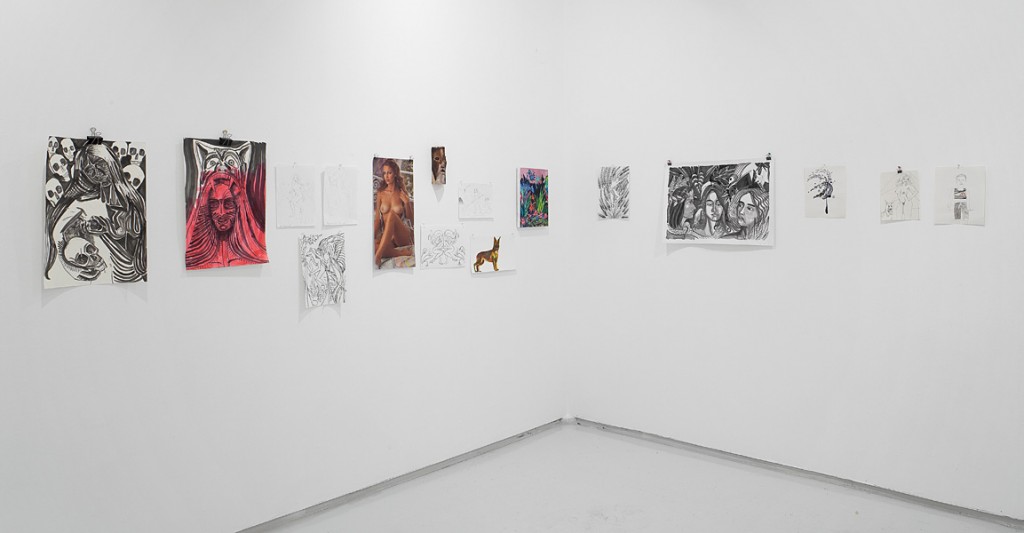
Shangri-La, Installation view, Noga Gallery of Contemporary Art, 2011
Untitled #6, lambda c-print, 74x100cm, 2009
Untitled, lambda c-print , 50x70cm, 2009
Untitled #3, lambda c-print, 50x70cm, 2009
Untitled (pool), lambda c-print, 110x150cm, 2009-2010

“I therefore claim to show, not how men think in myths, but how myths operate in men’s minds without their being aware of the fact.” — Claude Levi-Strauss, The Raw and the Cooked


Shangri-La—an imaginary earthly paradise, a fictional, mythological utopia in the Himalayas, was first described in James Hilton’s 1933 novel Lost Horizon: a happy, isolated place whose inhabitants are virtually immortal. Shangri-La is a Western invention, an Orientalist fantasy.


In my work I embark on a virtual journey into Shangri-La. From the website of a hotel chain named Shangri-La I borrowed PR and advertising images featuring interior spaces and artificial nature intended to attract tourists. I manipulated these images by erasing details such as tourists and waiters, and adding others of my own in their stead in a near-Sisyphean work process striving to generate tension between a luring paradise which abruptly turns into Hell; the fantasy of perfection dissolves. The hotels exist in the real world, but the images used to market them are a-priori processed and manipulated; images that strive to create a dream, to reconstruct a mythology by real means. The boundaries between fact and fiction become blurred; spaces ostensibly symbolizing perfection, tranquility, and idyll nature forthwith become threatening, uncanny, artificial, and hackneyed; the myth is shattered—furnishing me with a fertile ground for exploration.


I intentionally employ readymade, web-based images, rather than photographing the sites myself, since these loci are based on nonexistent mythological sites, much like my own journey. This work corresponds with previous works which explored bodily traces in various spaces—at home, school, etc. Here, the traces are the erasures and additions. Shangri-La is a constant quest for the unobtainable; a fantasy about another, far-removed, different place; a Sisyphean pursuit, symbolizing perfection and utopian ideals that do not exist.

Lilian Adventures

Galia Pasternak / Lilian Adventures

Opening: 18/11/2010   Closing: 31/12/2010

Lilian Adventures, Exhibition view, Noga Gallery of Contemporary Art, 2010
Lilliane in the Forest of the Dogs, oil on canvas, Lilliane in the Forest of the Dogs, oil on canvas, 25x35cm, 2010
Liliane in the Crystal Ball, oil on canvas, 35x25cm, 2010
Lilliane and the Butterfly Twin, oil on canvas, 25x35cm, 2010
Lilliane and the Twilght Dance, oil on canvas, 30x40cm, 2010
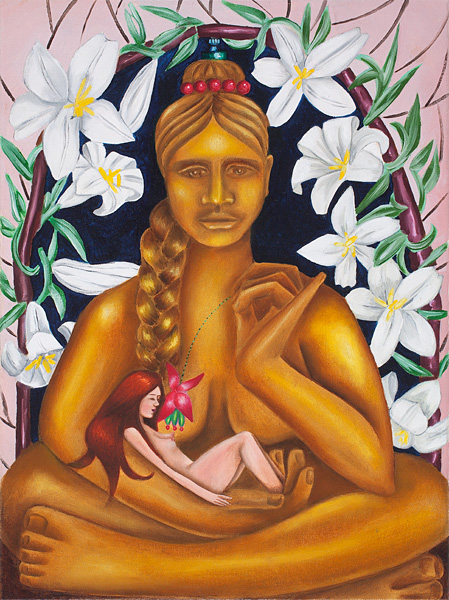
Lilliane on the Lap of the Goddess of Flower Art, oil on canvas, 40x30cm, 2010

“Lilian’s Adventures”, Galia Pasternak’s solo exhibition in Noga Gallery, presents a new series of surprising and fascinating paintings. The series follows the tails of Lillian, a fictitious mythological character, a “super hero” living and moving around between areas of fictional nature, culture and history. The character’s image is based on a playboy centerfold from 1980, “a time when soft porn still corresponded with traditions in classical painting, in relation to the way the female nude was presented and perceived” says Pasternak. “Today’s representations of nudity in porn have almost no connection with reality. Sexual stimulants may need such extremities of blown up images verging on the grotesque, in order to climax. A picture of a beautiful woman with small breasts, sitting crossed legged and hiding her privates, seldom arouses these days”.


Similarly, the nudity in Pasternak’s paintings is na?ve, harmless and unaware of itself. Thereby the viewer is freed from the moral duties that normally confront him in voyeuristic situations.  Our heroin Lilian corresponds not only with the playboy centerfold but also with Eve, Venus and Maria Magdalene. A character of a naked vagabond wandering around a wild, dangerous and beautiful world brings to mind grand tails of voyages by religious characters and comic- book heroes.  Each picture becomes an epic event, concentrating the culmination of the scene- a moment of clarity, of grace, of danger or of pleasure. Pasternak tells the tail of her fictitious heroin Lilian and gives every event a mythical title: “Lilian and the dream on the rocks”, “Lilian inside the dragon’s maw” or “Lilian in the showers of milk and honey”. These titles connect the character to the so called male dominant world of religious myths.


The world Pasternak has created simultaneously brings to mind other examples of references in art history, such as Rousso, Blake, Botticelli, Fuseli, pre- Colombian painting, comics, a mixture of east and west. “This multiculturalism merges ‘high’ and ‘low’ art and allows me to paint the way I like, to say practically anything I wish to say and showcase what I find to be most beautiful. In general, I want to show mostly beauty in my painting, I want to give the viewer an aesthetic pleasure as well as consolation, as if I was sending out a message of kindness. I wish my painting to communicate a narrative coherently” says Pasternak.  While her previous large and colorful work, were always charged with a bizarre, circus like, bitter- sweet tension between animals and human figures, in her current series there is a more organic, even symbiotic relationship between Lillian’s character and different signs of danger or threat. She doesn’t fear threat and rather approaches it as an equal, with no known history, which is exactly what allows her to blend in and consequently win.


In addition to the paintings exhibited in the main gallery space, Pasternak reveals in the project room photographs, sketches and paintings that are in fact a “behind the scenes” look in to the “Lilian’s Adventures” exhibition. The materials she worked with in creating the character, her distinguishing traits and her environment. A supposed peek into the private studio space Pasternak worked in, almost uncensored. A space where the magic of the final art work fades and you can see the “actors” without their costume, in their “real life”. “I find this aspect very intriguing and I deal with it many times in my work. The “making of”- to see a painter paint, to see what goes into the process of his work. Mainly, to see the difference and the distance between what the painter did with the image he chose and the finished product. I find it to be like a detached look at the exhibition, like an exhibition inside an exhibition”.


Galia Pasternak, born 1977, lives and works in Tel Aviv.
Has a BFA with honors and MFA from the Academy of Arts, Bezalel. Studied as part of the student exchange programs at the “Slade” school in London and at the “Ecole de Baux Arts” in Paris. Showed in dozens of group exhibitions in Israel and abroad. In 2008 she published an artist book named “Clips” that accompanied her solo exhibition at the Haifa Museum. Has also had solo exhibitions at the Artist Studios in Tel Aviv and at Noga Gallery.


Last Watch

Talia Keinan / Last Watch

Opening: 16/09/2010   Closing: 30/10/2010

Last Watch, Installation view, Noga Gallery of Contemporary Art, 2010
Smoke Bomb, mixed media on paper,21X29cm, 2007
The Cooler, ink and oil on paper, 65x50cm
Burning Wood, mixed media on paper, 24.6X34.5cm, 2010
Empty Hours, mixed media on paper, 29.5X42cm, 2009

Talia Keinan’s solo exhibition marks the opening of the 2010-2011 exhibition season at Noga Gallery.


The exhibition is a development drawn from Keinan’s solo exhibition at the Goch Museum in Germany, held last March, which was accompanied by a catalogue.


Keinan shows five new works which combine murals and installations with video projections. The entire space is surrounded by sound created by the musician Gai Sherff, Keinan’s partner.


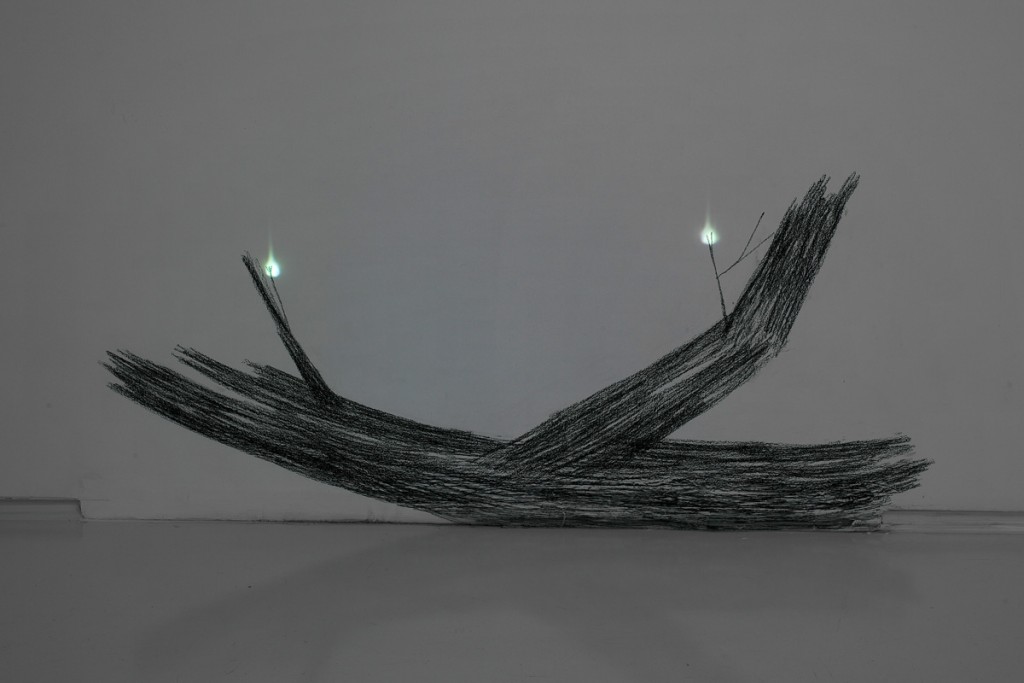
Keinan turns her work into living surroundings, through her use of light and sound. As in her earlier work, she creates an environment assembled of drawings, installations, sound and video projections. Each piece works individually and nevertheless, they come together as one organic and vivid environment, bracing the whole space with a continuous flux of movement, light and sound, the combination generating a magical surrounding. This mysterious ambience, with its many occurrences, almost gives the impression that the works are autonomous: the mountain comes to life, the wishing well shimmers from broken glass and coins. An animal moves restlessly in its cage.


In the project room Keinan shows a collection of new drawings and paintings.


Talia Keinan, 32, has shown over the past few years an outstanding record of work in the Israeli art field, her work being an inspiration for many artists. Among her awards are the Anselm Kiefer Prize for a young artist and the Tel Aviv Museum Gottesdiener Prize. She has held solo exhibitions at the Tel Aviv Museum, the Goch Museum, Germany, and Art Basels’ “Art Statement”.

July

Group Exhibition / July

Opening: 23/07/20103   Closing: 13/08/2010

July, Exhibition view, Noga Gallery of Contemporary Art, 2010

A summer group exhibition- new works, new faces.

Participating artists:

Lea Avital

Ilit Azoulay

Oren Ben Moreh

Michael Halak

Shahar Yahalom

Porat Salomon

Max Friedmann

Jossef Krispel, Orit Raff


B-Side Paintings

Orly Maiberg / B-Side Paintings

Opening: 10/06/2010   Closing: 16/07/2010

B-Side Painting, Exhibition view, Noga Gallery of Contemporary Art, 2010
Kris Kristofferson, watercolor on canvas mounted on cardboard, 30x30cm, 2010
Beck I, watercolor on canvas mounted on cardboard, 30x30cm, 2010
JEFF BUCKLEY, Grace, watercolor on canvas mounted on cardboard, 30x30cm, 2010
Bruce Srpingsteen, watercolor on canvas mounted on cardboard, 30x30cm, 2010
Beck II, watercolor on canvas mounted on cardboard, 30x30cm, 2010
P.J. Harvey I, watercolor on canvas mounted on cardboard, 30x30cm, 2010

B-side is a term borrowed from the 1950s’ world of music. The A-side was the side with the hit, the music that would be heard on the radio. The B-side was the underside, but with music close to the heart of the performer.


Besides painting playing music to myself


In the exhibition B-side, there are about forty portraits of musicians drawn from their photos on the record sleeves. The format of the paintings is square and uniform – 30 by 30 cm. (2 cm. less than the vinyl sleeve). The intimacy of listening to music pervades the painting. The physical contact with the surface of the painting reminds us of how we approach the sleeve of a record: holding it close up, examining the contours of the portrait as if looking at our own face in the mirror, turning it over – anyone who has ever played records is familiar with the process.


This is the way in which we achieve intimacy with something that is popular, anonymous and not ours alone. The embodiment of the personal and private within the general. After all, the image on the sleeve is reproduced again and again and again in millions of copies and subjected to the gaze of millions of pairs of eyes. This particular image is at one and the same time a personal memory that enfolds within itself something almost totally my own and is, at the same time, the product of an endless production line. For a moment I disturb this impossible but inescapable oneness and, almost literally, demand my part.


The collection of portraits in this exhibition are my gang of friends, PJ Harvey, Patty Smith, Jeff Buckley, Beck, Nancy Sinatra, Nick Drake, Marianne Faithful, Johnny Nash, Tim Buckley, Cat Power Stephen Stills and many others. I play Tim Hardin and paint his portrait not only according to the photograph but also in response to the music, the song, the text. The portrait of P. J. contains the sound loop in the studio, the sound of the tape as I drive, the memories attached to the song. The portrait on the canvas – immersed in my listening experiences – is not always identifiable.


Sonny and Cher’s “I Got You Babe” performed by Orly Silberschatz and Avi Baleli Alongside the portraits, as part of the work of the exhibition, I invited Orly Silberschatz and Avi Baleli to video tape a version of Sonny and Cher’s familiar and beloved song. Originally it was an A-side. Compared to the youthfulness, innocence and promise of the original, the version of Silberschatz and Baleli is full of pain. It is the same text invested with another experience, mature, disappointing, and scarred. It promises nothing to anyone, except perhaps loneliness. That is a B-side version.

Places That Were Not

Ori Gersht / Places That Were Not

Opening: 29/04/2010   Closing: 04/06/2010

Places that are not, Exhibition view, Noga Gallery of Contemporary Art, 2010
Drape 02, 100x100cm, 2008
Green Swamp, 150x120 cm
Swamp 02, 120x150cm, 2008
If Not Now When 02, 100x240cm, 2008
Ashes, 150x120cm, 2008
Swamp 01, 120x150cm, 2008

The artist is showing photographs from two bodies of work made in 2008 and 2009, Hide and Seek and Evaders.


Hide and Seek


As in previous series, Gersht’s depictions of landscape address ideas about memory, history and identity. They are images of places or journeys that are simultaneously physical and metaphysical, partly real and partly mythological. Photography’s claim to truth is questioned and rather than being presented with the depiction of a specific moment in time, the viewer is left instead with images that are suggestive of something that happened in the past, or might happen in the future.


The photographs in the series Hide and Seek depict hidden swamps and marshes located in the remnants, on the borders of Poland and Belarus, of the vast primeval forests that once covered most of Europe.


Gersht was seeking locations that at times of political conflict, during the Second World War, had become places of refuge for partisan communities.


Hide and Seek attempts to explore the dialectic between metaphysical and real places. Photography can only depict the reality that is physically present in front of the lens, and Gersht was interested in finding places to photograph that do not, or did not exist on the map and that therefore may be referred to as ‘nonplaces’ or voids. In doing so he attempted to take the photographs out side of the physical confinements of a place or a time and to relocate them in a subjective psychological space. This journey in search of the remote and historical hides was realized in a series of images that attempt to depict absence.


In these large-scale panoramas the horizon line is often dissolved and the special perspective is compressed, this visual approach enabled Gersht to unify the spaces and blur the distinction between reality and its reflection causing the images to liquefy and reappear like a mirage out of fragile stained colours.


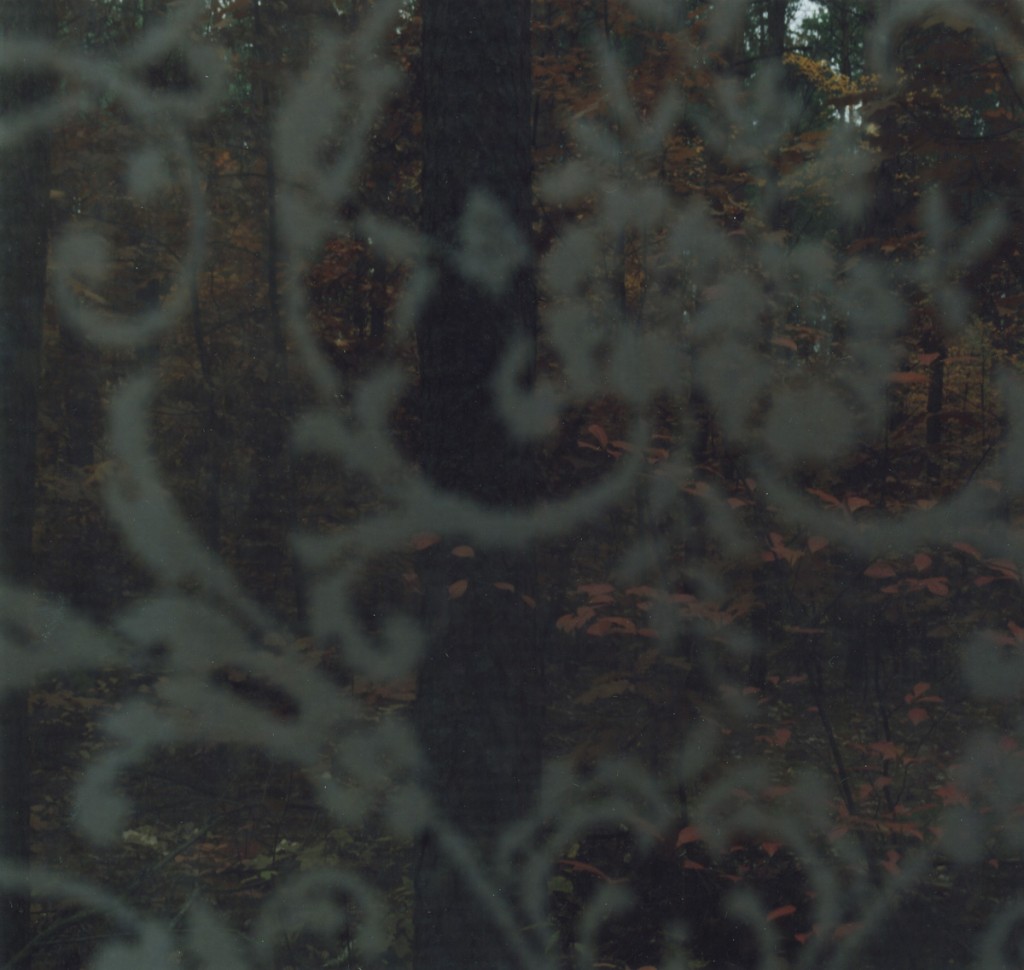
In conjunction Gersht also took photographs in the vicinity of Sobibor forest where the sobibor death camp once sited and quickly replace by trees, whose routes thrived on the ashes below the surface. The photographs were taken through net curtains that traditionally are used by the local villagers to delineate public and private space. In doing so Gersht diminished the perspective and created the illusion of the lace and the landscape melting into one another while disguising and revealing each other.


Evaders


The long panoramic images in Evaders were photographed in the Pyrenees along the Lister Route, on the border between France and Spain. This route is symbolic as a place of transition, suspended between past and future. It has a long history of smuggling, economically motivated migration and the search for refuge from political or religious persecution. During World War II many used this route to escape Nazi occupied France. One of these was the critic and philosopher Walter Benjamin, who committed suicide after he found the border closed on the day he attempted to cross it in September 1940. Benjamin’s failed escape has become tagged with a prophetic forecast of the impending cataclysm in Europe.


The clear visual references to German Romanticism in Gersht’s photographs, particularly to the paintings of Caspar David Friedrich, are suggestive of a fatal attachment to German culture that prevented Benjamin, like many others, from grasping the horrific scope of the Nazi agenda until it was too late to escape its consequences. Since the introduction of the Single European Act, the physical borders are no longer there, but Gersht’s work raises questions about the continued existence of cultural and psychological borders.


Ori Gersht was born in Tel Aviv in 1967 and studied at the Royal College of Art in London. He has exhibited internationally since 1999, including solo exhibitions at the Art Now room at Tate Britain (2002) the Tel Aviv Museum (2002), The Photographers’ Gallery, London (2005/06,) the Yale Center for British Art, New Haven (2008) and in the Black Box at the Hirshhorn Museum Washington (2009). He lives and works in London

It could have been otherwise

Roi Kuper / It could have been otherwise

Opening: 18/03/2010   Closing: 23/04/2010

It could have been otherwise, Exhibition view, Noga Gallery of Contemporary Art, 2010
Untitled, color print, 240x300cm, 2010
150x60
Untitled, color print, 30x40 cm, 2010

In the main space the artist is showing two large scale works, each divided into nine parts. One shows yellow flowers that resemble little bonfires, hovering on a black background. The other shows a bush on rocky soil, at a water source’s ledge. The sunlight eliminates the bush, so it seems to be on fire. The enlargement of the image, which usually entails a loss of sharpness and information, provides the images with a sensual, hypnotic physicality. The lack appears as excess.


The disintegration of the image delays the gaze and brings up the question of selection that is intrinsic to photography, including the choice of what is kept and what is lost. The absolute black and the burnt white seemingly mark the boundaries of visibility; however, here they are part of the image. The image in this case does not exclude the present element (the absent) from the visible, but allows the exploration of the relations between the visible and the absent. The absent appears in the figure of the opaque black and the blinding white, and in this manner penetrates the space of the visible.


If it were possible to observe each part of the image as a separate image, one might have asked about the almost completely black in the work with the yellow flowers. It is hard to see anything, and yet this part is essential, and it is there, laid in front of the viewer, widely opening an infinite space which is subjected equally to viewing and imagination.

The large works are not framed and thus, in the upper part of the work with the flaming bush where shines a bright white light, the boundaries of the image are unraveled. The absence of a frame allows the image to break out of its own ends, to break out from the position of an object into the site in which the observance takes place.


The bush, consumed by the sun’s rays, brings to mind the biblical burning bush. The burning bush is the site where the ultimate unseen (god) appeared in the domain of the visible.


Another work shows a primordial landscape. Blinding light floods the frame’s upper part and the skies mix with the earth. A black spot, the source of which is not clear, penetrates the frame and threatens to undermine the serenity.


In the Project Room the artist is showing 4 works in which yellow butterflies turn into sparks of fire hovering above a green field.


The intervention in the captured image reveals itself to the viewer at first glance. This action claims the attention, denying the source in favor of the image, choosing what is there for what could have been. The overwhelming beauty, the so sought after sublime, is not out there waiting for the photographer’s wandering gaze, but is rather extracted from within the image through an act of alchemistry, springing out of it in a full annihilating eruption. The fire takes hold of the image.


The shining light is repeated through the works, as though allowing the metaphysical to be revealed as concrete, to be seen.


Liat Lavi

Hogwarts

Group Exhibition / Hogwarts

Opening: 28/01/2010   Closing: 12/03/2010

Hogwarts, Installation view, Noga Gallery of Contemporary Art, 2010

Gili Avissar, Roey Heifetz, Andrey Lev, Sagit Mezamer


‘Hogwarts’ is not a thematic exhibition: the thread connecting the four participating artists- Andrey Lev, Gili Avissar, Sagit Mezamer and Roey Heifetz- is hardly that of theme, technique or medium.


The four are recent graduates of the Bezalel Academy M.F.A and advanced studies program, whose works stood out at ‘Haroshet’ (“industry”), the 2009 graduation show.


In this aspect, ‘Hogwarts’ (named after the school of witchcraft from the ‘Harry Potter’ book series) is a kind of continuum of the ‘continuing studies’, a showcase that preserves something of the interactions and reciprocal influences typical of a framework of joint studies and artistic practice.


However, the grouping of these four artists in a new exhibition less than a year after their graduation show, consists not merely in marking a transitory phase for them, but also gives the opportunity to follow some fascinating artistic trends whilst they are emerging; for in ‘Haroshet’, one couldn’t help but sense a new and spectacular direction: risking a generalization, there appeared to be a turn from the text-image direction, one that is so common and familiar in Israeli art, to a different direction- that of image emerging from matter.

Carrots & Refreshments

Amikam Toren / Carrots & Refreshments

Opening: 18/12/2009   Closing: 22/01/2010

Carrots & Refreshments, installation view, Noga Gallery of Contemporary Art, 2009
Refreshments (Video Installation), Still from Video, 2009
Carrots (Video Installation), Still from Video, 2007
Carrots (Video Installation), Still from Video, 2007 (4)

In his new exhibition “Carrots & Refreshments”, Amikam Toren will show two new series of video works from the years 2008-2009, a sculpture, and paintings from the series “Armchair paintings”.


About the videos: Twelve stories, strangely moving tales touched with humour, edged with the surreal. True stories, narratives of experience from the artist’s life, selected from a period of 40 years.


The precision of observation and the almost casual, natural humanity are arresting but, while the narratives themselves are deeply affecting, their form as voice-overs to fixed camera films of the scene of their occurrence has a powerful impact on our perception of location. Background and foreground, setting and story, softly change places as our listening and viewing shift as impulses to imagination.


Six short tales assembled into a seventeen minute anthology of acute reflection.


In Toren’s work the most elemental form or mundane object has its very material redeployed to suck out hidden meaning. It’s an alchemical process: a little assistance, a redistribution of resources, is all that is required to reveal the energy and significance contained within dull matter. Object, sign, experience, each and every casually accepted, and more often discarded, mundanity is open to challenge, transformation and adjustment, teasing out truths beyond its basic nature. In this exhibition, short deadpan videos, paintings and the orange peel sculpture are revealed as harbingers of formal and fanciful delight