Monochrome

monochrome / group exhibition

opening: 24/05/2024   closing: 31/07/2024

Alexandra Zuckerman, Indanthrene Blue, 2024, soft pastel on paper 102 × 72 cm
Alexandra Zuckerman, Scarlet Red, 2024, soft pastel on paper 102 × 72 cm
Joshua Borkovsky, Dream Stones 25, Oil on wood, 40 × 40 cm
 Joshua Borkovsky, Echo and Narcissus (Dyptich), 2020 Distemper on gesso on wood 81.5 × 70 cm
Yitzhak Livneh, The Invention of Photography 8, 2012, Oil on canvas 100 × 100 cm
Yitzhak Livneh, Adonis, 2011,Oil on canvas, 100 × 90 cm
Mosh Kashi, Blue Spectrum #3, 2019 Oil on canvas 60 × 40 cm
Maayan Elyakim, Pineal Gland, 2010 archival inkjet print on cotton rag paper 180 × 120 cm
Maayan Elyakim, Untitled (Ha'levana), 2018 screen print, offset print, foil emboss and pencil on black paper in artist frame 47 × 35 cm
Maayan Elyakim, Untitled (Kiss), 2017 Archival Pigment Print 34 × 23 cm
Talia Keinan, Untitled (Moths), 2020 Mixed Media on paper 49 × 48.5 cm
Carlos Amorales, Bird Woman Family, 2010, Oil on wood 50 × 38 cm
Eti Jacobi Lelior, The Blue Bambi 2, 2023, Acrylic on canvas, 100×100 cm
Lea Avital, Eye, 2014, Mixed Media, 41 × 45 cm
Yonatan Zofy, Rock, 2023 Pin holes on paper 31 × 42 cm
Rachel Rabinovich, Untitled, 2022 Acrylic and gouache on paper 45 × 25 cm
Rachel Rabinovich, Erut Layla, 2022 oil and pencil on wood 60 × 52 cm

Carlos Amorales · Lea Avital · Joshua Borkovsky · Itzhak Livneh · Maayan Elyakim · Eti Jacobi Lelior

Mosh Kashi · Talia Keinan · Rachel Rabinovich · Yonatan Zofy · Alexandra Zuckerman


The painting presents the “outward appearance of the self-centered inner life” *

The monochromatic painting, reduced in colour, tending towards abstract minimalism is the symbol of material erasure and spirituality. it allows a deeper reflection and an inward observation.

For the exhibition, single coloured works in a variety of tonal shades were chosen. most of them are in lack of an image, or it may appear hidden or disguised.

Although each of the participating artists works in a different method, the reduction of means offers a quiet, focused uniformity, free of noise, converging into silence.


* “The Western System of the Arts”, P.O Kristeller • M. Barash
The Western System of the Arts, (D) p. 88

Haim

Haim | Alexandra Zuckerman

opening: 07/02/2025   closing: 08/03/2025

Haim (18), Pencils on A4 paper, 29.7X21cm, 2025
Haim (1), Pencils on A4 paper, 29.7X21cm, 2025
Haim (2), Pencils on A4 paper, 29.7X21cm, 2025
Haim (3), Pencils on A4 paper, 29.7X21cm, 2025
Haim (5), Pencils on A4 paper, 29.7X21cm, 2025
Haim (6), Pencils on A4 paper, 29.7X21cm, 2025
Haim (11), Pencils on A4 paper, 29.7X21cm, 2025
Haim (12), Pencils on A4 paper, 29.7X21cm, 2025
Haim (13), Pencils on A4 paper, 29.7X21cm, 2025
Haim (14), Pencils on A4 paper, 29.7X21cm, 2025
Haim (15), Pencils on A4 paper, 29.7X21cm, 2025
exhibition view, photo by elad sarig

The work of Alexandra Zuckerman takes the language of drawing on paper as a way to reflect about inner connections between the field of fine art to that of applied arts and craft.


“Haim” is the title of a new body of work that Zuckerman has been developing over the past few months. It consists of drawings on A4 format paper (29.7 by 21 cm), meticulously created with colored pencils, covering the entire surface of the paper.


The stripes featured in the drawings are inspired by the arrangement of warp threads used in the weaving process. This series reflects her ongoing interest in design, textiles, and weaving, as well as their connection to modernism and abstraction seen from a feminine perspective.


The formal and chromatic choices made by the artist result in repetitive patterns, offering extensive opportunities for playfulness and creative freedom in composition, color schemes, and their combinations, while simultaneously conveying a unique sense of discipline.


The title of the series, haim [חַיִּים], is the Hebrew word for life and a male given name that used to be quite popular in Israel. In Hebrew life is always defined as plural – lives – and in this context the title embodies the repetition and plurality that is inherent in the works.


Alexandra Zuckerman (*1981, Moscow) lives and works in Tel Aviv. Her work was presented at Israel Museum, Jerusalem, Tel Aviv Museum of Art, Petah Tikva Museum of Art, MoBY – Museums of Bat Yam, Artist’s House in Jerusalem, kim? Contemporary Art Centre in Riga, Galeria Sabot in Cluj-Napoca, and Magasin III in Stockholm. This is her third solo exhibition at Noga Gallery for Contemporary Art.


Nicola Trezzi

What the moon saw

Alexandra Zuckerman / What the moon saw

Opening: 14/03/2013   Closing: 19/04/2013

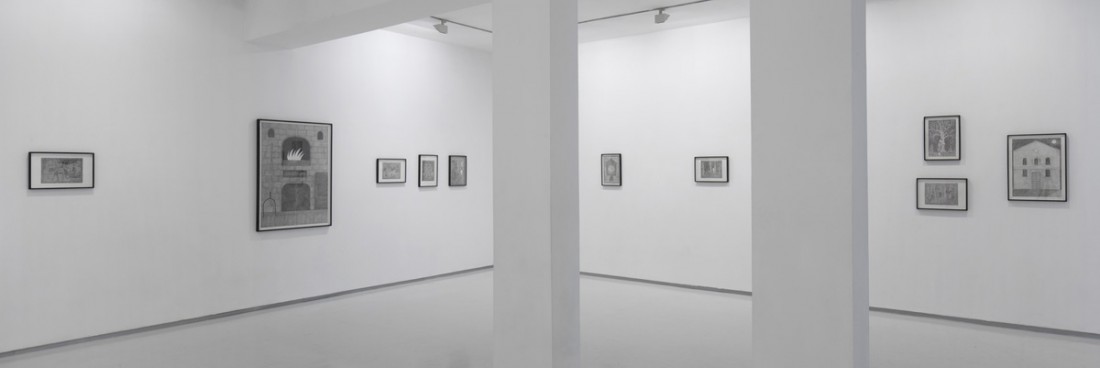
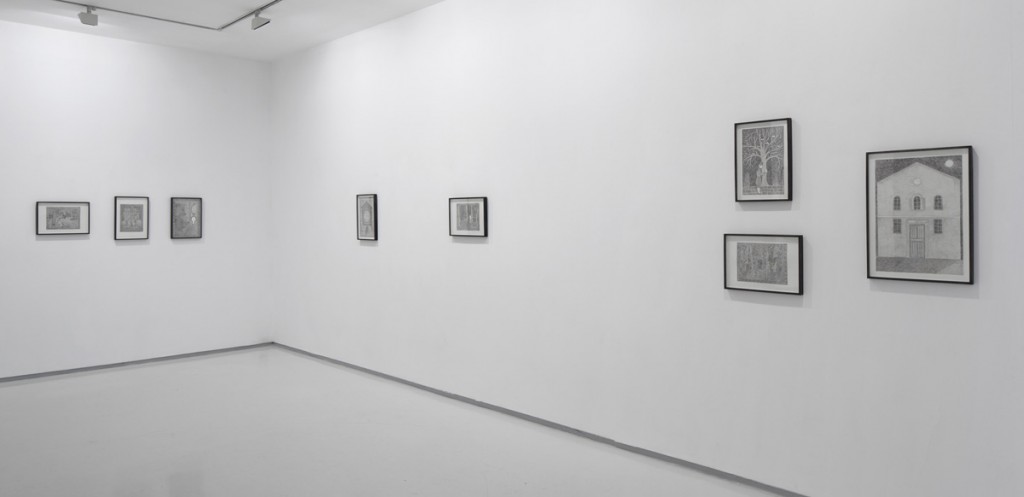
What the moon saw, exhibition view, Noga Gallery of Contemporary Art, 2013
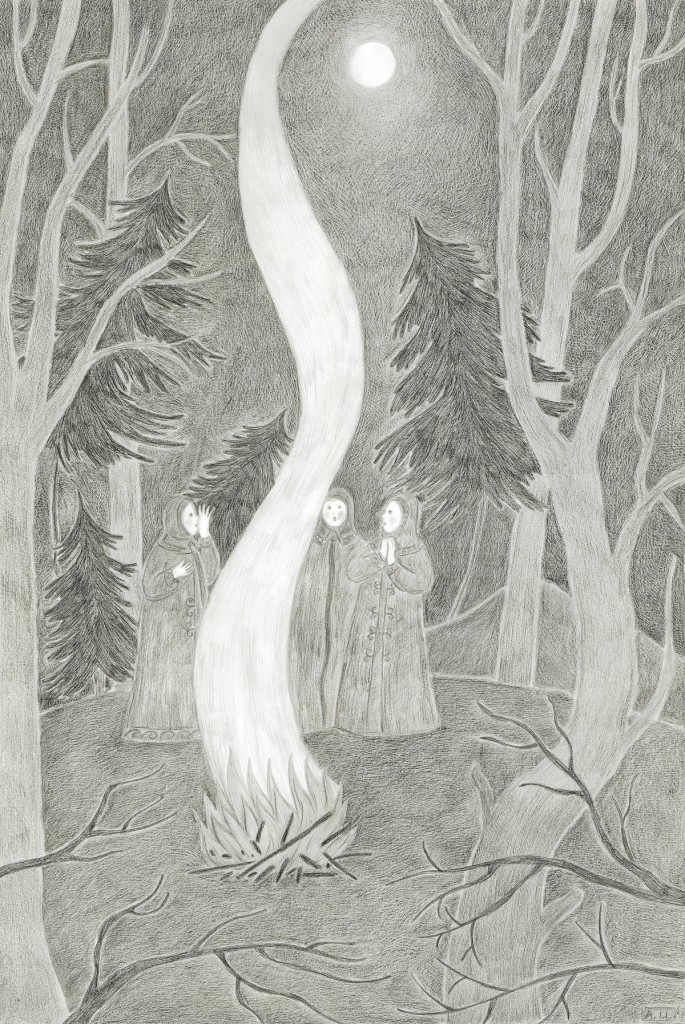
Smoke, Pencil on paper, 59.4x42cm, 2012
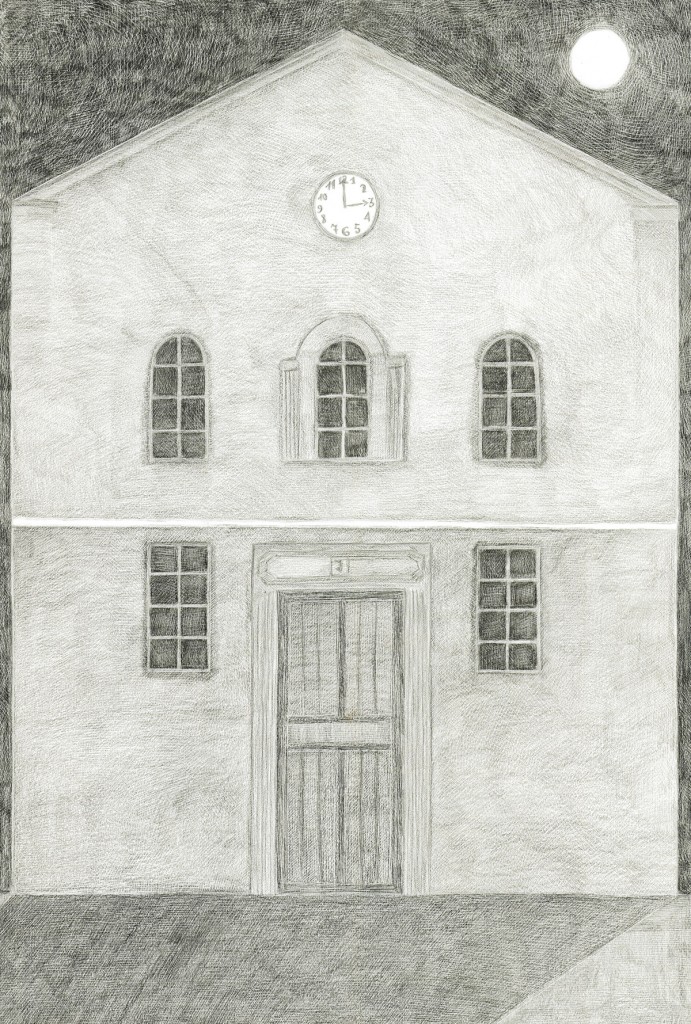
House number seven, Pencil on paper, 42x29.7cm, 2012
Goat crying at the window, Pencil on paper, 42x29.7cm, 2012
Girl meets bear in the woods, Pencil on paper, 42x29.7 cm, 2012
Hole, Pencil on paper, 119x84 cm, 2012
Bears looking through a hole, Pencil on paper, 42x29.7cm, 2012

A series of new black drawings are exhibited in Alexandra Zuckerman’s new exhibition. The scenes constructed in them seem perhaps as a fairy tale, or perhaps threatening, whilst moving in the space between memory and wistfulness. What has the Moon Seen, asks Zuckerman, and spreads before us what may be seen, furthermore, she points out what may only be glanced at. Opaque doors, closed spaces, a keyhole and forest animals concealed in spaces or performing on a stage, all these are exhibited in the same joyless bacchanal.


Zuckerman draws from the world of Russian fairytales she heard as a child and intentionally interweaves it with influences from the world of Russian animation and illustration. The drawings themselves deal to a large extent with the appearances; they seem as toiling work of engraving, yet they are not. The flatness is their guiding principle. Each seemingly illusionistic space reminds us that we are in a display of sorts, that there is a stage before us, a play, an amusement meant for our eyes alone. Zuckerman reminds us that the secret, if indeed exists, lies elsewhere. The moon – that sees all – is in fact the one that is seen, subjected to the gaze. The moon, just as the eggs and the feminine-childlike body, is the empty space in the drawing that overcomes the fear of space that rediscovers the impossibility, magnificent in itself, to devise a fairy tale.


Alexandra Zuckerman was born in Moscow in 1981, an immigrated to Israel at the age of ten. She graduated from her studies in the Bezalel art academy in 2006, and received an award for excellence from the Department of Fine Arts, Bezalel. She was also awarded the Sharet scholarship from the America-Israel Culture Foundation. Zuckerman has exhibited a solo exhibition in the Noga Gallery project room, in Christian Nagel gallery in Berlin, in the “Open Space” sector in the Cologne art fair, where she represented the Christian Nagel Gallery, and in several group exhibitions in Israel and abroad.