
September 22, 2022
In
Uncategorized


Gali Blay | Joan Vellvé | Shahar Livne | Guy Königstein | Lila Chitayat
Curator: Tal de Lange


The term “Potential Space” (intermediate area) is taken from the theory formulated by psychoanalyst D. W. Winnicott. According to Winnicott, the potential space stretches between existence that is detached from reality to one that holds on to reality. The term delineates a third mental realm, a place of encounter between Inner and Outer Reality. Neither external nor internal, this space is a nebulous intermediate zone where subjective experience and creative life unfold. A dynamic realm of play and creativity, where the cultural experience takes shape. As an intrinsically indefinite realm, this space lends itself to new discoveries.
The term serves as a conceptual basis for the exhibition, where the potential space is given complex interpretation, drawing on the tension between the three states. The six works featured in it offer a personal take on this concept, while each address it in its own unique way, presenting disparate and diverse readings.


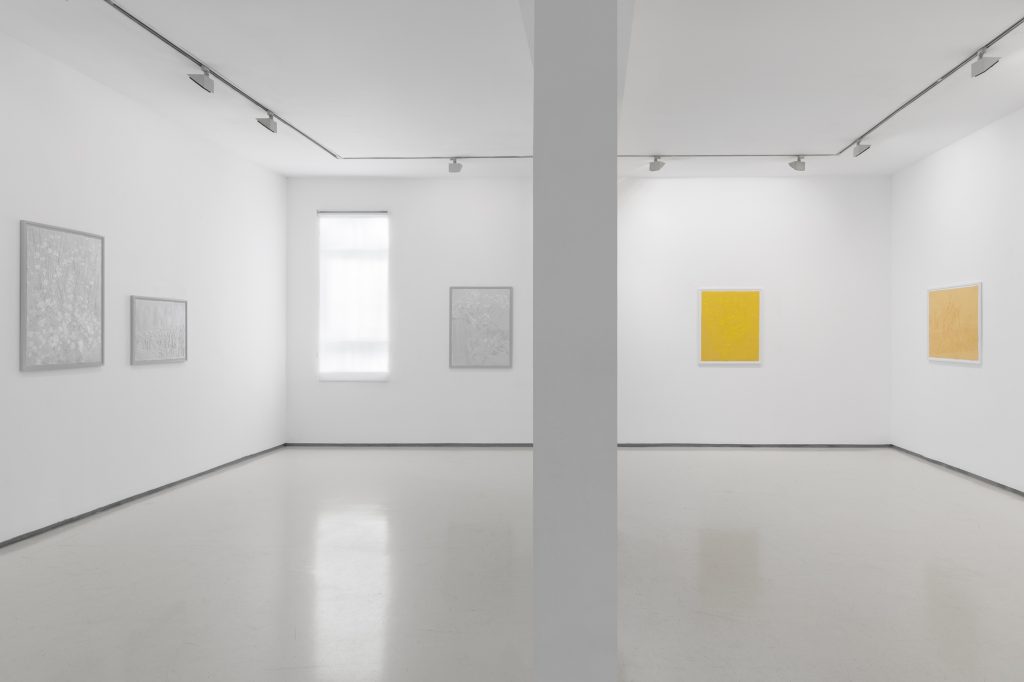


The works in the exhibition are made of acrylic on plastic. The acrylic was not applied directly to the surface. Each section was painted separately on a large nylon sheet, and after drying, it was peeled from the nylon and attached to the plastic. Thus, each painting consists of a combination of hundreds of dried acrylic strokes. It is a method of painting with “dry” acrylic.
Each stem and each leaf previously existed as a separate object. Each part had a separate existence, a thing in itself, and only then was it added to the whole, assimilated into the painting. Even after joining the painting, each part maintains a thin contour around it, a frozen memory of its former independence. Each painting in the exhibition presents a world made up of countless “individual details.”
The stem progresses in a straight line toward the light, to the moment of realization. In stems, life is pushed through a narrow aperture, thrusting forward in a straight line, aspiring to the sun, determined to open up to the world.
Yonatan Zofy
Eyeful
Yonatan Zofy’s flowers open and close day in day out. When the sun shines, they glimmer, turn golden, aspiring upward, towards the light. When the moon rises they bow their heads and hide in the dark, occasionally emerging with a faint twinkle.
The crown daisies and groundsels bloomed at the right times of the year around Zofy’s studio in Ramat Gan, resembling yellow suns: the former in mid-spring, and the latter in early winter. They all withered eventually. Zofy waited patiently for them to bloom or dry out, so as to paint and peel them. Inside the narrow studio, the summer sun gradually turned yellow on the plastic, becoming multiple rugs of living or dead crown daisies; while the fog was absorbed in the plastic as grayish azure in which groundsels appear and disappear. Only after an annual cycle in the flowers’ life passed, and a moment after they sprouted again, was his work completed.
In his previous works, Zofy’s point of departure was the technique, which gradually crystallized into an image obeying a predetermined regularity: an intense graphite drawing created waves on paper, transforming it into a compressed pillow; an act of filling squares in shades of gray ultimately materialized into the shape of a fish. In the current works, Zofy performs a reverse move: now, the point of departure is an image. The flowers blooming around his studio are the basis for his technique. The three-dimensional crown daisies and groundsels turn two-dimensional via applications of acrylic paints; they are subsequently peeled off the nylon and return to their three-dimensional state, floating and hovering on the surface, as if they were about to develop roots in the air and climb up.
From a distance, Zofy’s crown daisies and groundsels are almost invisible. They form two uniform fields, each single-colored and one-dimensional: gold and silver, summer and winter, sun and moon. Approaching the work, the stems and petals that Zofy gently peeled from the nylon sheets are revealed in their three dimensions, and the eyes suddenly open.
Text by Noga Litman
Translated by Daria Kassovsky

