
March 20, 2014
In




Memories from the Future
About Michael Halak Solo Exhibition
Michael Halak was born in Fassuta Village in the Galilee. He earned his Bachelor’s and Master’s Degrees from the Fine Art Department at the University of Haifa, and a certificate of studies from the Florence Academy of Art 2005. Halak received the 2016 Ministry of Culture and Sport Prize, the 2012 Rappaport Prize for Young Artist from Tel Aviv Museum of Art, and the 2010 Young Artist Prize from the Ministry of Culture and Sport.
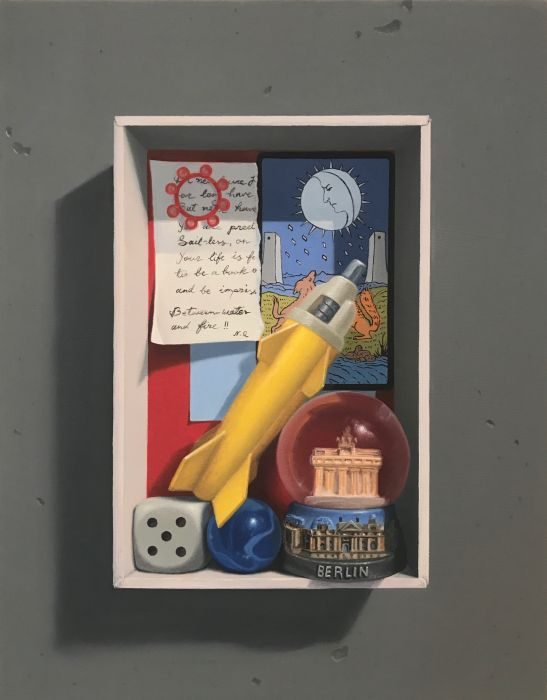
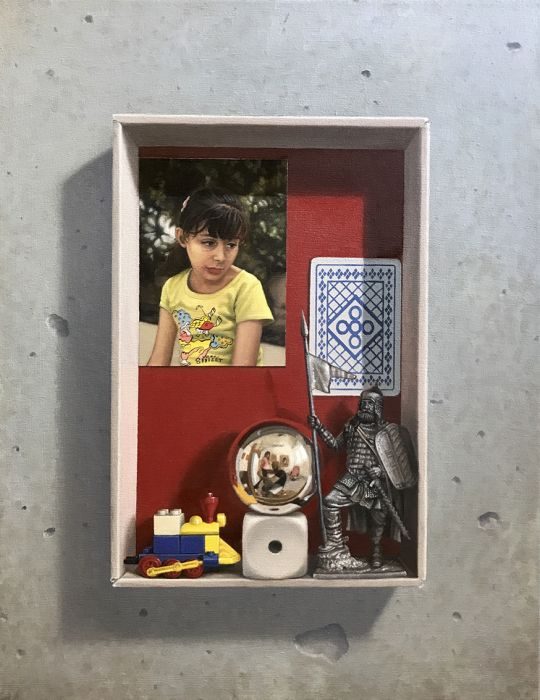
Michael Halak’s exhibition, Memories of the Future, features five new small-scale paintings, “memory boxes” of sorts, larges scale work comprised of nine paintings of cut cardboard boxes, and a large-scale portrait of a girl.
The paintings of memory boxes, painted in an impressive realistic technique, interweave objects, toys, still life, landscape views, portraits, and at times text. At first glance, the collection of objects seems random. A more careful look reveals that the virtuously painted items serve as a lure aimed to trap the viewer’s gaze, directing it towards the artist’s biography and the past as a decisive moment in his art, one that is inseparable from the present and the future. The illusion of reality that takes shape on the canvas is seductively beautiful, yet fraught and fragmented, engendering confusion and unease.
The duality of the past and the present is particularly prominent in the reflection of the artist in a glass ball, his figure documenting reality (the artist in the studio next to his assistant), tying him to the past through the connection to the collection of childhood items.
The paintings of cut cardboard boxes symbolize a state of passage and transience, a precarious situation that may collapse with one gust of wind. This experience has been accompanying Halak for years, as well as the connection between man and the place, presence and absence, belonging and alienation, identity and the lack of identity, testament and silencing.
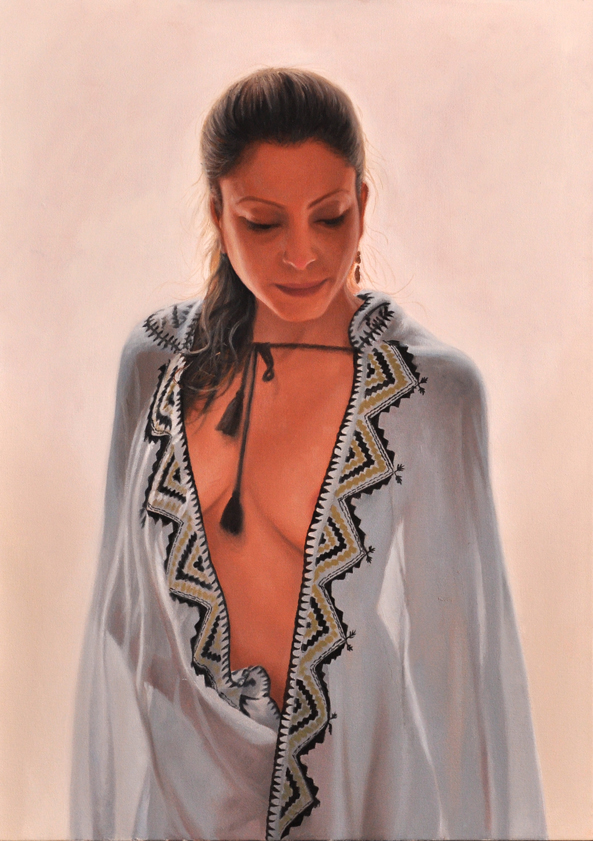
The cropped painting of a girl is seductive in its beauty and at the same time evokes feelings of disintegration, fragmentation, and disruption, held together by pieces of tape that prevent it from falling apart. In this painting too, the skillful painting creates vitality, the composition, the gaze turned towards the viewer, even the emphasis on the earring – bring to mind Vermeer’s renowned painting Girl with a Pearl Earring. Halak paints the background in yellow-ocher – the colors of the girl’s dress in Vermeer’s painting – in an unknown space. The reference to such a prominent painting from the history of art strives to expand the image beyond the local to the universal.
Halak’s painting holds biographical, universal, and historical layers. His paintings are imbued with the tension that accompanies him in his life and art, demonstrating the dichotomy and split between distinct yet inseparable worlds.


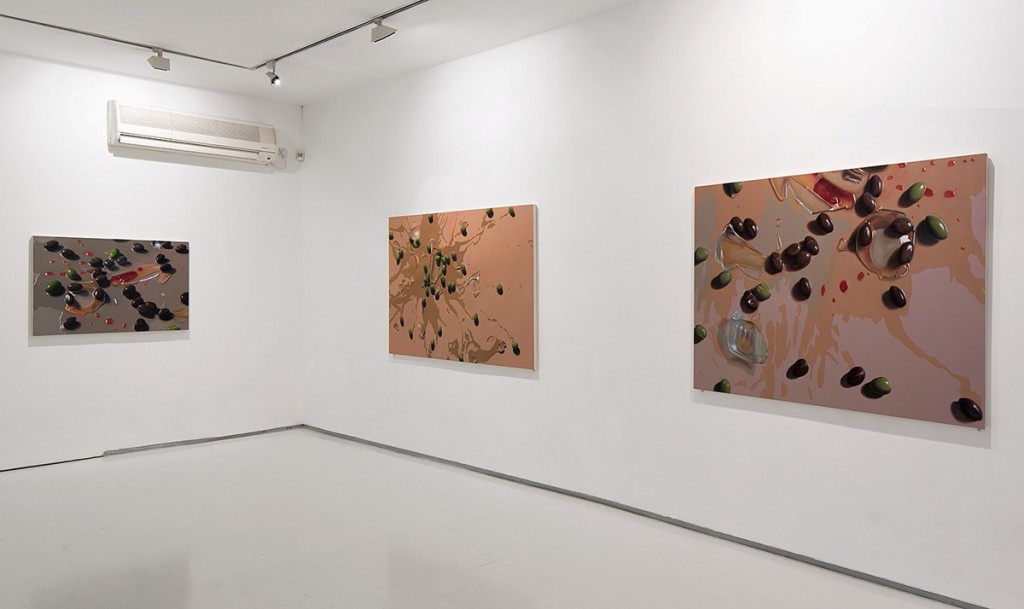

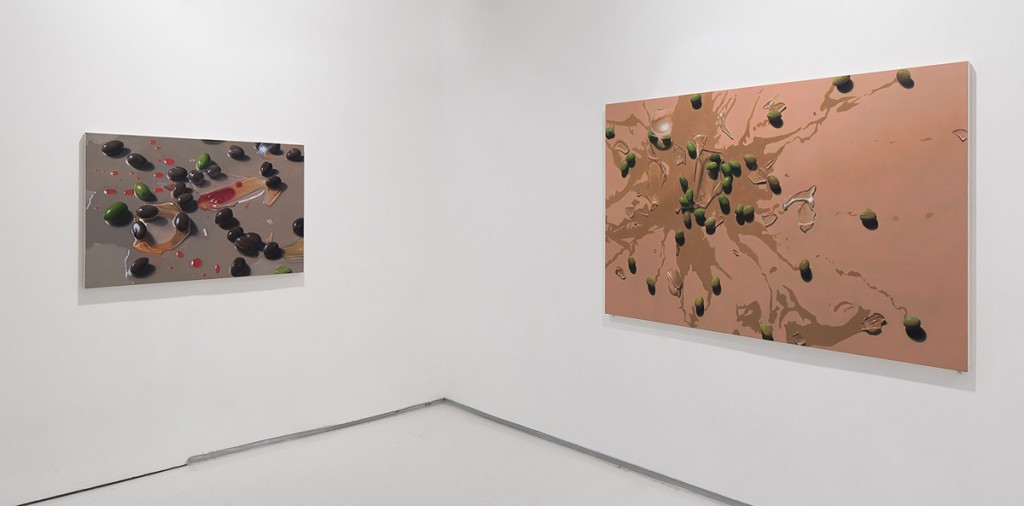


Michael Halak’s solo exhibition at the Noga Gallery of Contemporary Art presents the fragility, transparency and impossible structure of broken tools. The cracks are internal and are an inherent feature of an introspective dive. The ensuing explosion is centripetal while exposing one’s inner personal parts. Metaphorically, the light and dark olives embody the fragility of personal existence. The tension created between the fragmented vessels containing olives and oil, which are strewn across the damp saturated earth, indicates an obstinate repudiation of the inevitability of fragmented being.
Halak’s personal view corresponds with the works of British artist Phyllida Barlow, however not at eye level, but rather at ground level where all life’s cracks, which Halak is focusing on, lie wallowing in the ashes of the saturated earth.
Dispersion of the fragments is not incidental but rather predictable. They cannot be gathered up, and can no longer be reconstructed, but can only be used to produce new tools that are perhaps even more resistant to internal pressures. Halak provides an intense and painful glimpse of his innermost parts. This outward view from the inside, allows the observer to feel the vortex of internal pressures, the almost impossible combination of a private and public life, and the Sisyphean task of coping with life’s finiteness.
Similar to the German artist Ulrich Rückriem, Halak is more interested in cracks and parts rather than in the whole. The display of cracks shows the loss of the absolute value of the whole and of unbroken perfection. Even the olives are cracked as if they are participants in a general cracked scene.
The concrete wall, still exhibited as a whole unit, is there to separate the fragments on each side of it: both those broken from within and those broken from without. The chaos exhibited on the different canvases represents an anthology of repressed and forgotten memories of whole tools that were removed from their natural environment. Halak’s metaphors, referred to by Linda Nochlin as “fragments, ruins and mutilation echo the mourning for past grandeur as a whole, which can only be revisited through its remains amidst modernity”1.0 Those fragments beckon us to descend to the saturated earth and observe the fragmented tools – those cracks in our lives.
Halak attempts to cope with the absurdity of what he sees against the wall while expressing his yearning for unity. In a world created out of fragments and the inherent contradiction that spumes forth through the invisible cracks in the concrete wall, Halak suggests correcting a point of view — one that makes meeting with a transparent and imperfect past more feasible.
Curator: Dr. Gabi Geva
1 Nochlin, Linda, (2001), The Body in Pieces: The Fragments as a Metaphor of Modernity, Thames and Hudson

Michael Halak, The Usual Suspects, Oil on Canvas, 40x30cm each, 2010

Ori Gersht, Ghost series (Olive 20), C-Print, 120×150 cm, 2014

Michael Halak, Olive, Olive Oil and Oil Press, oil on canvas, 180×120 cm, 2014

Michael Halak,fragile, oil on canvas, 40x30cm,2011
