Bat Kol | Matan Ben Tolila
Standing in his studio, he lays a blank canvas down on the floor. It is the end of the day, soon he will go home to his family. He pours diluted paint and turpentine on the canvas, allowing the mixture to spread across it. In a couple of days, he will return to the studio and discover the stain that was created and its boundaries, from which he will build a place – a cave, a lake, a mountain.
The stain is a piece of information or a message without clear guidelines, like a divine voice (Bath ḳōl) of sorts, which appears before the painter and asks him to give it shape and essence. It is the one that prescribes where the entrance to the cave will be, the direction of the light, the dark areas, the water reservoir, and at some stage, after the place has been created and materialized on the canvas, also how it will be populated.
In the seven preceding years, the painter Matan Ben Tolila followed a different work method. He would go to the studio and create preparatory sketches, stretch a canvas and transfer the grid onto it, choose a color palette and create the predetermined image. His works featured imaginary landscapes and delineated structures, bold and phosphoric hues against the emptiness of the blank canvas, and they were created by an aware and meticulous painter, an artist who feels responsible for the vibrancy of his works and does not compromise its relation to the painting’s past, present, and future. But over time, the advance planning that gave him control over the work process and confidence in the finish point, has run its course, and was replaced by a desire to exist in painting’s other places, those that search for not knowing, wondering, and hesitating.
As a painter, he always felt that he has a responsibility to be clear, unequivocal, impeccable and known, to instill confidence in the images and the words, and now he created a series of works of an abstract origin. The painted expanses and the presence that belongs in them emerge from the paint that spread across the canvas, and he understands the painting while working, as he lays down paint on the canvas. As part of the new practice, he parted ways with the other artist who shared the studio, emptied it of previous works and started working on the new series without preparatory sketches and grid. Each painting starts with the arbitrary action of the paint and turpentine stain. And when he allowed himself to follow the unfathomable stain, he was engulfed by sweet sense of disorientation.
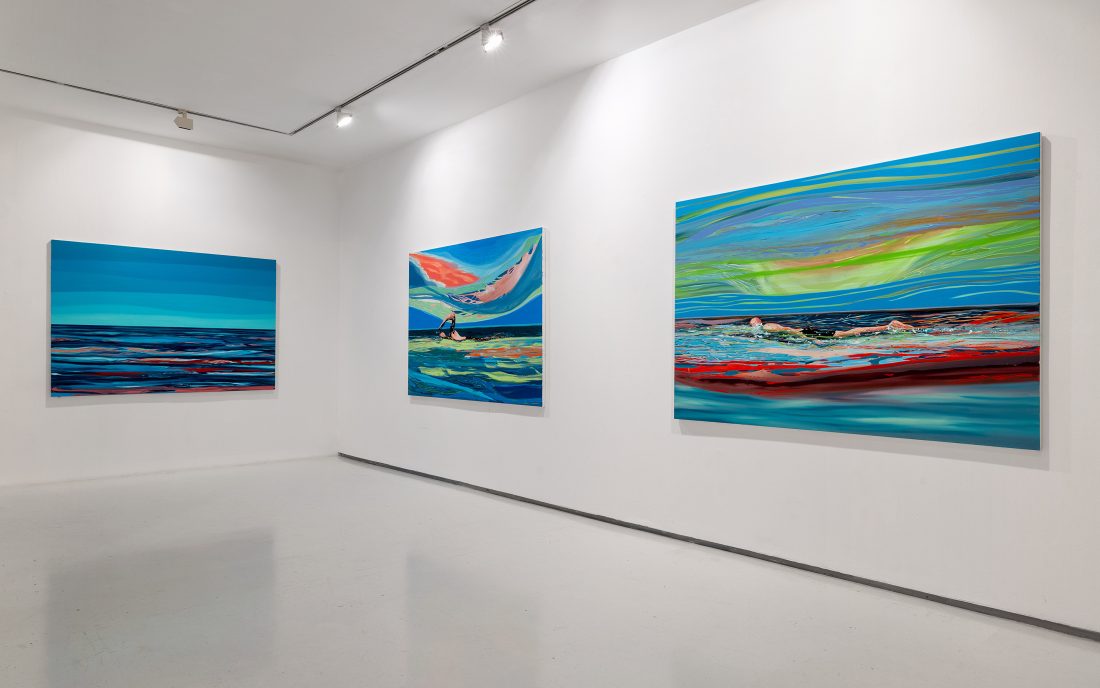
Upon first encountering the new series of works, I find myself in a world I recognize from Matan’s previous series of painting. Like in the series Moonwalks (2013) or The Young Mariner (2015), I am facing melting mountains and fantastic landscapes in phosphoric and pastel colors. However, as I spend more time in their presence, I realize that this time I am entering this world from a different place. The landscapes that were always there, as settings to be filled by a certain presence, have now moved center stage, becoming the main event.
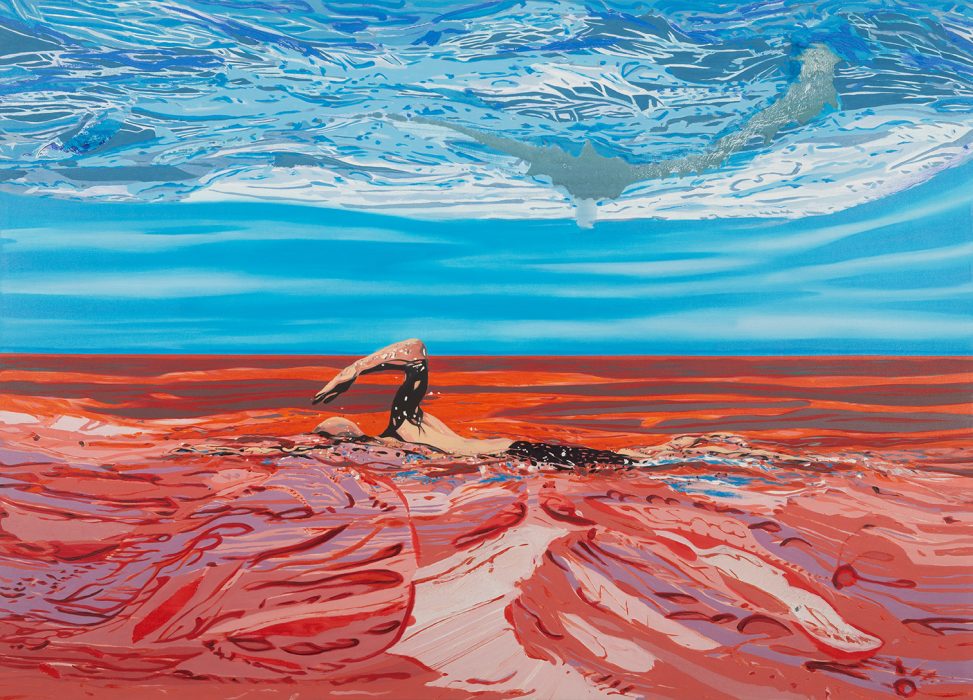
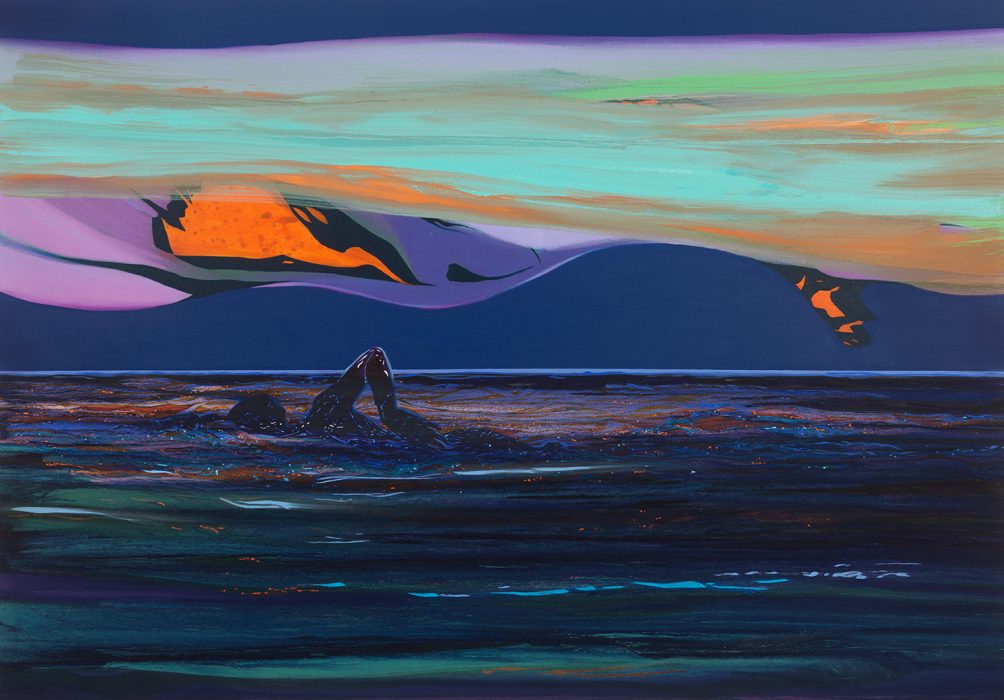
In this series, I feel that the line Matan walks is finer than ever. The fantastical worlds, full of colors, textures, and figures whose faces and eyes are hidden from the viewer, demand precision– any deviation may push the painting further away from its meaning. More than these, it is dangerous, certainly for the more organized and methodical among us, to lose control, to summon unknown voices into our room, and hand our brushes over to disorientation. But, just like the figures’ hidden eyes, the paintings in this series wish to say that there is more than meets the eye. Disorientation asks of us to trust the other order it holds, listen to the divine voice (Bath ḳōl), and let it guide us. If in Matan’s previous series I could hold on to the image of the transient house, the structure that promises stability but does not deliver it, in this series there are no walls or roof, no structure to give us shelter. The closest things to an anchor are a kite, a billboard, or fence fragments. The unnatural, saccharine colors offer me no comfort, but rather trigger unease, bringing to mind acids and corrosive compounds. The figures in the paintings do not belong to the caves and unfolding landscapes – how did they get there? Are they abandoned in a world which, in the absence of order or grid, allowed itself to expand, grow, and take over the space of the painting?
Two main figures in the painting are the painter’s best friend, a free spirit who found his death at a young age several years ago, and Matan himself. The encounter between the two, which could not take physical shape in our world, can take place in the expanses born from the expanding shapes. For the first time, the painter brings his figure into this world. More than a self-portrait, I see a man who tries to situate himself in the spaces that exist inside him, in an attempt to fathom them. As though until now the landscapes created by his own brush were foreign to him just as they are to the viewer, and only now he dares to be present.
Picasso suggested that “the purpose of art is washing the dust of daily life off our souls.” It seems that in the new decisions he has made, Matan transformed the action that is so known and familiar to him from years of painting into a new action. Surrounded by his largescale works, the eye and mind trace a line between the flying kite, the figures in the cave, and the floating man, and in an instant, they all exist in a shared space, which is different and other from our world. A place like this, whose realness is only possible in Matan’s painting, recounts a story through which I can part with the quotidian and give myself to the new action, to the echo that reverberates from the mountains, that fills the caves, that dives into the water. I can sail and float in a place I do not know but does not threaten me, wander through disorientation, without losing touch with reality, wash the dust of everyday life off my soul.
Gil Cohen
Gil Cohen has initiated, curated, and produced art and culture projects since 2007. She is a graduate student in the interdisciplinary program of the Faculty of the Arts, Tel Aviv University, where she explores the connection between objects and memory.