
June 1, 2022
In


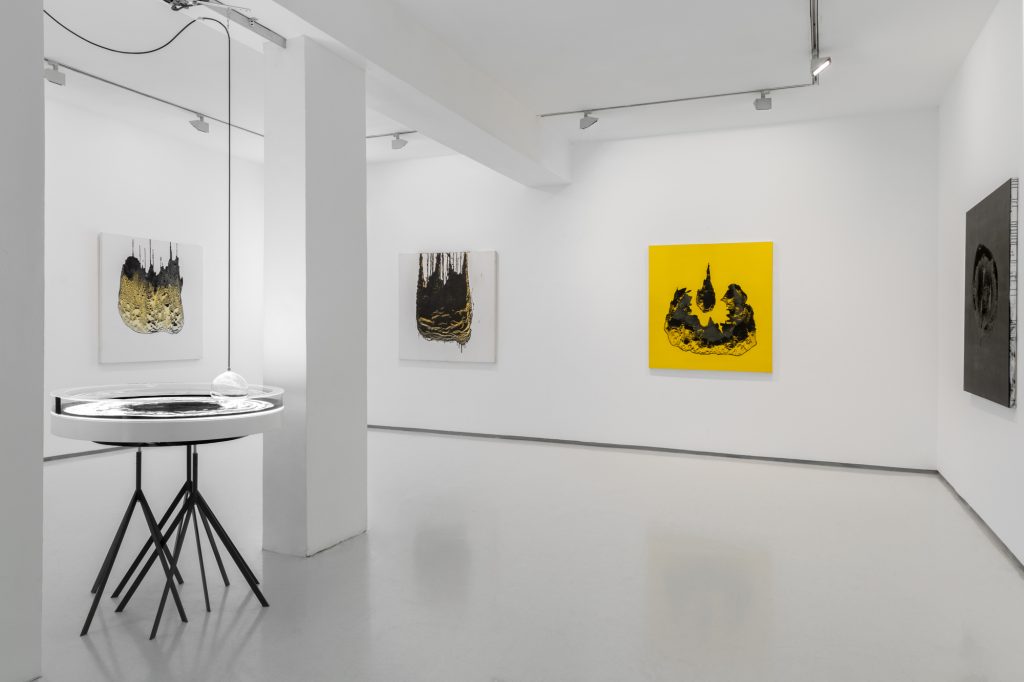


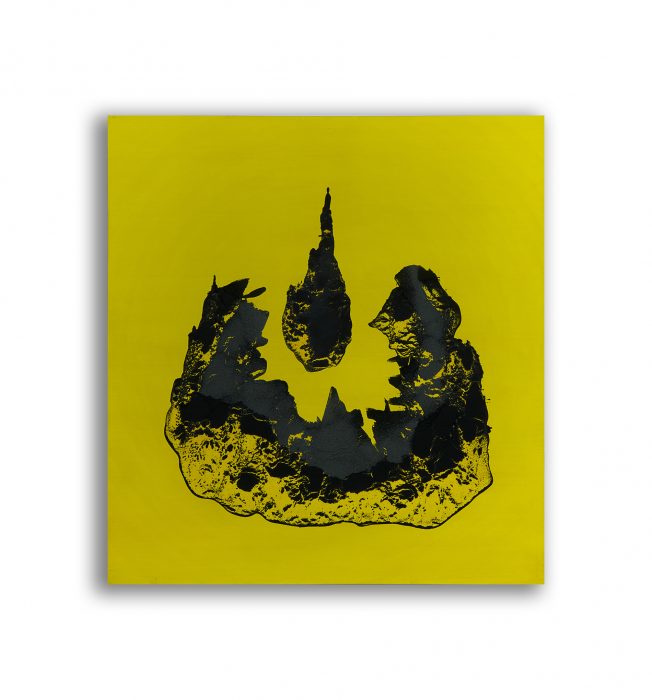


Chanan de Lange | So It goes | 23.6.22-30.7.22
“And Lot’s wife, of course, was told not to look back where all those people and their homes had been. But she did look back, and I love her for that, because it was so human. So she was turned into a pillar of salt. So it goes.” – Kurt Vonnegut, Slaughterhouse-Five
In his recent series of works, Chanan de Lange focuses on sand as a material and a signifier – of mankind, of a place, of the land. First, de Lange lays down cotton canvases painted with acrylics on his studio floor, “pouring” yellow carpenter’s glue on the canvas to create the work’s formal foundation. He then sprinkles sand on the glue, using a sieve: burnt black industrial sand, red sand gathered near Mitzpe Ramon and quarry sand. While the glue is still in its liquid state, he picks up the canvas and tilts it, allowing gravity to guide the movement of the sand in a controlled manner.
The grains of sand move and shift along the glue according to de Lange’s hand movements. The action stops once the desired shape “takes hold” on the canvas. After the glue has completely dried, loose sand is removed with a hard brush, and the sand grains fixed in the glue remain and determine the final work. Like in action paintings, the body takes part in the artmaking process. In de Lange’s practice in general, and in this exhibition in particular, there is always significance to the random, to uncertainty, both in the creative act and as part of the statement.
The works featured in this exhibition engage with forced migration as a result of wars, persecutions and pandemics, most of which are the outcome of human actions. The grains of sand that de Lange scatters are at the mercy of external forces that impact their migration. They are pushed out of their place, and settle on the glue, with no control over their fate until the work is completely dry. So it goes.
The exhibition takes its name from Kurt Vonnegut’s Slaughterhouse-Five. Throughout the book, the depictions of cruelty and death almost always end with the phrase “so it goes,” as a critical commentary on the ease with which human injustices are tolerated, and the indifference in the face of tragedies.
*
Prof. Chanan de Lange is a B.des Graduated with honors of the Department of Industrial Design at Bezalel. Active as a designer since 1985. Lecturer at Bezalel since 1988. Previously served as head of the bachelor’s department in industrial design at Bezalel and head of the master’s program in industrial design at Bezalel.
Chanan de Lange has presented a variety of solo exhibitions in Israel and abroad, including at the Tel Aviv Museum of Art (1994, 2011); Haifa Museum of Art (2000, 2005); Novalis Fine Arts Gallery, Torino, Italy (2008); Living Design Center Ozone, Tokyo, Japan (2002) and more. Participated In many group exhibitions, including at the Israel Museum, Jerusalem; Haifa Museum; Design Museum, Holon; Cooper Hewitt, Smithsonian Design Museum, New York; The University Art Gallery, Tel Aviv; Wilfried Museum and more. His works are included in the collections of the Tel Aviv Museum, the Israel Museum, the Design Museum in Holon, the Haifa Museum and other public and private collections.
*
With thanks to: Yoram Aschheim, Eyal Shushan, Boaz and Alon, Noga Litman. With a special Thanks to Tal de Lange.
Translated by Maya Shimony

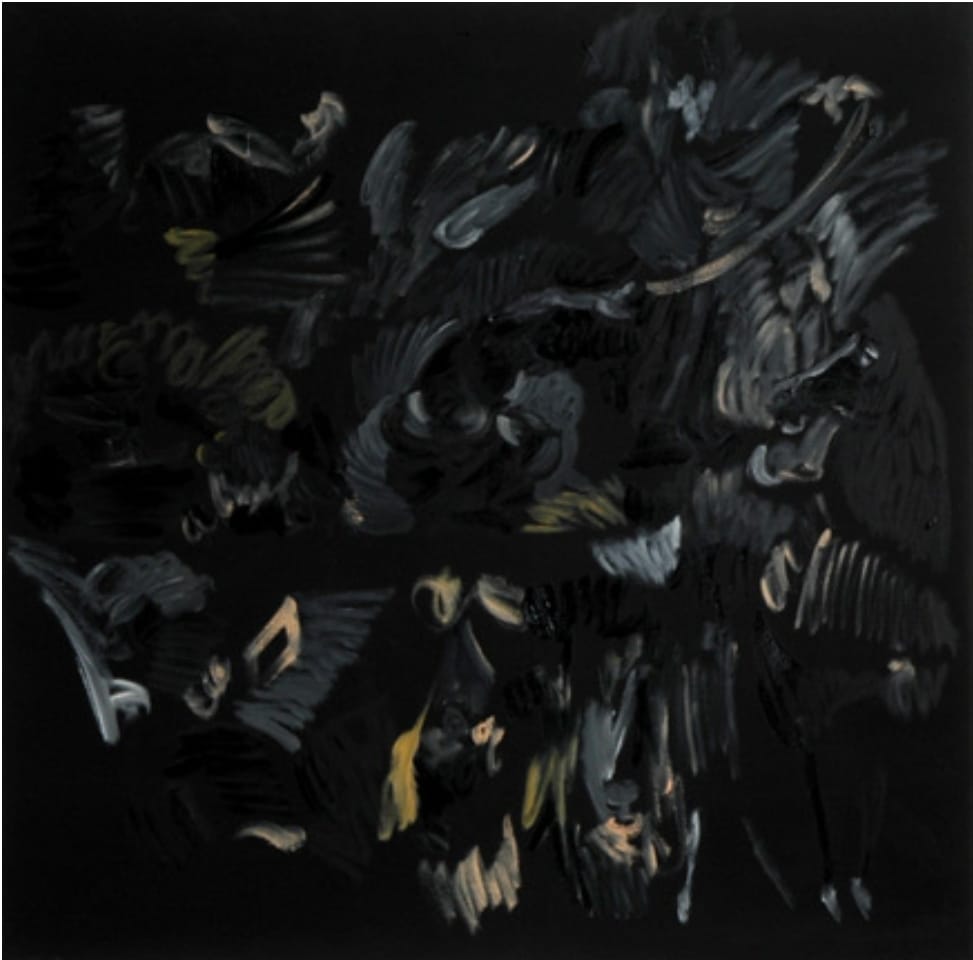


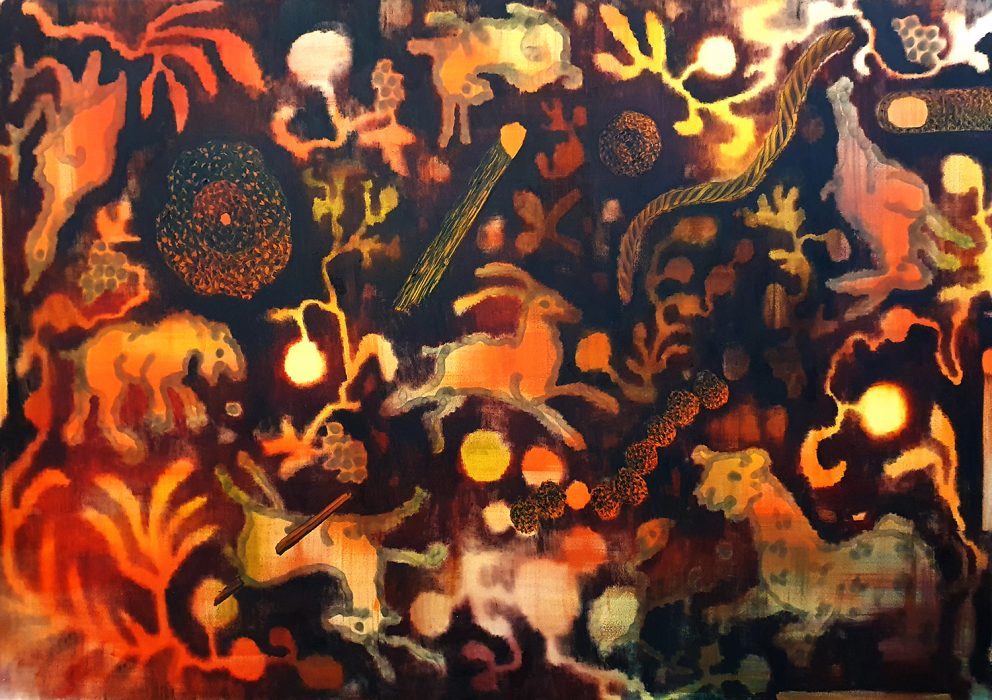

Real Life
Tal Yerushalmi
A few years ago, I left a hole in a painting; exposed canvas, non-painting at the very heart of the pictorial domain. The painting started filling with other holes, which over time turned into images: a rock, necklace, bone, sun moon and stars, a flame and a scorched hole with thick smoke rising from it. The painted flame wished to burn the painting and so I lit a fire, this time a real one, and with a lit candle burnt holes through the canvas. I had no idea that the holes I was burning will blur the line between life and painting, opening a space between reality and illusion. Was I playing with fire? Was I provoking the void?
The burnt holes became flowers and eggs, complete with snakes, spiders, and insects that crawled out of them. As I lay underneath the canvas and burned holes in it, sooty figures started to take shape: donkeys, rabbits, tigers, fish and birds, animals painted with flames. The new guests populated and animated the painting, floating as smoke without a place, space or time. The painting was their world. But I was not satisfied with the abstract space, I was looking for something else. I sought a place to be in, a ground on which I can put my feet, real life.
I mix Prussian blue with some black, creating a deep, dark and infinite space. Here I will find what I am looking for. I struggle to see in this darkness, my eyes cannot tell dark purple from black, I light a candle. Herons, cranes, and ducks flock to the canvas, asking me to draw a small lake for them to stay and wade through the water, after all, they are waterfowl. But all that flows from my brush is muddy turpentine, greenish brown puddles. This is not exactly the ground I am looking for, but I guess it will have to do.
Cockroaches, cobwebs, and insects fill the empty space, running along the ropes, eating the paint and leaving the canvas, eating the canvas and leaving holes to remember them by. The cockroaches get everywhere, inside the painting and on the frame, greeting me in the stairwell each morning, smiling at me upside down and wiggling a tentacle. At night, I catch one of them on my toothbrush and another swimming in the sink. Pigeons find refuge in the space under the tiled roof, building nests on my windowsill, laying eggs from which chirping chicks hatch and wake me up at dawn. They enter through the windows, leaving droppings everywhere and then cannot find their way out.
Did the pigeons and cockroaches come through the hole I have left in the painting and reached my home? Did I create them in matter and paint and turned them into flesh and blood, feathers and tentacles? Should I have exercised more caution with the power of the brush and paint? Exhausted and at my wits’ end with the chaos in my home, realization dawned on me: That is exactly what I have been looking for. The life that teems under the tiled roof set my imagination ablaze, and I do not stop painting: Cockroaches in the bathroom and in the kitchen, climbing on me at night, pigeons laying eggs on my head. There is a party on the roof, the pigeons are drunk on vodka and wine, the cockroaches breakdance, blasting tracks by Fatboy Slim at full volume. “Enough! Keep it down!” I yell, but they cannot hear me. Either way, I do not dare go up on the roof. Maybe if I stop drawing birds they will disappear from my life? I erase them from the paintings, covering them with layers of paint. If painting has the power to conjure, then surely it also has the ability to banish. And maybe also the other way around?
I called Igor over to seal the openings in the roof. He promised he will chase away the pigeons but I heard them dying over two weeks. I called Oshri the exterminator, who climbed down the roof horrified, swearing to never come back. In the morning I arrived at my studio to discover that insects have eaten my paintings. They settled for the layer of paint, leaving white holes in the surface of the painting, exposing the canvas. What a beautiful image! After all, I invented it.
Noga Gallery of Contemporary Art
February 2022
Text editing: Mei-Tal Nadler | English translation: Maya Shimony