
September 16, 2016
In
Uncategorized


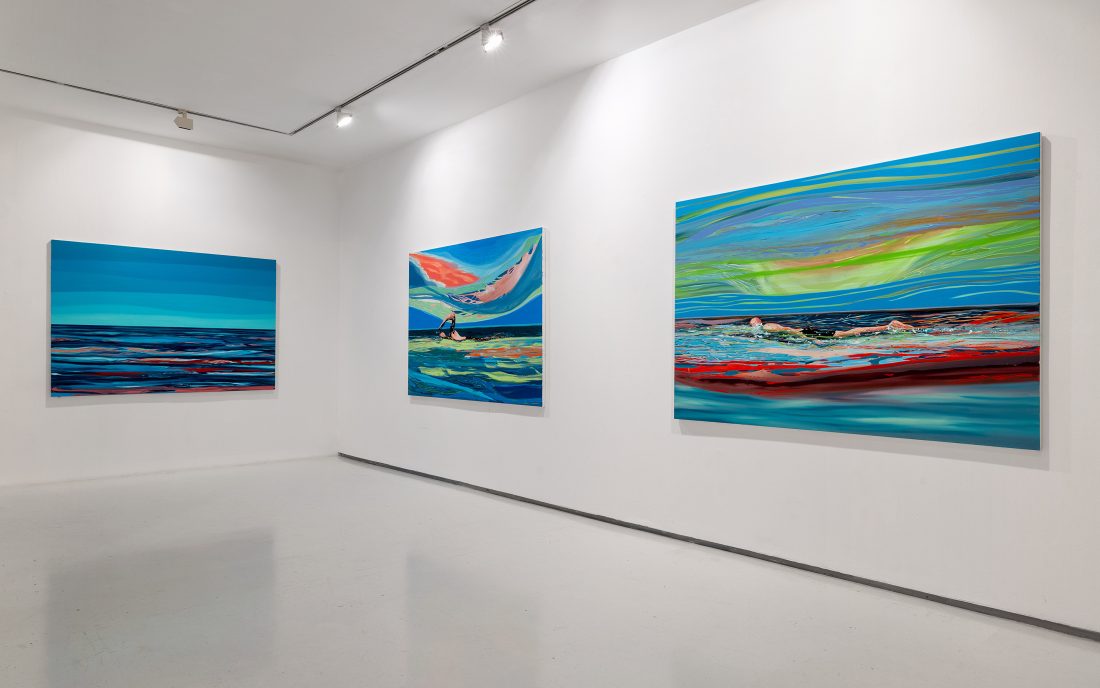


“The sea was a mirror” is a familiar expression describing a calm, smooth sea, inviting leisurely swimming and perhaps quiet, contemplative drifting.
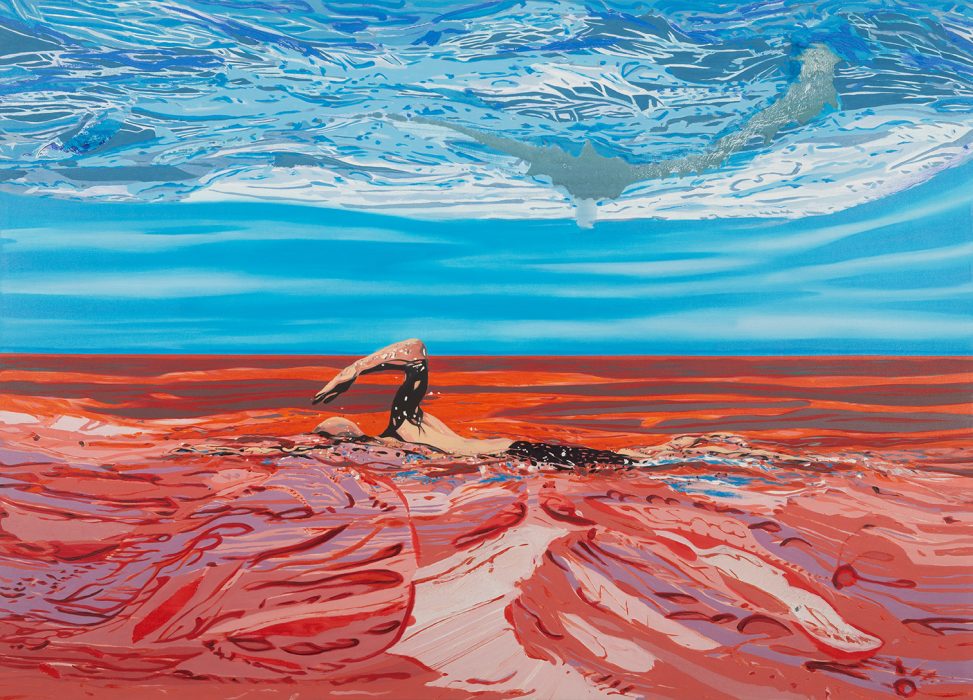
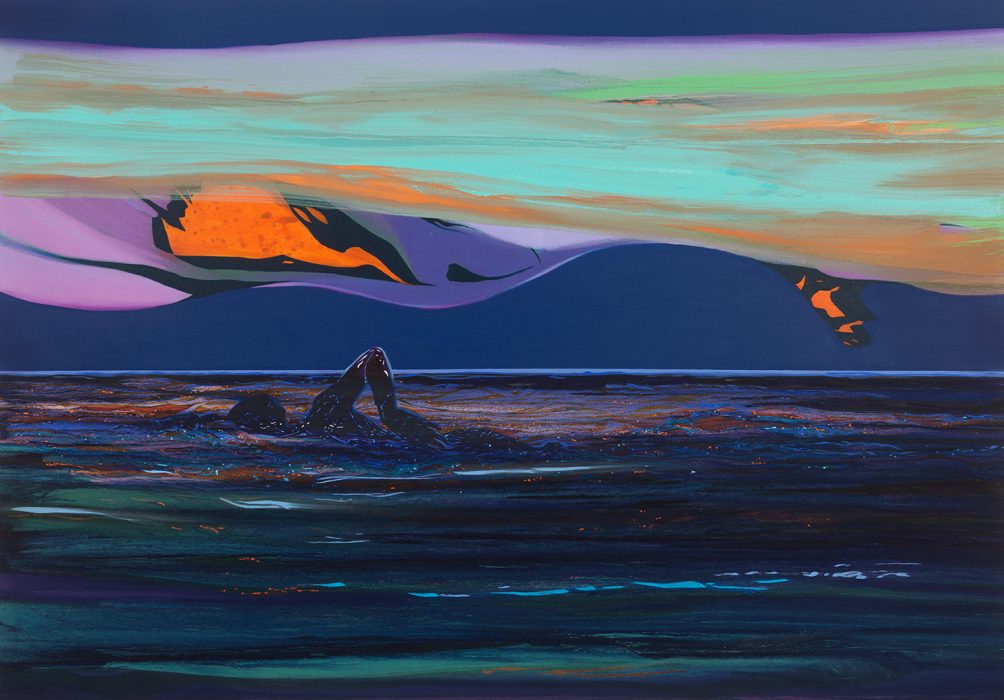
This exhibition presents two series of paintings: The Rower, in which the artist paints himself rowing through the sea that becomes a mirror to his inner consciousness; and the later series, Light on the Water.
Carl Gustav Jung wrote that “The sea is the favorite symbol for the unconscious, the mother of all that lives,” and it is one of the most common symbols of our collective unconscious. These days are filled with constant battles; terror, anxiety, and anguish grip each and every one of us, and our shared consciousness, here in this place, finds little rest.
As you look at this sea, of day and night, it is not calm, smooth, or tranquil. The solitary rower swims within its depths, surrounded by its threatening blood-red waters. Even when the upper currents clear again beneath the sunlight, the crimson sediments that once filled them still flow in the depths below. And in those deep waters deprived of sunlight, where darkness steadily gathers, the skies above still cast their rays, perhaps the last light of sunset, perhaps the afterglow of bloodshed, across ominous currents. Yet in the series Light on the Water, the rower has detached from the self, shed the body that once contained him. He swam far, far away. Here, in the depths, the self has released from the body and immerses itself in light. The body disappears, and with it, the terrors of the unconscious.
Here the brushstrokes reveal the painters gaze, delighting in the light falling upon the water: shimmering glimmers, gentle ripples spreading outward, sprays and droplets. Is it light, or water? A line that is color or color that is line? Space containing nothing but color, wash, and beauty itself.
Light on the Water belongs to a long tradition of painting that observes the reflection of light upon water.
While these paintings depict the image of reflected light, they moreover invite the viewer to contemplate the very act of seeing: the moment in which eye, light, and the pleasure between them unite. Look at the line stretched across every canvas, separating sea from sky. The artist acts as the Creator of the world. For the line dividing sea from sky is itself the act of creation: the act of painting. That primordial line marks the separation through which the world itself was created.
And God said, “Let there be a vault between the waters to separate water from water.” So God made the vault and separated the water under the vault from the water above it. And it was so. God called the vault “sky.” (Genesis, 1: 6-8).
Tsila Hayun, writer and multi-disciplinary curator

Matan Ben Tolila, Blue Horse, Oil on Canvas, 155x85cm, 2015
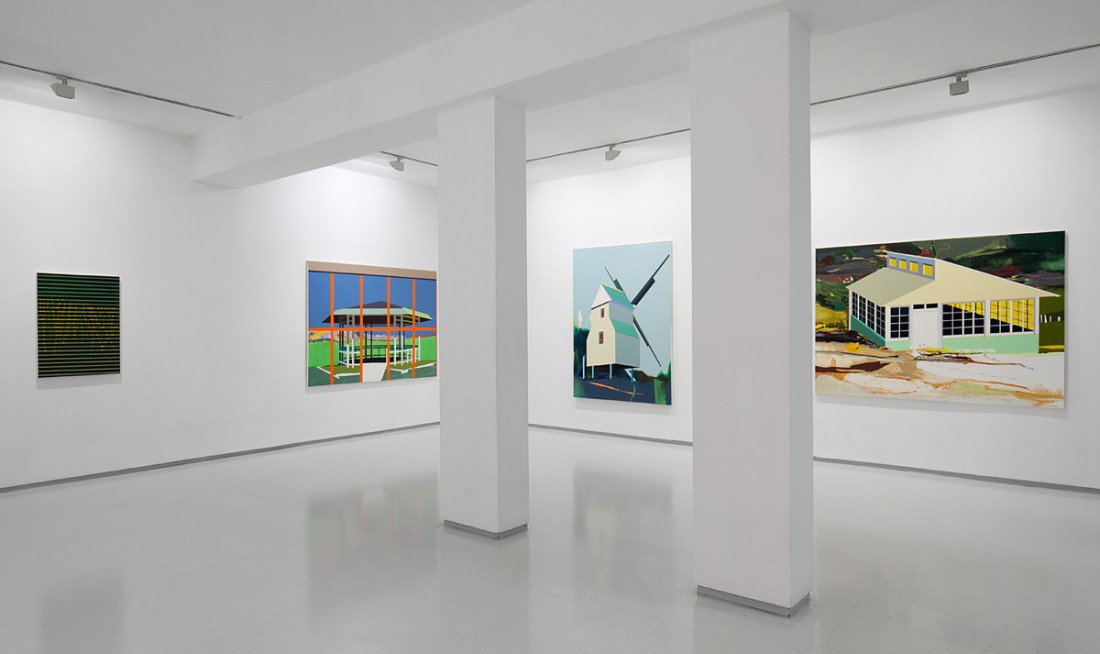


Noga Gallery is happy to show the first solo exhibition of Matan Ben-Tolila.
Matan Ben-Tolila paints mental landscapes, as though they were exterior landscapes. He tantalizes our eyes with familiar and tangible objects, yet places for us un miss able tracks of illusion and riddle, a labyrinth, as though explicitly telling us: The image before you is in my mind and in your mind only.
A landscape stretching out, not a single soul appears. An empty space, with no possibility to place anything within it. An open and lit house – no one comes or goes, its entrances and exits are blocked. A mountain in the distance, no trail leads to it. Distant sceneries fading and collapsing into themselves. The meticulously drawn structures hold no substance, their walls do not connect to one another, and their spaces contain nothing. There is no door to enter through. There is no window to look out from.
For a moment he deceives us with colorfulness, in clean and clear lines, we are swiftly invited inside, to sit in the “Gazebo” and restfully ponder. Yet it then becomes apparent to us that the path leading up to it is blocked by a white unpainted area, an empty canvas that the artist’s hand chose to leave untouched. A momentary illusion will cause us believe that the billowing sheet in “Two Moons of Autumn” – on it are painted what seem to be perhaps moons, perhaps eyeballs – is an invitation to an exotic journey, a hedonistic search after a perfect beauty. But these two moons lead us to the ironic haiku song:
Press your eyeballs And there you have two moons of autumn [1]
If you search for beauty, search for it within yourself. Do not turn your gaze outside, to the scenery surrounding you, but press your eyes and materialize the beauty within you. Will you be willing to pay the price of pain that is entailed in pressing the eyeball? Is the search for beauty, color and magic not doomed to be a painful and agonizing process that compels us to close our eyes to the true reality that surrounds us?
In the painting “Blue Gate” we are left wondering in front of a childish playground, its simple colors and shapes show a fleeting illusion of childhood, an illusion that quickly fades while facing the two eyeballs, looking at us silently like two full moons. The metal gate threatens to turn into a guillotine before our very eyes, while they linger for another glance.
The moon, its beauty illuminating the night, does not shine its light from within itself, but is irradiated by the light of the sun. In itself it is opaque and impenetrable.
The paintings in the exhibition are full of light and color, a colorful palette, an almost “Pantone” color scale, colors hinting at the industrial and artificial. A palette that deliberately veers as far as possible from natural coloring. These colors are the making of the artist, painting a world where all the outlines and joints are his making. A creation entailing toiling preciseness, meticulous thoroughness, as though a carpenter or an expert metal worker – the making of a master craftsman.
Moon walking, the iconic treading of the astronaut walking on the moon, touching the ground, and leaping back off of it, their weight is no longer weight, their step is no longer a step. Moon walking, as Michael Jackson’s dance moves, is a deceiving walk, steps that repeat themselves with a misleading ease, where feet graze the ground, hover over it, hardly touching.
The act of painting wishes to assimilate the moon walk. To be laid on the canvas as though not painted but projected on it, as though it’s light and colors do not come from within itself, but from the gazing vision of the painter. The gaze will disappear and with it the sights, the colors and the structures.
And we, the viewers, standing between the painter’s eye and the image projected on the canvas, can only leave but a shadow of our figure; and just like it, will fade with the disappearance of the last rays of light and the disappearance of the gaze.
Tzila Hayun – creator and curator of interdisciplinary culture programs.
———————–
Matan Ben-Tolila was born in 1978, Kibbutz- Yavne. Graduated his studies in the Bezalel Art Academy in 2006, and the Bezalel MFA program in 2010.
Ben-Tolila has exhibited in many group exhibitions, among them “Shesh-Besh” in the Petah-Tikva museum, curated by Hadas Maor. In the Lincoln center in New-York, Mani House in Tel Aviv, and more. He was twice awarded the Excellency award by the America Israel Culture Foundation, and was awarded the Presser award for Excellency in painting by the Bezalel Academy.

Matan Ben Tolila,No strings attached ,Oil on canvas, 128x160cm, 2013

Matan Ben Tolila, Screen, Oil on canvas,135×200 cm, 2011

Matan Ben Tolila,Raft,150×185 ,2014,oil on canvas
