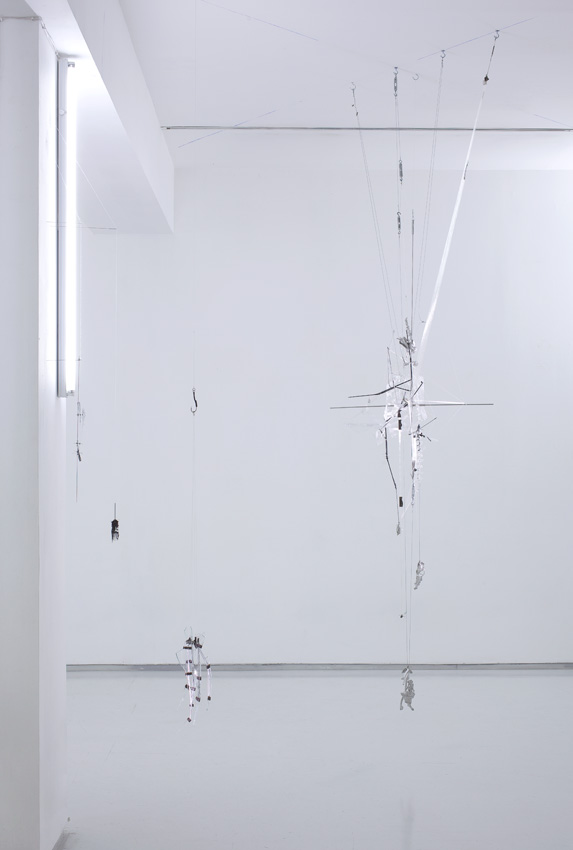
Shahar Yahalom, Draw, Group Exhibition, Inside Out Art Museum, Beijing, China. March 28th 2015
Shahar Yahalom, Canibals, woodcut print (monotype), 50x50cm,2015
In the exhibition: Tree incubator (Live statue), drawings, video work, and tattoo machine drawings on silicon.
Following the opening night of her exhibition Shahar Yahalom will leave for New-York, for MFA studies at Columbia University. Yahalom is the winner of the Young Artist Award of the ministry of Culture and Sports for 2012. Among other venues she has exhibited: final nominees for the Gottesdiener award exhibition at the Tel Aviv Museum at 2011. On 2009 she exhibited at the Herzliya Biennial and Art TLV.Biennial.
“…Following past exemplary shows in which Shahar Yahalom masterfully created objects and installations that corresponded with the contemporary art discourse, in her present exhibition she examines the borders of the high road of the art discourse in which she conducted herself so naturally. The exhibition ED raises the possibility of the turn towards perversion. This possibility is found in canonic aesthetic doctrines that see in the artist one to whom the law, the example or school do not constitute a barrier, but rather a leverage.
… Beyond the description of the artist’s action of drawing, the word “drawing” in Hebrew applies to different forms of drawing, such as literary notes, supply lists, or any other type of list in which something is written, jotted down, leaving a mark. In Hebrew the name of Shahar Yahalom’s current exhibition ED encapsulates within it at least two meanings of “Drawing”. On the one hand it is vapor, which is at once visible yet will soon dissipate. Similarly to the random scribbling of the grocery list that will soon be forgotten after it will be replaced with the groceries themselves. Yet it also keeps the meaning as a witness that will remember and remind of the occurrences.”
-Taken from the ED exhibition text “Five Remarks on Drawing” by Efrat Biberman.
A conversation between Nechami Gotlib and Shahar Yahalom
Question: What brought you to create an incubator for a tree?
Answer: The incubator originated as a thought of an object, a collage of ready-made objects. One of the images used as a source for the work is a photograph of the first space shuttle to land on the moon, Apollo 11. The space shuttlecraft seemed to me as a collection of junk pieces, and it wasn’t clear how such a thing managed to reach the moon. The fantasy that guided me was taking a Sycamore tree, whose origin is in North America, there is a difference in its behavior in Israel and at its natural habitat abroad, so I wanted to build it a space or “space craft” – a space constructed from many elements. The tree is physically too weak to sustain the fantasy, the incubator suffocates it rather then allowing it to live. There is use of every bit of air in the space, there is no one consolidation point. Near the tree sculpture/ incubator there is a Styrofoam sculpture that creates a sort of glacier and snow or ice flakes. Above the tree, there is a lamp that is a source of energy.
Question: The use of “ready made” in your works is new. In the previous works there was always a wish to “invent” something.
Answer: That’s right, in this exhibition there isn’t an expression of freedom in the sculptural work. In this case I didn’t want to invent, but rather to combine things, create objects that are not sculpted.
Question: Why not sculpt?
Answer: In my previous works, and especially in the work “Raspberry Land” that was exhibited in the Tel Aviv Museum, the sculpting was very physical, erupting, grand and full of passion, abounding in creation, not taking into consideration anything besides itself. This exhibition is the complete opposite; it brings out a will to think from the other side of the ball. It’s a struggle not to sculpt. There is use of living and breathing material as the tree and the air that creates the interactions on its own – A living sculpture.
Question: And the video work “Window Over Dead Body”?
Answer: The video is a window, a diversion, the escape of a glance. This was taken in a dissection room (the room in which autopsies by medical students take place), the gaze of the living upon the dead. The gaze is constantly attracted to the light sources, the window, the light, the outdoors. The gaze is diverted to the conditions rather then the object.
Question: The work “Map” is a drawing done by using a tattoo machine on silicon surface, what brought you to this type of work?
Answer: The drawing is impressed upon the material, penetrates it, enters through it. It does not exist merely upon the surface.
Shahar Yahalom, Coconut , Hydrocal, 121x66x20 cm, 2015
Shahar Yahalom, Vegans, Still from video Animation, 2014
Shahar Yahalom, Entrance, Ink On Paper, 40x30cm, 2014
-80°C is the temperature at which bodies are stored while waiting for the future life – an encoded extension to the future – as well as embryos and organs for transplantation. The exhibition space is planned to serve as an experimental lab or a refuge of an alchemist/architect/philosopher busy with creating a new reality by sorcery and calculation: every sculpture may be translated into a mathematical equation.
Jacques Derrida defined the term ‘deconstruction’ as a method and not a style. An attempt to attribute Shahar Yahalom’s work to any style seems forced, and one should rather focus on her method. The majority of the compositions in the exhibition are based on two poles – one vertical and the other horizontal making together a cross (in the architectural connotation*), an unhesitating static structure. The strong juxtaposition of two intersecting axes lies at the base of architecture since the early ages. Postmodernism has undermined this stability by breaking angles and conventions.
At the center of a human skeleton there is a cross-like bone called sacrum (‘holy’ in Latin) and ‘krestetz’ in Slavic languages (‘krest’ = ‘cross’). According to the Zohar book, at the time of resurrection the lower part of the sacrum, usually identified with the coccyx (etzem ha-luz), will expand to four directions to form the body anew. The sacrum is the Foundation Stone of the human body, responsible for its posture; however, in art as in anatomy the physical stability does not depend on the structure alone but on the flow of life itself. Without it the structure will collapse.
Thus, the center poles are well positioned, and the artist may now begin her dance. She scatters other axes in the space as broken arrows. The small details hang on the axes, holding on to them, while their form becomes less geometrical and more organic.
Does the artist rely here on chance creating a chaotic structure and letting it grow as it pleases? It is indeed and intentional coincidence. In this intelligent way a plant occupies its designated space, feels it and sends its tendrils in every direction.
The exhibition space seems spellbound; otherwise how did the artist set these impossible sculptures? The space is pierced, unraveled, dissected, sliced, drawn with strings, straggling on hooks, alluring with its transparent screen traps, An astute pleasure.
Perhaps there is no magic here, but rather the gravitation laws were changed? The artist created a universe with two moons as in a recurring childhood dream. A heavenly duplicity as opposed to an earthly duplicity – the exhibition is designed according to a principle of duplicity, and from a certain point the view is repeated.
Perhaps the afterlife is here? The bones of fish from the Chernobyl area are curled as tendrils. Will the new world be created as a result of a crisis? In Chinese the word ‘crisis’ is composed of two ideograms: one means ‘danger’ and the other ‘new possibilities’.
The artist is fascinated with Gothicism, with the structure of a cathedral and its emptiness as opposed to the sculptural images. Yahalom sticks to daring perpendiculars and diagonals that strive to stretch the boundaries of matter and spirit and to defy the skies. The gothic creatures are not in the exhibition, but their presence is duly felt. Stubbornly they creep into the space leaving behind marks of claws on the glass. They scratch the slides with sharp beaks chucking their excretions here and there and wink from every corner.
Derrida rejects the confrontation of the tradition with the avant-garde. The contemporary age enables the two poles to collaborate – no more rebellion of the avant-garde against the tradition but coexistence. Yahalom is true to this philosophical view, but in her work she does not discard the visual art for philosophy that would have conceptualized the sculpture. She is devoted to her work, reminding of a craftsman sculptor; she does not order but skillfully carries out her own creation.
One literary character used to say: “children and good pipes one should make by himself” – to which I would add – good sculptures as well.
*The success of the campaign of Christianity was affected, among other things, by the catchy logo – the cross.
Miriam Gamburd
Shahar Yahalom, Columbia University, installation view, 2014